Plaza de España guide: what to know before visiting
Seville: Plaza de España private tour and María Luisa park
Is Plaza de España free to visit?
Yes. Plaza de España in Seville is free to enter at any time. The rowboat hire on the canal costs approximately €6 per boat for 35 minutes. There is no official admission charge. Some guided tours include the Plaza as part of a broader circuit of the Parque de María Luisa and the south of the city.
Plaza de España is the kind of place that looks like a film set because it has, repeatedly, been one. The semicircular colonnade, the moat-like canal, the 48 tiled alcoves representing every Spanish province, the twin baroque towers at either end — it was designed in 1914 for an exhibition that would not open until 1929, which meant the architects had 15 years to build something excessive and did so with evident pleasure.
It is also entirely free to visit. In a city where the major monuments cost €12–€15.50, Plaza de España functions as a counterpoint: equally photogenic, architecturally ambitious, and with no ticket queue.
| Where | Parque de María Luisa, south of the Alcázar |
| Cost | Free (rowboats around €6 per boat, 35 min) |
| Time needed | 30–45 min alone; 2–3 hrs with the park |
| Getting there | 20-minute walk from the Cathedral |
| Best time | Before 9am or after 5pm |
The architecture: what you are looking at
The plaza is a semicircle 170 metres in diameter. The curved colonnade, faced in brick with terracotta and azulejo tile decoration, encloses a central fountain and a moat-canal crossed by four bridges. Two baroque towers rise at the ends of the colonnade.
The architectural style is regionalist — specifically, Seville Regionalism, an early 20th-century Spanish movement that drew on Mudéjar, Baroque, and Renaissance forms to create buildings that were self-consciously “Spanish” and specifically “Andalusian.” Architect Aníbal González was the leading practitioner; Plaza de España was his largest and most elaborate project.
The building uses azulejo (blue and white tin-glazed ceramic) as both structural decoration and as the material for the 48 provincial alcoves. The azulejo tiles were made in Triana — Seville’s historic ceramic district, across the river — and the production represented one of the largest ceramic commissions in the history of the craft.
The 48 provincial alcoves
This is the detail that rewards slow walking. Along the base of the colonnade, 48 semicircular alcoves are set into the wall, each representing a Spanish province and labelled in ceramic letters. Inside each alcove: a hand-painted tile mural depicting a historical event from that province, a tiled map of the province’s borders, and seating in the form of tiled benches.
The historical scenes are painted in the style of academic history painting — you can read each panel as a mini-narrative. Seville’s own alcove (near the main entrance axis) is naturally the most elaborate. Cataluña, Galicia, and Madrid have some of the most detailed scenes.
Visitors from Spain spend time finding their home province. Non-Spanish visitors often photograph the alcove representing the country or city that their family or history connects them to (Cuba, for example, is represented through the colonial provinces of 1929).
The canal and rowboats
The moat-canal that runs around the inner perimeter of the colonnade can be navigated by rowboat. Boats are available for hire at the northern boat station; the cost is approximately €6 per boat for 35 minutes. Capacity is 3–4 people per boat. In summer, sunset rowboating — with the colonnade lit against the sky — is one of the more memorable minor experiences in Seville.
The canal passes under each of the four ornamental bridges. The bridges are decorated with azulejo panels in the same style as the alcoves.
Film locations: Star Wars and Lawrence of Arabia
Plaza de España private guided tour with María Luisa ParkThe plaza has been used as a film location repeatedly because it photographs as something impossible — too ornate to be European, too ordered to be chaos, too large to be real. Key productions:
Star Wars: Episode II — Attack of the Clones (2002): The plaza appears as the planet Naboo’s capital city, Theed. Specifically, the colonnade is visible in the scene where Padmé Amidala returns to Naboo. The production added minimal set dressing — the existing architecture was sufficiently science-fiction.
Lawrence of Arabia (1962): The plaza was used for scenes in which Lawrence reviews troops in Cairo. The production moved from the Plaza de España to the Moroccan desert in the same production period.
The plaza’s function as a film stand-in for imaginary places is appropriate: it was itself designed as an idealized image of “Spain” for an exhibition audience rather than as a functional civic building.
Visiting in practice
Hours: The plaza is open 24 hours. It is never locked. The canal and rowboats operate from approximately 10 AM to sunset (hours vary seasonally).
Crowds: Peak visiting times are 10 AM–2 PM. The plaza is at its best at opening (the fountain and canal reflect beautifully in the morning) and in the hour before sunset. In summer evenings, the plaza is particularly pleasant as a cool (relatively) outdoor space.
What to bring: Water in summer (there is a café near the southern tower but no drinking fountains). Comfortable shoes — the plaza’s tile and brick paving is hard underfoot.
Surrounding context: The plaza is in Parque de María Luisa, a 34-hectare public park with walking and cycling paths. The Museo Arqueológico de Sevilla (closed for renovation; check the official museum site for the reopening date) and the Museo de Artes y Costumbres Populares are both in the park, in buildings constructed for the 1929 exhibition. See the María Luisa Park guide for the full park, and the parks and gardens of Seville guide for how it compares to the city’s other green spaces.
Getting there
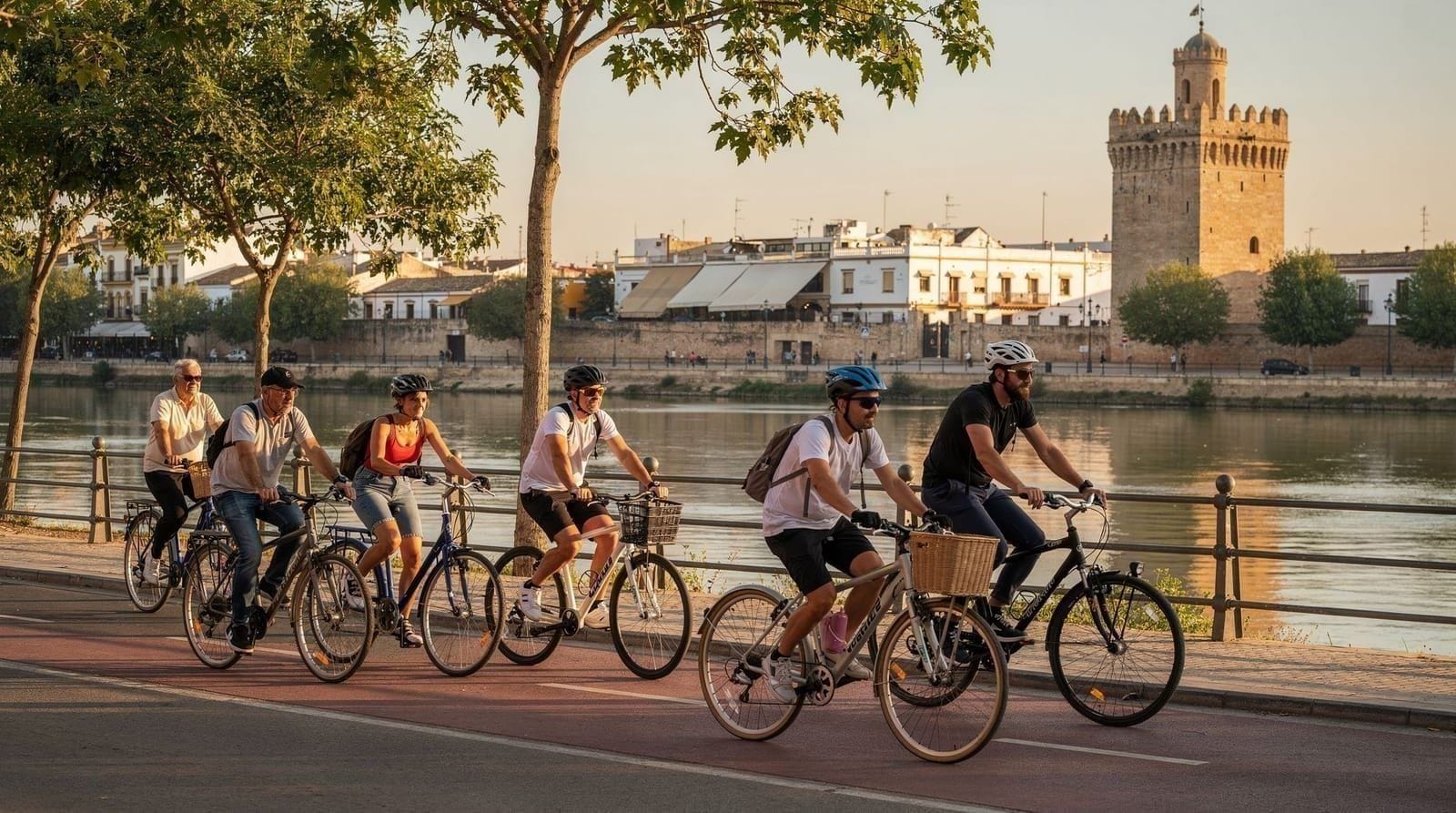
Plaza de España is in the south of the city, between the Alcázar and the Guadalquivir riverfront. It is a 20-minute walk from the Cathedral or a 5-minute bike ride. Seville’s public hire bikes (Sevici system, requires app registration) are an excellent way to combine the Alcázar, the Cathedral, the Archive of the Indies, the Torre del Oro, and Plaza de España in a half-day circuit.
For the cycling option, see the Seville by bike guide. For a walking tour that includes the plaza, see best walking tours in Seville.
Seville highlights bike tour, including Plaza de España and María Luisa ParkPractical photography notes
The plaza’s semicircular colonnade means the light shifts meaningfully across the morning: the eastern half catches direct sun first, while the western half stays in shadow until later, which is useful if you want to time a specific alcove or the fountain for even lighting. The canal produces its best reflections when the water is still, which is more reliably the case early morning before rowboat traffic starts (around 10am) than in the afternoon. Wide-angle shots from ground level exaggerate the scale of the towers; standing at the centre of the plaza near the fountain and shooting outward toward either tower is a reliable composition that most visitor photos on the plaza’s own social feeds converge on for good reason.
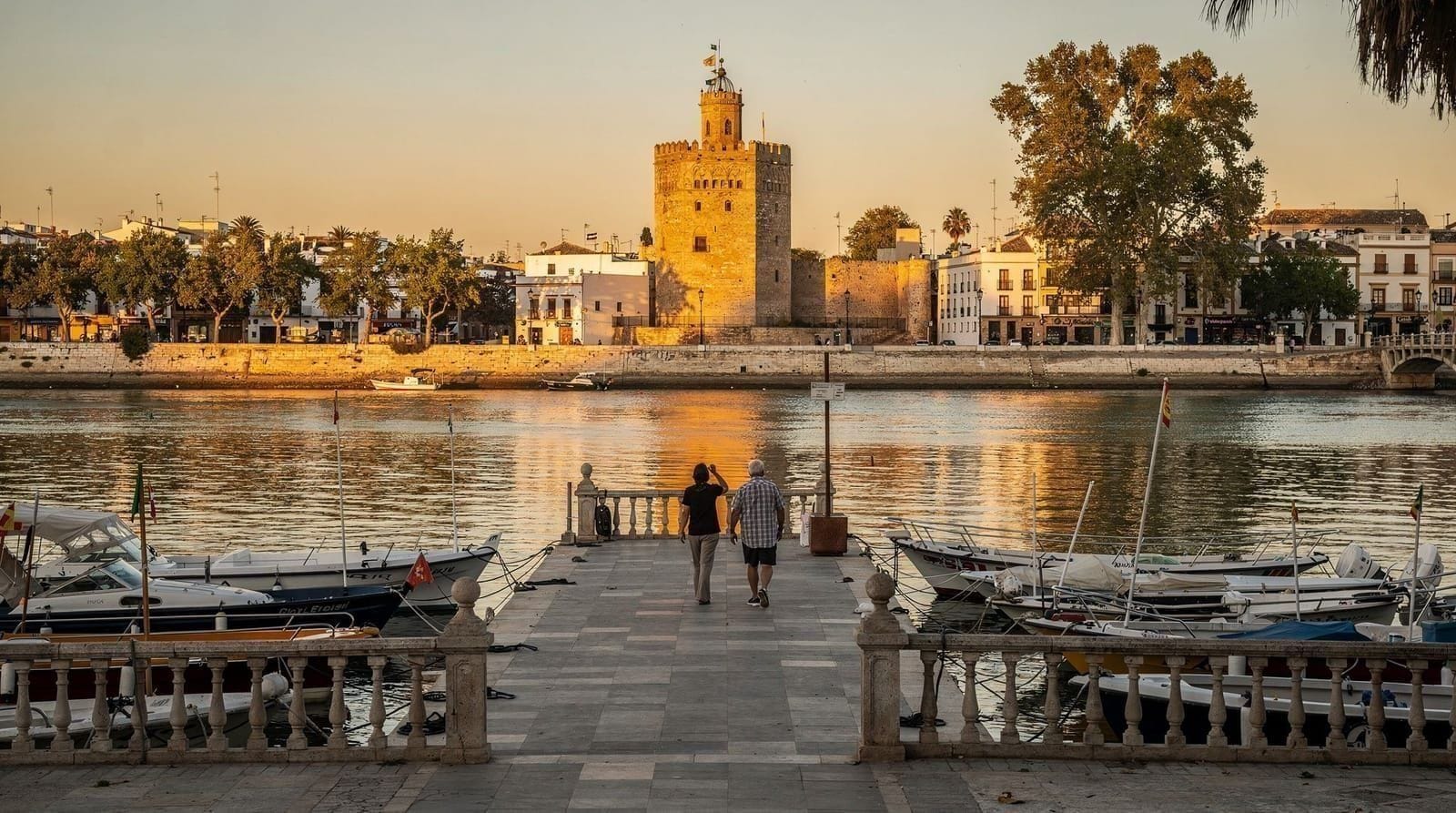
If you’re combining the plaza with other Seville landmarks in one photography-focused outing, the golden-hour sequence that works well is: Plaza de España in the last hour before sunset, then a 15-minute walk to the Torre del Oro and riverfront for the sunset itself over the Guadalquivir, then a rooftop bar for the blue hour afterward.
Fitting the plaza into a wider Seville plan
Because the plaza costs nothing and has no timed entry, it is the easiest stop in the city to slot around the ones that do. Book the ticketed sights first, then let the plaza fill the gap: the Real Alcázar complete guide and the Seville Cathedral complete guide explain how to structure those visits, and the skip-the-line decoder helps you choose between ticket types. If you are unsure which of the two big monuments to see first, Alcázar vs Cathedral: which first lays out the trade-offs.
The plaza also works as a soft landing at the end of a heavy morning of sightseeing. After the dark interiors of the monuments, the open space and the shade of the park feel like a reset. Our Seville first-timers itinerary and the one-day Seville itinerary both use this logic, and the three-day itinerary gives the plaza and park a calmer, unhurried slot.
On the way, you pass through the riverside district covered in the El Arenal guide, home to the Maestranza bullring. For a contrast in architecture, the modern wooden canopy described in the Metropol Parasol guide sits at the opposite end of the aesthetic spectrum from the plaza’s brick and tile, and seeing both in one day says a lot about the city.
If you are planning around the weather, the best time to visit Seville and the Seville in summer heat guide will help you decide which hours to give the plaza. For moving between the sights without wearing yourself out, see getting around Seville, and for a view of the city after your plaza visit, the rooftop bars and views guide picks up where the golden-hour route above leaves off.
Accessibility
The plaza itself is fully step-free — the colonnade, central esplanade, and bridges are all flat, wide, and paved, making it one of the more accessible major sights in Seville’s historic south. Wheelchair users and visitors with pushchairs will find it considerably easier going than the cobbled streets of Santa Cruz or Triana. The rowboats are not wheelchair accessible, since boarding requires stepping down into the boat, but the canal-side path allows full viewing without needing to board. The surrounding Parque de María Luisa has a mix of paved and gravel paths; the main routes near the plaza itself are paved and manageable.
The 1929 Ibero-American Exhibition: broader context
Plaza de España was the centrepiece of the Ibero-American Exhibition of 1929, one of a series of world’s fairs that Spain used to project its cultural and economic ambitions in the early 20th century. The exhibition coincided with the dictatorship of Primo de Rivera and had an explicit ideological purpose: to rehabilitate Spain’s relationship with its former Latin American colonies, emphasizing cultural continuity and shared identity rather than the painful history of colonial rule and the 1898 war (in which Spain lost Cuba, Puerto Rico and the Philippines to the United States).
The fairgrounds occupied much of the area south of the Alcázar, along both sides of the Paseo de las Delicias. Most of the pavilions built for the exhibition have survived as museums, government buildings, and cultural centres:
Palacio de San Telmo: Originally a 17th-century palace, used as the presidency of the Junta de Andalucía (the regional government). The facade is one of the most elaborate examples of Baroque architecture in Seville — worth studying in detail from the street even though the interior is not publicly accessible.
Pabellón de México: The Mexican government’s pavilion, built in a version of the Neo-Plateresque style (16th-century Spanish decorative architecture as interpreted in 1929). Now houses a government office.
Pabellón de Argentina: In Parque de María Luisa, now the Museo de Artes y Costumbres Populares.
Pabellón del Renacimiento: The Renaissance Pavilion, the building of the Museo Arqueológico, currently closed for renovation. One of the two major exhibition pavilions that became permanent museums in the park.
The 1929 exhibition was, by most accounts, a financial and organizational challenge: it took more than a decade to prepare, cost substantially more than budgeted, coincided with the Great Depression, and attracted fewer visitors than planned. But it permanently transformed the south of Seville, creating a public park and a cluster of institutional buildings that the city uses today.
Parque de María Luisa: what to see beyond the plaza
The park surrounding Plaza de España — Parque de María Luisa — was donated to the city by the Infanta María Luisa of Bourbon in 1893. It was redesigned for the 1929 exhibition by landscape architect Jean-Claude Nicolas Forestier, who also worked on the Retiro Park in Madrid and the Champs-Elysées in Paris.
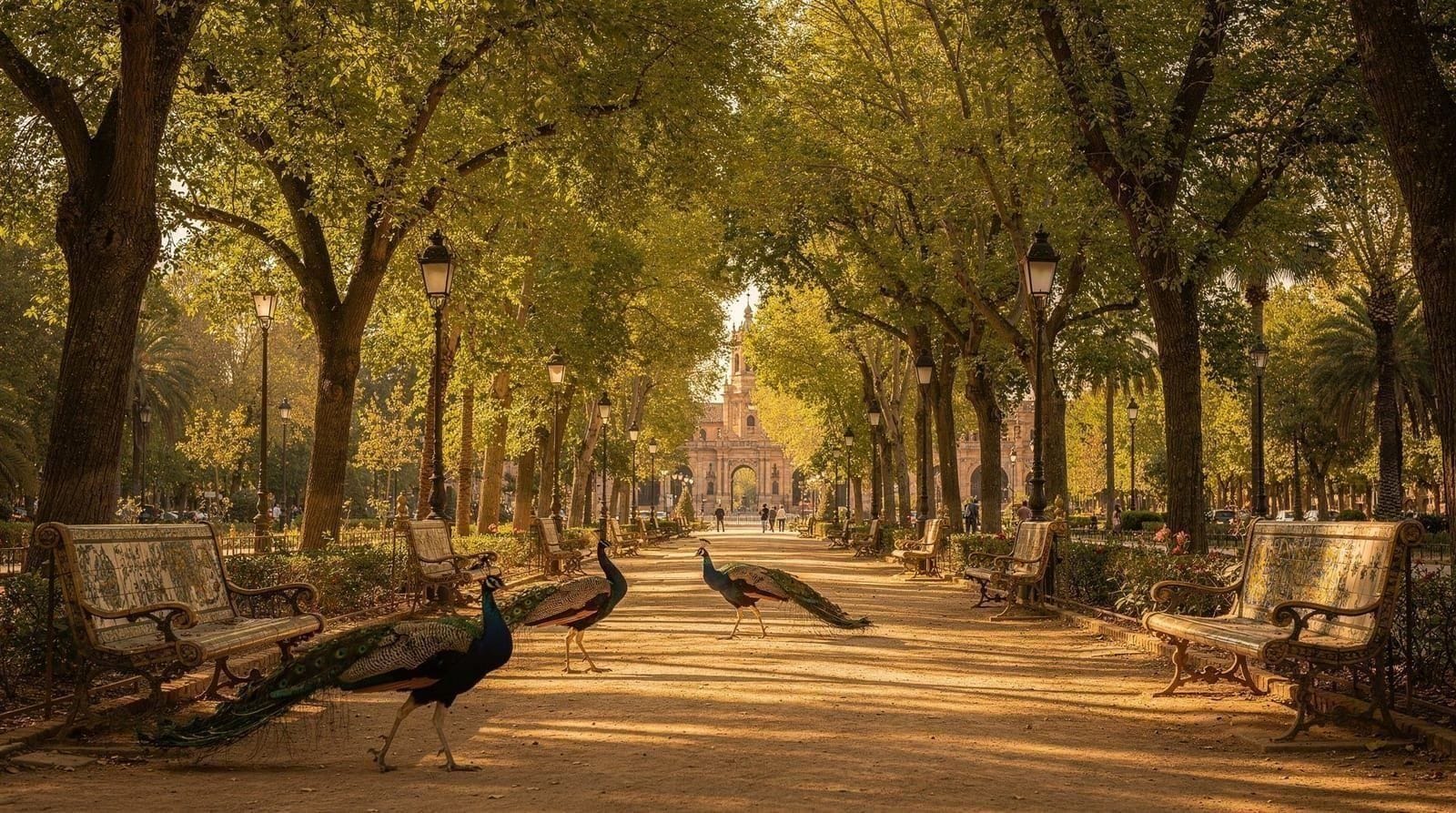
The park covers 34 hectares. It is best experienced by walking or cycling without a specific plan — the network of shaded paths, azulejo-decorated benches, and small plazas rewards exploration. A few specific locations:
Glorieta de Bécquer: A circular plaza containing a monument to the Sevillano Romantic poet Gustavo Adolfo Bécquer (1836–1870). Three figures in allegorical form surround a tree. Simple and effective; the park is full of this kind of monument.
Estanque de los Patos (Duck Pond): A large pond at the park’s southern end. Popular with families; boat hire available.
Los canales: The irrigation channels running through the park date from the Moorish period and were incorporated into Forestier’s 1929 design. In the early morning, the channels reflect the palm trees and create one of the most photogenic light conditions in the park.
Getting from Plaza de España to other sites
The plaza’s location in the south of the city creates some navigation questions. Practical distances and travel times:
To the Cathedral: 20 minutes on foot (through El Arenal or along Paseo de las Delicias). 5 minutes by bike (Sevici hire). The walk is pleasant and passes the Torre del Oro.
To the Alcázar: 20 minutes on foot, same route.
To the Maestranza Bullring: 15 minutes on foot along the river.
To Triana: 25 minutes on foot across the Isabel II bridge (Puente de Triana).
To Las Setas (Metropol Parasol): 35 minutes on foot, or 15 minutes by Sevici bike.
The Seville hop-on hop-off bus stops near Plaza de España and connects to most major sights — useful if you are combining the plaza with other sites that are spread across the city.
The Azulejo tradition and Triana ceramics
The tilework on the provincial alcoves and throughout the Plaza de España is Triana azulejo — named after the Triana neighbourhood across the Guadalquivir river that has been Seville’s ceramic production centre since the Moorish period.
The Triana azulejo tradition produces tin-glazed earthenware tiles decorated with cobalt blue, copper green, manganese purple, and iron red on a white ground. The geometric and figurative patterns draw on Moorish, Mudéjar, and Renaissance sources. The tiles for the 1929 exhibition were produced by Triana workshops operating at the height of their craft — skilled craftspeople producing complex interlocking designs in large quantities on a tight schedule.
Today, several Triana ceramic workshops still produce handmade azulejo using traditional methods. The Triana neighbourhood has a dedicated ceramics museum (Centro Cerámica Triana) in a former factory building on Calle Antillano Campos. The museum displays both historical production equipment and finished examples — worth 45 minutes if the ceramic tradition interests you.
The connection between the tiles you see at Plaza de España and the workshops where they were made is a 15-minute walk across the Triana bridge. The combination — Plaza de España in the morning, lunch in Triana, ceramics museum in the afternoon — makes a coherent full-day circuit.
For the full Triana neighbourhood guide, see Triana neighbourhood guide.
Best time to visit, by season
| Season | Conditions | Notes |
|---|---|---|
| Spring (Mar–May) | Mild, occasional rain | Peak crowds; go before 9am for clear photos |
| Summer (Jun–Aug) | Very hot midday | Early morning or after 8pm only; the fountain cools the air slightly |
| Autumn (Sep–Nov) | Mild, fewer crowds | Excellent light, second-best window of the year |
| Winter (Dec–Feb) | Cool, occasional rain | Quietest season; midday visits are comfortable |
Frequently asked questions about Plaza de España guide
What was Plaza de España built for?
Plaza de España was built for the Ibero-American Exhibition of 1929, a world's fair showcasing Spain's relationship with its former American colonies. The architect Aníbal González designed it over several years; construction ran from 1914 to 1928. The exhibition also produced the Palacio de San Telmo and several museum buildings that remain in Parque de María Luisa.What are the tiled alcoves in Plaza de España?
Each of the 48 alcoves represents one of Spain's provinces, with a painted tile mural depicting a historical scene or map of that province. The alcoves are numbered and run alphabetically by province name. Visitors often walk along the arcade locating their home province or a province they have visited. The tilework is azulejo — the traditional blue-and-white Sevillano ceramic style, made in Triana.What films and TV shows have used Plaza de España?
Star Wars: Attack of the Clones filmed here (the plaza appeared as the planet Naboo). Lawrence of Arabia used it for desert scenes. The Spanish TV series El Ministerio del Tiempo filmed several episodes here. The site has been used repeatedly as a stand-in for various historical and sci-fi settings due to its architectural scale and ornate detailing.What is the best time to visit Plaza de España for photography?
Early morning (before 9 AM) or late afternoon (after 5 PM) for the best light and minimal crowds. The central fountain and the canal reflect the surrounding colonnade beautifully at these times. Midday in summer makes the plaza uncomfortably hot and the light harsh.How do I get from Plaza de España to the Alcázar?
Plaza de España is in Parque de María Luisa, approximately 15–20 minutes on foot from the Alcázar. The walk passes through the park and through the El Arenal neighbourhood near the Torre del Oro. Alternatively, the hop-on hop-off bus stops near both sites.Is there parking near Plaza de España?
Street parking in the area is limited. The nearest practical parking is along Paseo de las Delicias (along the river), approximately 400 metres from the plaza. A better approach is to walk from the city centre — the Alcázar-to-Plaza-de-España route is one of the nicest 20-minute walks in Seville.How much time should I budget for Plaza de España?
30–45 minutes for the plaza alone (walking the colonnade, viewing the alcoves, a rowboat ride if you want one). Budget 2–3 hours if combining it with a proper walk through the surrounding Parque de María Luisa, as most visitors do.Is Plaza de España worth visiting if I've already seen photos of it?
Yes — photos flatten the scale, which is the plaza's most striking quality in person. At 170 metres in diameter, the sense of being inside a genuinely oversized architectural gesture is not something a photo conveys well.
Top experiences
Bookable activities with verified prices and instant confirmation on GetYourGuide.