Granada
Alhambra tickets sell out weeks in advance. This honest guide covers booking strategy, Albaicín, and how to plan a Granada day-trip from Seville.
From Seville: Granada day trip with Alhambra and Albaicín
Quick facts
- Best for
- Alhambra palace, Albaicín, Moorish history
- Days needed
- 1–2 days
- Getting there
- Bus from Seville 3h (no direct AVE), or guided tour
- Peak crowds
- Spring (April–June) and summer
- Currency
- EUR
Granada is the most complex day-trip from Seville. The travel time is long (about 3 hours by bus or a combination of trains with a change), the Alhambra sells out weeks in advance, and doing it right requires more advance planning than the Córdoba trip. But the Alhambra is one of the most extraordinary palaces in Europe, and Granada’s Albaicín and Sacromonte neighborhoods offer a character unlike anywhere else in Spain.
| Where | Granada province, around 3h from Seville (no direct AVE) |
| Cost | Alhambra + Nasrid Palaces + Generalife €22.27; Gardens-only €12.73 |
| Time needed | Full day trip, or 1–2 days if staying overnight |
| Getting there | Direct bus (~3h), train with a change at Antequera-Santa Ana, or guided day tour |
| Best time | October–November and February–March, and book Alhambra tickets ~3 months ahead |
The Alhambra ticket problem — and how to solve it
The Alhambra receives around 2.7 million visitors per year and limits daily entry to protect the monument. The Nasrid Palaces section — the heart of the complex, with the Court of the Lions and the Comares Tower — has the most restricted access.
The blunt truth: if you want to visit during spring or summer without a guided tour, you need to book on the Alhambra website (tickets.alhambra-patronato.es) the moment sales open for your date, which is up to 3 months in advance. They disappear within hours for peak dates.
If you have already missed that window, the practical options are:
-
Guided day-trips from Seville that include Alhambra access. Tour operators block-book slots well in advance. The Granada day-trip with Alhambra and Albaicín tour includes transport from Seville, guided Alhambra entry, and a walking tour of the Albaicín.
-
Same-day resale: a few tickets may be available at the main ticket office, which opens at 8:00, subject to availability. Queue by 7:30. Not reliable in peak season.
-
Visit non-Nasrid areas: the Alcazaba fortress, Generalife gardens, and the Charles V Palace do not have the same access restrictions. You can visit these with a general ticket even when the Nasrid Palaces are sold out. These are genuinely worthwhile on their own.
Book the Granada and Alhambra tour with optional ticket access for flexibility if you are unsure whether full Nasrid access will be available on your date.
Getting from Seville to Granada
There is no direct AVE service between Seville and Granada. Options:
By bus: ALSA runs direct coaches from Seville’s Plaza de Armas bus station to Granada bus station. Journey time: approximately 3 hours. Cost: €15–25. Departs several times daily.
By train: requires a change, typically at Antequera-Santa Ana. Total journey 2h50 or more. The Seville–Antequera section is fast (AVE); the Antequera–Granada section is slower regional train. Not necessarily faster than the bus when you include the change.
By guided day-trip: the fastest logistically, as the bus picks up at multiple Seville hotels. These typically depart around 7:30 and return by 22:00, making it a long but manageable day.
By car: 2h30–3h depending on route (A-92 motorway). Granada has a paid parking area at Palacio de los Deportes.
What to see beyond the Alhambra
Albaicín: the medieval Moorish quarter on the hill facing the Alhambra. A UNESCO World Heritage Site alongside the Alhambra itself. The streets are steep, narrow, and largely car-free. The Mirador de San Nicolás is the standard viewpoint for the Alhambra against the Sierra Nevada — best at sunset, extremely crowded at sunset. Arrive at the mirador by late afternoon rather than at the golden hour if you want a manageable crowd.
Sacromonte: the cave neighborhood above the Albaicín, traditionally associated with Granada’s gitano (Romani) community. Flamenco shows take place in the cave venues (zambras) here; more authentic in atmosphere than Seville’s tablaos but variable in quality.
Granada Cathedral and the Royal Chapel (Capilla Real): the Catholic Monarchs Fernando and Isabel are buried in the Royal Chapel, along with Philip I and Juana I. The mausoleum is impressive. Each has its own ticket; check current prices and opening hours on the official Royal Chapel and Cathedral websites.
The free tapas tradition: Granada is one of the few cities in Spain where bars serve a free tapa with every drink. This is not a myth. Order a beer or glass of wine at a bar and a small dish appears — olives, a slice of tortilla, a croqueta. In student bars around the university, the tapas can be substantial. Budget meals are significantly cheaper here than in Seville.
Where to eat in Granada
Bar Los Diamantes (Calle Navas 26): classic tapas bar in the city centre. Famous for fried fish (pescaíto frito). Get there early for a spot at the barra. Expect to eat standing.
Bar Bodegas Castañeda (Calle Almireceros 1): one of Granada’s most atmospheric bars, covered floor-to-ceiling with wine barrels and cured ham legs. Traditional tapas. The house red is served cold, which is correct for the region.
El Bar de Eric (Calle Rosario 22): smaller, more relaxed, reliable free tapas with every drink. Good base for an evening in the Realejo neighborhood.
Practical notes for the day-trip
A day-trip from Seville to Granada is genuinely long. Leaving at 7:30 and returning at 22:00 is a 14.5-hour day with roughly 6 hours of travel. It is doable and worth it for the Alhambra, but arrive knowing this.
If you are staying overnight in Granada, book accommodation in the Albaicín for the experience, or in the city centre for convenience. The Granada Parador (Parador de Granada), inside the Alhambra grounds, is one of the most dramatically located hotels in Spain — and books out months in advance.
Visiting both Córdoba and Granada from Seville in separate day-trips is reasonable if you have 3+ days in Seville. Choosing between them is harder — see the Córdoba vs Granada comparison guide. If you want to do both cities plus Seville as one connected trip, the Seville–Córdoba–Granada itinerary lays out a realistic sequence.
Which Alhambra ticket type to book
| Ticket type | Covers | Best for |
|---|---|---|
| General (Nasrid Palaces + Alcazaba + Generalife) | Everything, including the timed Nasrid Palaces slot | First-time visitors who booked 3 months ahead |
| Gardens & Generalife only | Generalife gardens, Alcazaba, Charles V Palace — no Nasrid Palaces | Anyone who missed the release window |
| Night visit (Nasrid Palaces) | Nasrid Palaces only, evening slot | Visitors who want the palaces but only found night tickets |
| Guided day-trip from Seville | Transport + pre-booked general access + Albaicín walk | Anyone without their own advance ticket |
The guided option is the most forgiving choice logistically, since the operator has already secured the Nasrid Palaces slot as part of a block booking — see the Granada day-trip guide for how the timings usually work from Seville.
Frequently asked questions about Granada
Can you visit the Alhambra without booking in advance?
Only by joining the same-day queue at the ticket office (arrive by 7:30) or by booking a guided tour that includes pre-purchased Alhambra access. In April–June and August, same-day walk-up is unreliable. The Generalife gardens and Alcazaba can typically be visited with less advance notice.
Is Granada worth a full day from Seville?
Yes. The Alhambra alone takes 2.5–3 hours if you are doing it properly. Adding the Albaicín, a long lunch with free tapas, and the cathedral fills a full day comfortably. A day-trip from Seville is a long but worthwhile day.
What is the free tapas tradition in Granada?
A tradition unique to Granada (and a few other Andalusian cities): when you order a drink at a bar, a free tapa arrives automatically. The quality and size varies — from olives in tourist bars near the cathedral to generous plates of stew in university-area bars. Budget travellers can eat remarkably well here on drinks money alone.
Is the Alhambra expensive?
Standard adult entry (Alhambra + Nasrid Palaces + Generalife) is €22.27. Night visits to the Nasrid Palaces are €12.73. The Gardens-only ticket is €12.73. These are reasonable given the monument’s significance. The main cost is time: booking in advance requires effort.
Should I stay overnight in Granada or do it as a day-trip from Seville?
A day-trip works if the Alhambra is your main goal and you are comfortable with a long day (6+ hours of travel). Staying overnight lets you see the Albaicín at a relaxed pace, catch a Sacromonte flamenco show in the evening, and avoid the return-journey time pressure — worthwhile if you have a spare night in your itinerary.
The Alhambra in architectural depth
The Alhambra was built as the palace complex of the Nasrid sultans of Granada between 1238 and 1492. It sits on a ridge above the city, surrounded by cypress forests, with the Sierra Nevada visible to the south. The name derives from the Arabic “al-Qal’a al-Hamrā” — the Red Fortress — referring to the reddish colour of the earthen walls.
The complex has four main components:
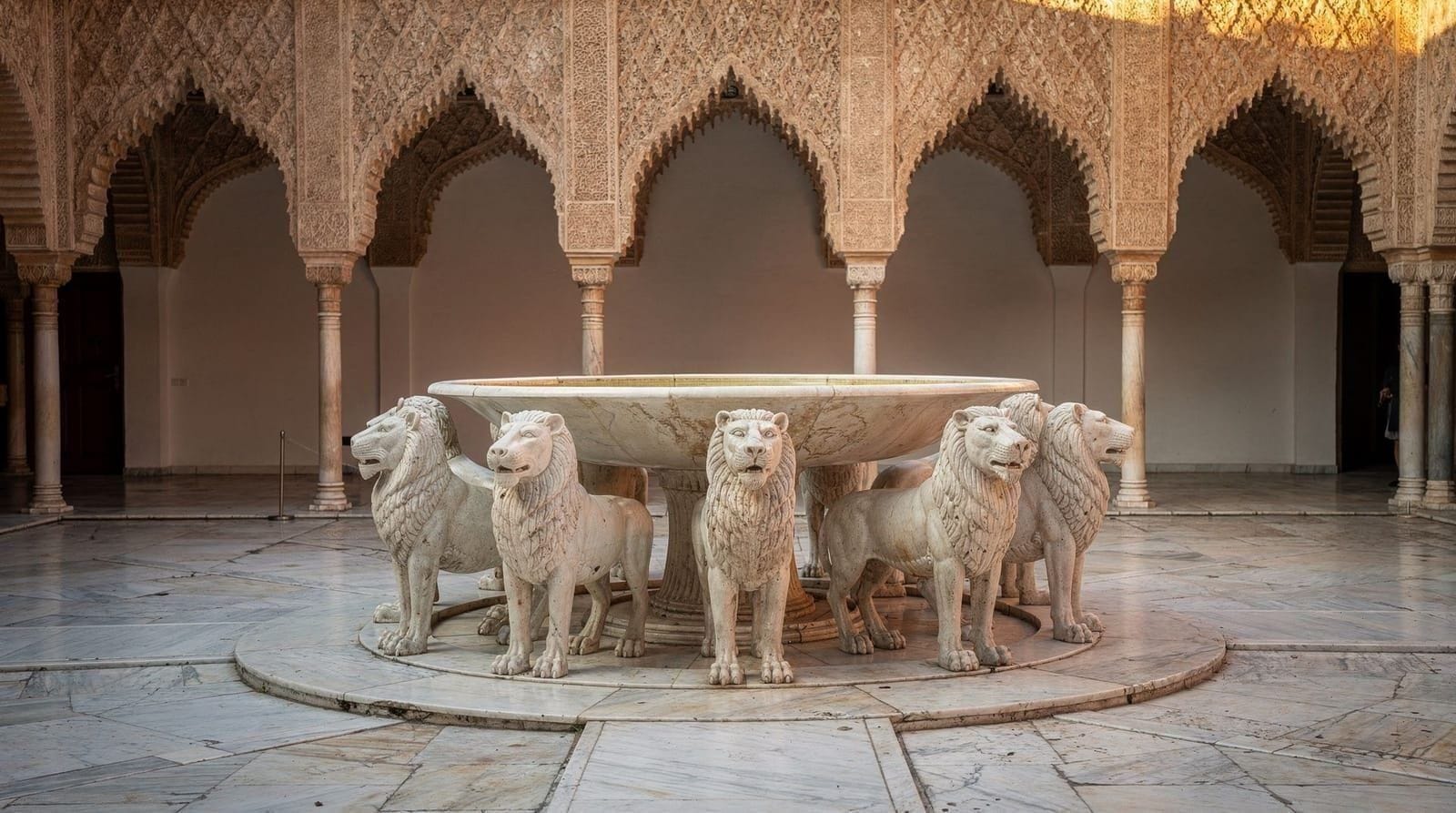
The Nasrid Palaces (Palacios Nazaríes): the three royal palaces built between the 13th and 15th centuries. The Mexuar was used for administrative and legal functions. The Comares Palace contains the Throne Room (Salón del Trono), with a cedar ceiling of 8,017 interlocking wooden pieces representing the seven heavens of Islamic cosmology. The Palace of the Lions contains the Court of the Lions — the central fountain surrounded by 12 marble lions, the columns of carved stucco, and the stalactite-honeycomb muqarnas vaulting. These are the spaces that define the Alhambra.
The Alcazaba: the military fortress at the western tip, the oldest part of the complex. The Torre de la Vela (watchtower) offers the finest views of the city, the Albaicín across the ravine, and the plains to the west.
The Generalife: the summer palace and gardens of the sultans, on the hill to the east. The Patio de la Acequia (Water Garden Courtyard) — a long reflecting pool flanked by fountains and flower beds — is the model for every subsequent Islamic garden in Spain.
The Palace of Charles V (Palacio de Carlos V): the Renaissance palace built inside the Alhambra complex by Carlos I of Spain after the Reconquista. Architecturally significant (circular courtyard, one of the finest Renaissance buildings in Spain) but jarring in its placement. Houses the Alhambra Museum (free entry to the museum within the palace).
Granada’s Albaicín in detail
The Albaicín is the medieval Moorish neighbourhood on the hill opposite the Alhambra, separated by the Darro river valley. It was inhabited from Nasrid times and largely survived the Christian conquest intact. The streets follow the original Moorish layout, with whitewashed carmen houses (private houses with walled gardens, a distinctly Granadan type).
Key spots in the Albaicín:
- Mirador de San Nicolás: the main viewpoint, with the Alhambra across the valley and the Sierra Nevada behind. Extraordinary at sunset but extremely crowded at that hour. Arrive by 17:00 for the view with fewer people.
- Carmen de las Tomasas: a neighbourhood restaurant in a carmen house garden (Calle Panaderos 19). Worth booking for the setting.
- Calle Calderería Nueva: the “Tea Street” — a Moroccan bazaar quarter with tetería (mint tea shops), ceramics, and Moroccan goods. Atmospheric and honest rather than purely tourist.
- Sacromonte caves: the gitano cave neighbourhood above the Albaicín. The zambra flamenco shows in the cave venues are marketed heavily; quality varies significantly between operators.
Staying overnight in Granada
If you can add a night to the trip, stay in the Albaicín for atmosphere or near the Cathedral for convenience.
Parador de Granada: inside the Alhambra grounds, in a converted convent. Rooms from €250–400/night. The most dramatically located hotel in Spain. Books out months in advance.
Hotel Casa 1800 Granada (Calle Benalúa 11): boutique hotel near the Cathedral in a 17th-century palace. Good value relative to the Parador.
Hostal Navarro Ramos (Calle Cuesta de Gomérez 21): budget option near the Alhambra entrance road. Clean, reliable, well-positioned.
Practical notes for Granada
Altitude: Granada sits at approximately 738 metres above sea level. Winters are genuinely cold (snow visible on the Sierra Nevada most years through April). Summers are hot but less extreme than Seville. Spring and autumn are excellent.
The free tapas rule: applies specifically at bars (not restaurants). One drink = one free tapa. Budget bars around Plaza Nueva and the university area give the most generous versions. Tourist bars near the Cathedral give olives. Local bars in the Albaicín give more creative dishes.
Getting between the Alhambra and the city: the Alhambra is on a hill, 30–40 minutes on foot from the city centre or the Albaicín. The Alhambra Bus (red minibus, lines C30 and C32) runs frequently from the city centre, costing €1.60.
For how Granada compares against Seville’s other long day trips in terms of effort versus reward, see the best day trips from Seville overview.
Fitting Granada into a wider Andalusia plan
Granada rarely works as an isolated stop. Most travellers weigh it against its neighbours, and the honest answer depends on how much time you have and what you care about most. If you are still deciding which city deserves your limited days, the guide to choosing an Andalusian city and the Seville vs Granada vs Córdoba comparison set out the trade-offs side by side. For a first-hand account of why one traveller preferred the other city, read why Córdoba beats Granada for a day trip.
If you are curious how the Alhambra stacks up against the monument you will already have seen at home base, the Alcázar vs Alhambra guide explains what the two palaces share and where they differ. Visiting the Alcázar first makes the Alhambra easier to read, because you will already recognise the Mudéjar and Moorish vocabulary of tilework, water and carved plaster.
Granada also pairs naturally with other stops on the route. Córdoba is the obvious companion for anyone building a longer Moorish-heritage trip, and Antequera, where the train change happens, can be worth a deliberate stop rather than a mere platform transfer. Travellers who want a slower pace in the mountains can add Ronda to the same journey. The week in Andalusia itinerary and the Seville day-trips itinerary show how these pieces fit together without exhausting you.
Finally, plan your Seville base around the excursion. The Seville planning guide helps you place a long Granada day on a morning when you are rested, and the where to stay in Seville guide points to areas that make an early departure easier. If you decide to stay overnight in Granada and want a flamenco evening in Sacromonte, the authentic flamenco vs tourist show guide gives you a useful way to judge any venue before you book.
Top experiences
Bookable activities with verified prices and instant confirmation on GetYourGuide.