Real Alcázar of Seville: complete visitor guide 2026
Seville: Alcázar skip-the-line tickets and guided tour
What is the Real Alcázar of Seville?
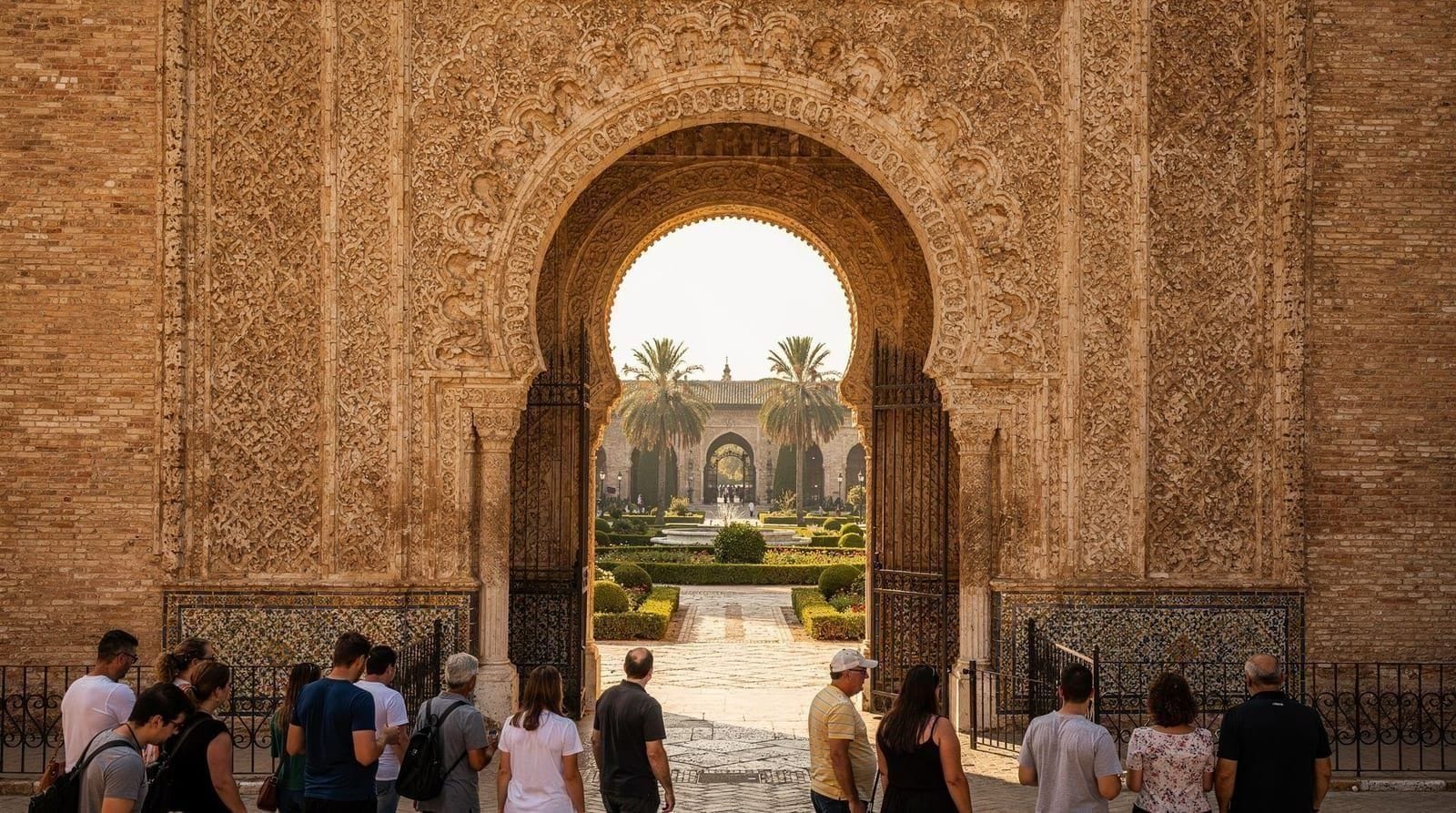
The Real Alcázar is a UNESCO-listed royal palace in central Seville, built on Roman and Almohad foundations and commissioned in its current Mudéjar form by Castilian king Pedro I in the 14th century. It remains a working royal residence — the oldest still in use in Europe. Adult entry is €15.50.
The Real Alcázar is a palace built on top of a palace, built on top of a palace, built on top of Roman walls. It has been continuously occupied and modified for over a thousand years — first as a Roman praetorium, then as a Visigoth episcopal palace, then as an Almohad fortress-palace, then as the residence of Castilian kings, and today as the official Seville residence of the Spanish royal family. That layered history is not just a historical footnote; you can read it in the architecture if you know where to look.
This guide covers what to see, why it matters, and how to navigate the visit.
| Where | Patio de Banderas, central Seville |
| Cost | Around €15.50 adult entry |
| Time needed | 2–3 hours minimum |
| Best time | 9:30am opening |
| Booking | Book the specific date and time slot online in advance |
A condensed history of the palace
Roman period (1st–5th century AD): The site that is now the Alcázar was a Roman administrative centre — the Praetoria — in the city of Hispalis. The current palace stands on these foundations; some Roman architectural elements have been identified in the lower structures.
Visigoth period (5th–8th century): The site was used as an episcopal palace following the Visigoth conquest of Hispalis. Limited architectural remains survive from this period.
Almohad period (12th–13th century): The current Patio del Yeso and sections of the Patio de la Montería date from the Almohad refortification of Seville in the 12th century. The Almohads were a North African Berber dynasty who ruled much of the Maghreb and southern Iberia; they also built the mosque whose minaret became the Giralda. The Alcázar under the Almohads was a functioning military complex as well as a royal residence.
Pedro I’s reconstruction (1356–1366): This is the period that created the Alcázar as it is primarily known today. Pedro I of Castile — known as “the Cruel” by his enemies and “the Just” by his supporters — demolished much of the existing structure and commissioned a new palace in the Mudéjar style. He specifically brought craftsmen from the Nasrid court in Granada (the builders of the Alhambra) and from Toledo to work on the decorative program. The result is a palace that looks more like a Moorish building than a Gothic one, despite being commissioned by a Christian king. The political signal was deliberate: Pedro I was aligning himself with Moorish aesthetic traditions as a statement of power and cosmopolitanism.
Later modifications: Ferdinand and Isabella used the Alcázar as a base for the organization of Columbus’s voyages, and the original documents authorizing the first expedition were signed here. Carlos V added the Gothic palace (Palacio Gótico) and made modifications for his marriage to Isabella of Portugal in 1526. Subsequent Spanish monarchs made further additions; the palace has not been frozen in any single historical period.
What to see: room-by-room guide
Patio de las Doncellas (Courtyard of the Maidens)
The central courtyard of Pedro I’s Mudéjar palace is arguably the finest surviving example of 14th-century Mudéjar architecture. The name comes from a possibly apocryphal legend about tribute of virgins paid to Moorish rulers — the Spanish name (Damsels) stuck regardless of historical accuracy.
The courtyard was restored in the mid-20th century to add a lower gallery and elongated rectangular pool, based on historical evidence of its original design. The upper gallery is original 14th-century construction. The carved plaster frieze above the lower arcade uses Arabic inscriptions (“Wa la ghaliba illa Allah” — “And none is victorious except God” — a phrase common in Nasrid Granada) combined with Castilian heraldic motifs: an extraordinary hybrid of two cultures.
The pool reflects the upper arcade on windless days. This is the most photographed space in the palace; arrive at 9:30 AM opening to have it to yourself.
Salon de los Embajadores (Hall of the Ambassadors)
The throne room and the most ceremonially significant space in the palace. A half-orange dome of interlocking carved wood panels — a muqarnas ceiling at the scale of a throne room — dominates the space. The geometric patterns were originally gilded; traces remain visible under raking light.
The room was used for royal audiences and diplomatic receptions. It connects to the Salon de Carlos V through a set of Renaissance arches added in the 16th century — the architectural transition from Mudéjar to Renaissance is visible in a single doorway.
Patio del Crucero (Crossroads Courtyard)
One of the older sections, with Almohad origins that were subsequently modified in the Gothic period. The sunken garden format — paths raised above the planting level — was a feature of Almohad garden design, allowing the irrigation channels to run below the path level. Game of Thrones used this courtyard for several Dorne Water Gardens scenes.
Palacio del Yeso (Palace of the Plaster)
The oldest section of the palace complex, preserving significant Almohad construction from the 12th century. Intricate carved plasterwork in Almohad geometric patterns lines the arcade. Access is not always available to general visitors; check the current visitor map at the entrance.
The gardens
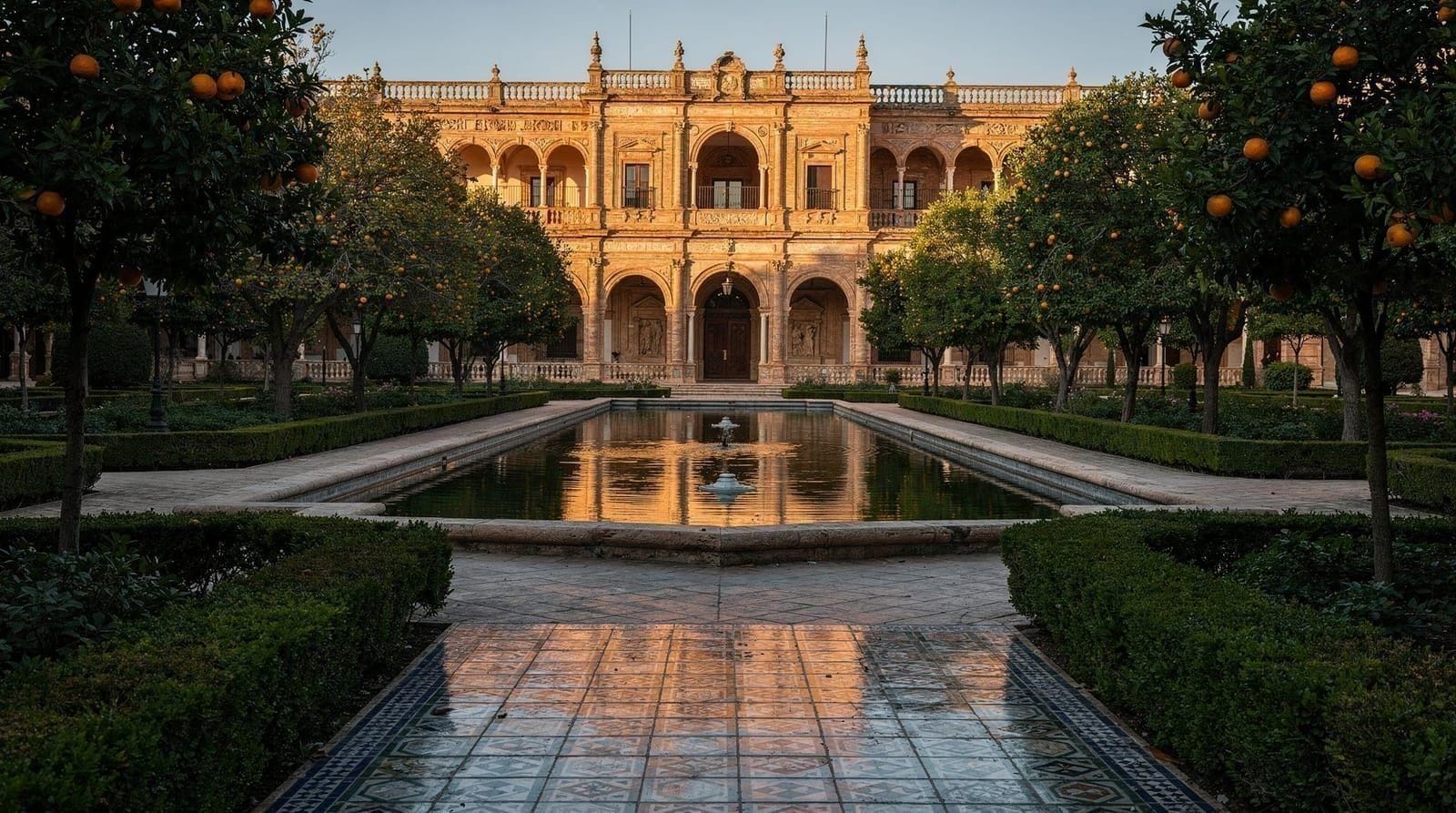
The Alcázar’s gardens cover approximately 8 hectares — significantly larger than the palace itself. They were developed over centuries and include formal Renaissance gardens, a labyrinth (Jardín del Laberinto), the Estanque de Mercurio (Mercury Pool), and the English Garden. The gardens behind the palace wall (the outer gardens) are less crowded than the immediate palace environs.
The Galeria del Grutesco is a raised garden walkway running along the top of the Almohad wall, offering views over the gardens and the city. In summer, this section is fully exposed to sun — see the timing advice in the best time to visit Alcázar guide.
Small-group Alcázar guided tour — gardens and palace rooms coveredGame of Thrones filming locations
The Alcázar appeared in Game of Thrones as the Water Gardens of Dorne, the seat of House Martell. The main filming locations:
- Patio del Crucero: Ellaria Sand and the Sand Snakes conspire here in Season 5
- Patio de la Montería: Myrcella Baratheon’s scenes in the gardens
- Jardines: Multiple scenes of the Water Gardens’ pathways
The showrunners chose the Alcázar over other Andalusian locations specifically because of the pool and fountain layouts in the Patio del Crucero. The production required evening filming access and minimal set dressing.
Fans of the show should note that the Dorne storyline in seasons 5–6 was widely criticized for its writing, but the filming locations themselves are beautiful and the Alcázar deserves a visit regardless of your feelings about those seasons.
Audio guides and guided tours
Royal Alcázar entry ticket with audio guide — self-paced narrationThe palace’s own audio guide (available at the entrance, bundled with some third-party tickets) covers the main rooms in approximately 90 minutes. It is accurate and updated. The limitation is that it follows a set route — if you deviate to explore a side room, the narration does not adapt.
A good human guide adds three things the audio guide cannot: they can point out architectural details you would otherwise walk past (the original paint in the corners of arches, the Roman stonework in the lower courses of the outer wall), they can answer questions in real time, and they can navigate the current layout (which rooms are accessible changes with royal visits and restoration work). For a first visit to the Alcázar, a guided tour is worth the cost.
Practical information
Address: Patio de Banderas, s/n, 41004 Seville. Main visitor entrance: Puerta del León (Plaza del Triunfo).
Hours: April–September: 9:30 AM–7:00 PM. October–March: 9:30 AM–5:00 PM. Last entry 1 hour before closing. Closed during some royal events (check website).
Tickets: Adult €15.50. Children up to 13 accompanied by an adult: free. Free public visits are sometimes offered on set days and times: check the official website.
Getting there: 10-minute walk from Seville city centre. No dedicated parking at the site.
For ticket booking strategies, see Alcázar tickets and skip-the-line guide. For the question of whether to visit the Alcázar or Cathedral first, see Alcázar vs Cathedral which first.
Ticket types compared
| Ticket type | Around | Best for |
|---|---|---|
| Standard entry only | €15.50 | Repeat visitors, budget-conscious first-timers with time to research beforehand |
| Entry with audio guide | €17–20 | Independent visitors who want context without a fixed group pace |
| Small-group guided tour | €35–45 | First-time visitors who want the full historical and architectural context |
| Priority access guided tour | €40–55 | Visitors short on time or visiting in peak season who want to skip the queue |
Best time of year to visit
| Season | Conditions | Notes |
|---|---|---|
| Spring (Mar–May) | Mild, orange blossom in the gardens | Peak season — book well ahead, arrive at 9:30am opening |
| Summer (Jun–Aug) | Very hot, 35–42°C midday | Morning slots essential; interior rooms offer some relief from heat |
| Autumn (Sep–Oct) | Mild, fewer crowds than spring | Excellent alternative to spring with similar light and comfort |
| Winter (Nov–Feb) | Cool, 11–18°C, occasional rain | Shortest queues of the year; interiors are comfortable, gardens cooler |
The Alcázar under Pedro I: the political meaning of Mudéjar architecture
Understanding why a 14th-century Castilian Christian king chose to build a palace in the Mudéjar style requires understanding Pedro I’s political position. He was known to his enemies (primarily the nobility who eventually overthrew him) as “the Cruel” — a characterization rooted in his ruthless treatment of rivals and his alliance with the Muslim king of Granada against Christian nobles who opposed him. To his supporters, he was “the Just” — a king who applied the law impartially and preferred the company of merchants and artisans to the nobility.
Pedro I chose craftsmen from the Nasrid kingdom of Granada (where the Alhambra was being built simultaneously) not because he was indifferent to religious or cultural distinctions but because he was making a deliberate political statement. The Mudéjar style in the 14th century was the most sophisticated architectural vocabulary available in the Iberian Peninsula. By building in this style, Pedro I was asserting cultural ambition, political eclecticism, and a rejection of the more austere Gothic forms favoured by the Castilian church and northern European courts.
The Arabic inscriptions in the Patio de las Doncellas — “Wa la ghaliba illa Allah” (None is victorious except God) — are the Nasrid dynasty’s motto, the phrase carved on every surface of the Alhambra. Pedro I had it carved into his own palace as well. Whether this represents genuine syncretism, political calculation, or aesthetic appropriation is a question historians still debate. What is clear is that the decision was intentional and meaningful.
Visiting with children: what works and what does not
The Alcázar has specific child-appeal elements that distinguish it from most historical monuments:
Game of Thrones: For older children who have watched the show, the connection to Dorne is a genuine hook. The specific filming locations can be identified with minimal research (a quick look at a GoT filming locations list before the visit). The Patio del Crucero in particular is recognizable.
The maze: The Jardín del Laberinto — a labyrinth in the gardens — is a straightforward play element that children enjoy without any cultural context required.
The gardens generally: The Alcázar’s gardens are extensive, varied, and open enough to allow children to move freely while adults look at the architecture. The fountain in the Estanque de Mercurio is photogenic and child-friendly.
What does not work for young children: The interior rooms require patience and relative quiet. The Patio de las Doncellas and Salon de los Embajadores are the highlights but are also the most crowded parts of the palace. With children under 6, the gardens may be more valuable than the interior for maintaining engagement.
Practical tip with children: Enter at 9:30 AM, do the interior rooms first (before crowds build), then spend the remaining time in the gardens. This maximises the value of both sections while managing the energy levels that interior monument visits require.
Practical photography guide
The Alcázar’s main spaces offer specific photography challenges and opportunities:
Patio de las Doncellas: Best light before 10 AM or in winter when the sun angle is lower. The lower arcade is in shadow while the upper storey is lit — exposing for the pool reflection balances the scene reasonably well. The crowd management challenge: the 9:30 AM slot gives you approximately 20–30 minutes of relative emptiness before later arrivals fill the space.
Salon de los Embajadores: The dome receives direct light from its surrounding windows at midday. The interior is otherwise dark. A wide-angle lens (or phone camera at ultra-wide) is needed to capture the full dome and the lower walls in a single frame. The gold-on-dark colour palette is challenging for automatic exposure — manual or exposure compensation is useful.
Gardens: Morning light (9:30–11 AM) is better than afternoon light for the main garden sections, which face east. The Galeria del Grutesco raised walkway faces west and gets better light in the late afternoon.
Where to go after the Alcázar
The Alcázar sits at the centre of Seville’s most historical square kilometre. What you do with the 2–3 hours after your visit depends on your interests:
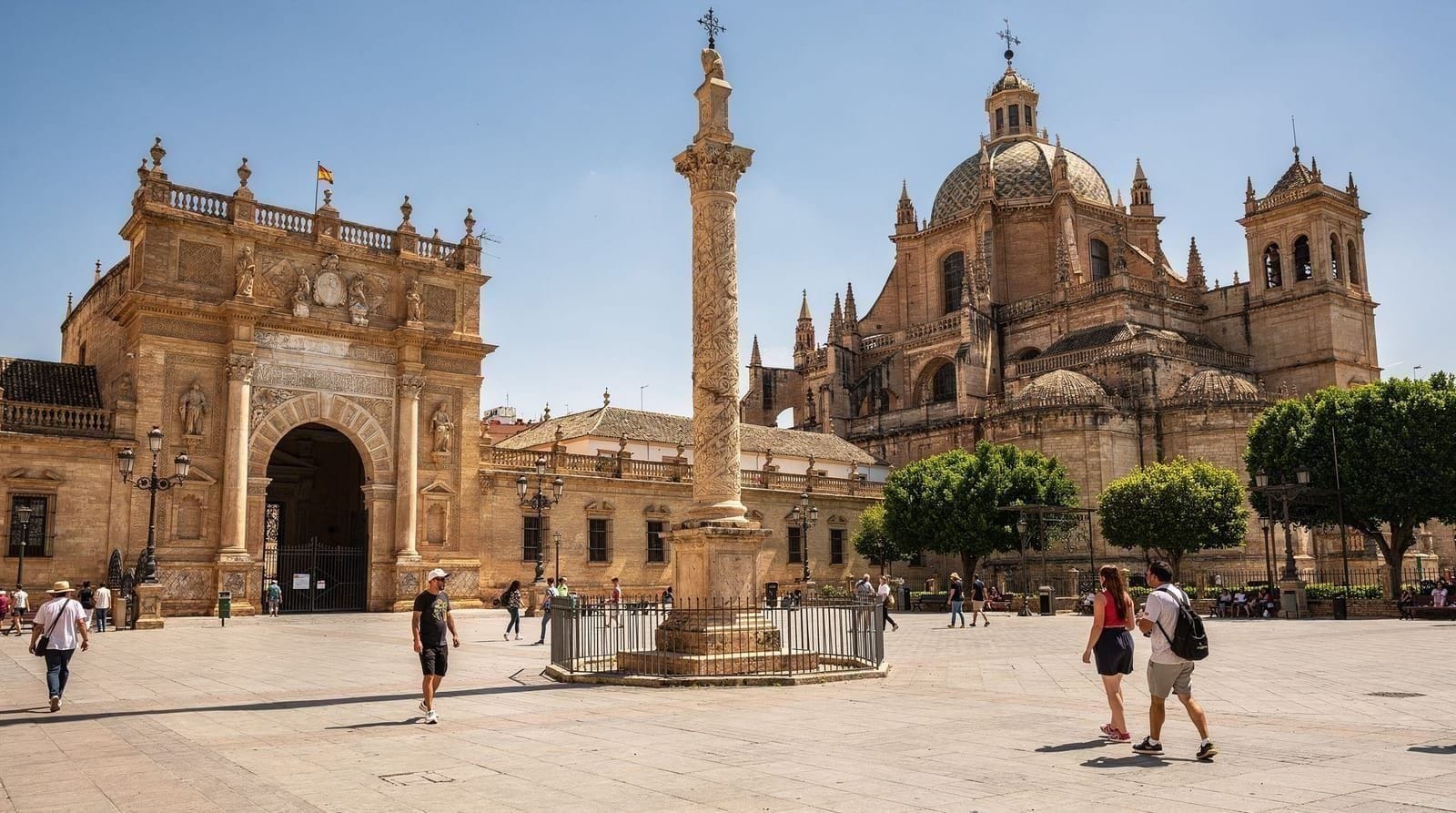
The Cathedral (5 minutes’ walk): The natural pairing, covered in full in the Cathedral and Giralda tickets guide.
Casa de Pilatos (12 minutes’ walk): The finest private palace in Seville, with a Roman sculpture collection that the Alcázar does not have. See the Casa de Pilatos guide.
The Barrio de Santa Cruz: The historic Jewish quarter surrounding the Alcázar and Cathedral. Walking without a specific destination for an hour yields more of the neighbourhood’s character than a structured tour.
The Archive of the Indies (3 minutes’ walk): Free, no queue, original Columbus documents. 30 minutes. An obvious add-on that many visitors skip. See the Archivo de Indias guide.
If you are building the Alcázar into a wider plan, the Santa Cruz neighborhood guide covers the streets around the palace walls, and the Seville Cathedral complete guide pairs naturally with this one. Visitors weighing the two great Andalusian palaces will find the comparison in Alcázar vs Alhambra. For a day that strings several sights together, the Seville in 1 day itinerary and the Seville first-timers itinerary both place the palace early, while the visit is still fresh.
Tickets are the part of this visit that most often goes wrong, so it is worth reading skip-the-line Seville decoded before you book anything. If you want to pair the palace with the cathedral on a single booking, the combined Alcázar and Cathedral tickets guide explains how that works, and the Seville first-time travel tips cover the wider logistics of a first trip.
Accessibility
The main palace rooms are largely step-free, with ramps at the principal thresholds, though some of the historic doorways are narrow and a few interior transitions involve small steps typical of a centuries-old building. The gardens are mostly flat and paved or gravel, manageable for wheelchairs and pushchairs on the main paths, though some of the more secluded corners (the Galeria del Grutesco walkway in particular) involve stairs. Visitors with mobility needs should contact the Alcázar directly or check with their tour operator ahead of the visit, since accessible routing can vary with which sections are open on a given day. Benches are available at intervals through the gardens for visitors who need to rest during a 2–3 hour visit.
A note on sustainability and etiquette
The Alcázar is a working royal residence as well as a monument, and a small amount of visitor etiquette goes a long way toward preserving both the experience and the building. Avoid touching the carved plasterwork and tile surfaces, even where barriers are minimal — centuries-old decoration is more fragile than it looks. Flash photography is discouraged in several interior rooms for the same conservation reasons that apply to textiles and painted surfaces elsewhere in the city. Given how much of the palace’s appeal depends on quiet contemplation of detail — the Arabic inscriptions, the muqarnas dome, the layered history in the stonework — keeping voices low in the interior rooms noticeably improves the experience for everyone, including you.
Frequently asked questions about Real Alcázar of Seville
What is Mudéjar architecture and why does it matter at the Alcázar?
Mudéjar refers to the style developed by Muslim craftsmen working under Christian rule in medieval Iberia. At the Alcázar, Pedro I deliberately brought in craftsmen from Granada and Toledo to create a palace that blended Islamic decorative traditions with Christian spatial organization. The result — carved plasterwork, geometric tile floors, wooden carved ceilings — is unique in Europe and has no direct equivalent north of the Pyrenees.Did Game of Thrones film at the Alcázar?
Yes. The Alcázar served as the Water Gardens of Dorne in seasons 5 and 6, appearing in roughly 10 episodes. The Patio del Crucero, the Jardines, and the Patio de la Montería are all identifiable locations. The filming required special access outside public hours and involved minimal set dressing — the palace looks in the show almost exactly as it does in person.What are the highlights not to miss?
The Patio de las Doncellas (Courtyard of the Maidens) — the architectural heart of the palace. The Salon de los Embajadores — the throne room with its spectacular dome. The Jardín del Estanque. The Palacio del Yeso (if accessible). The view of the Giralda tower from the rooftop terrace.How much of the Alcázar is accessible to visitors?
The public visitor area covers the lower palace (Palacio Mudéjar, Palacio Gótico, Palacio del Yeso, Palacio de los Infantes), the extensive gardens, and the historic upper area. The upper apartments — used by the Spanish royal family during their Seville visits — are closed to the public. During royal visits, some additional areas may be temporarily closed.How long should I spend at the Alcázar?
A minimum of 2 hours is needed to cover the main rooms and gardens. With a guided tour: 1.5–2 hours of structured content plus additional time to linger. If you want to explore all garden sections and the rooftop: 2.5–3 hours.Is the Alcázar or the Alhambra in Granada more impressive?
Both are UNESCO World Heritage Sites and both are extraordinary. The Alhambra is larger and architecturally more diverse. The Alcázar's Patio de las Doncellas and Salon de los Embajadores are among the finest surviving examples of Mudéjar architecture anywhere. For a first visit to southern Spain, both are essential — see the Alcázar on your Seville days and the Alhambra on a Granada day trip.Are the Alcázar gardens free to enter?
No. The gardens are included in the standard €15.50 admission ticket but are not separately free.Should I book a guided tour or self-guided entry for the Alcázar?
For a first visit, a guided tour is worth the extra cost — a good guide points out details (original paint traces, Roman stonework, the current visitor layout) that self-guided visitors typically miss. Repeat visitors, or those who prefer to linger at their own pace, do fine with self-guided entry and the palace's own audio guide.Can I visit the Alcázar without booking in advance?
Not reliably. The Alcázar uses strict timed-entry ticketing, and walk-up availability is unpredictable, especially in spring (March–May) and October, when slots can sell out days or weeks ahead. Book your specific date and time slot online in advance.
Top experiences
Bookable activities with verified prices and instant confirmation on GetYourGuide.