Seville Cathedral: complete visitor guide 2026
Seville: Cathedral and Giralda guided tour and tickets
What is the Seville Cathedral and why visit it?
Seville Cathedral (Catedral de Santa María de la Sede) is the largest Gothic building in the world by volume and a UNESCO World Heritage Site. Built between 1401 and 1528 on the site of the city's Almohad mosque, it houses Columbus's tomb, the world's largest altarpiece, and the Giralda bell tower. Adult entry is €13 online (€14 at the ticket office).
| Cost | around €13 adults, free under 13 |
| Time needed | around 75–90 min essential visit, 2.5–3hrs thorough |
| Getting there | 5-minute walk from the Alcázar |
| Dress code | Shoulders and knees covered |
| Best time | Morning, before 11 AM, for the Giralda view |
Seville Cathedral is the third-largest Christian church in the world — after St Peter’s Basilica in Rome and St Paul’s Cathedral in London — and the largest Gothic building by volume. Those superlatives are cited so often that they lose meaning until you stand inside the nave and discover that the far end genuinely disappears into shadow, that the pillars are as thick as mature trees, and that the retable behind the high altar is the largest painted altarpiece in existence. The scale is not a boast. It is a physical fact you experience rather than read.
The building’s history in brief
The site was the Great Mosque of Seville, built by the Almohad dynasty in the 12th century. After the Christian conquest of Seville in 1248, the mosque was converted to a cathedral — a common practice in the Iberian Reconquista. For 150 years, the converted mosque served as the city’s cathedral.
In 1401, the Cathedral chapter decided to demolish the mosque and build a new Gothic cathedral. The ambition was explicitly stated: they wanted to build something unprecedented. Construction began in 1402. The architect (or architects — the historical record is unclear) designed on a scale that was extreme even by Gothic cathedral standards: the nave width of 38 metres would have been remarkable in France or England; in early 15th-century Spain it was unprecedented.
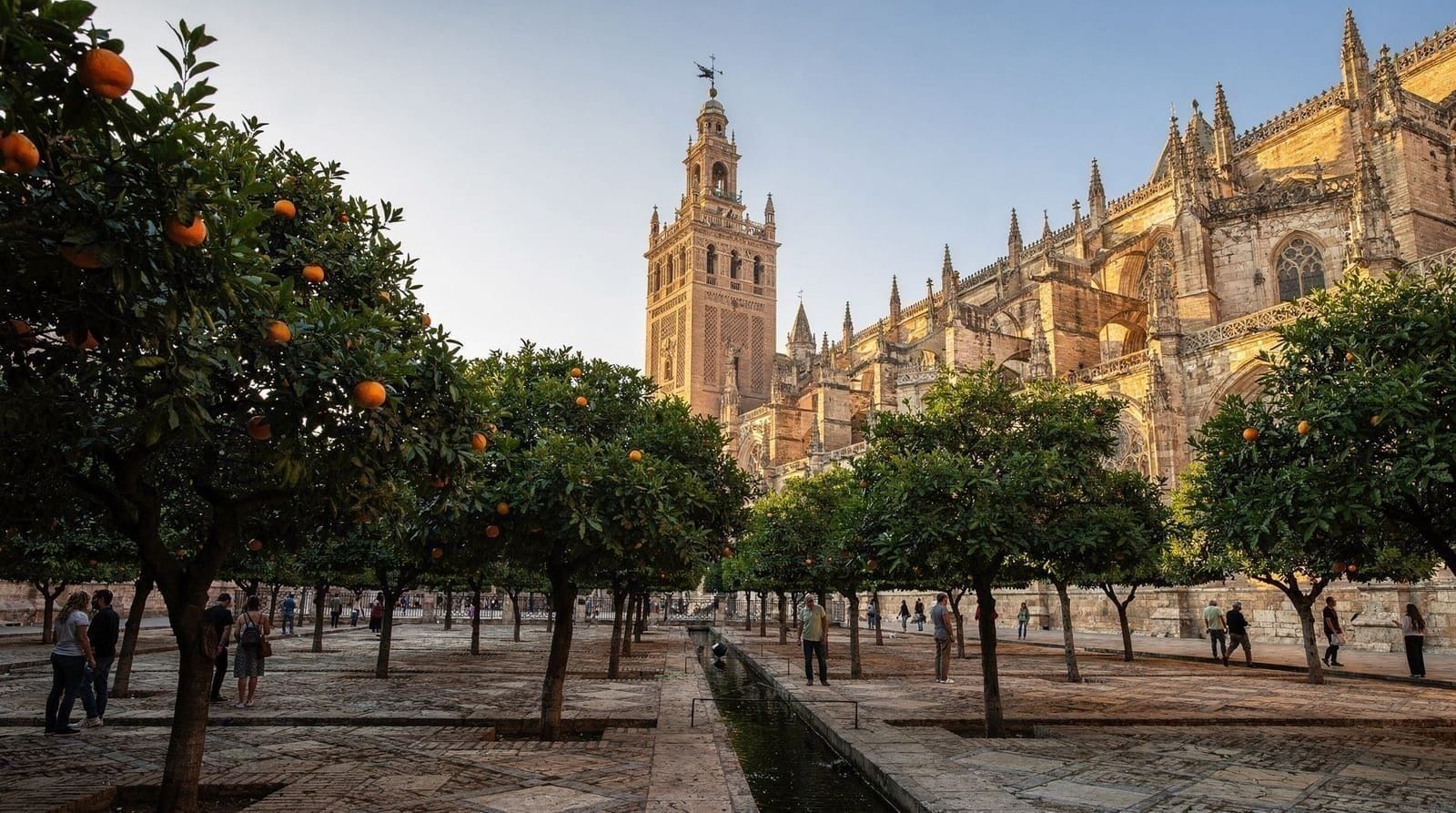
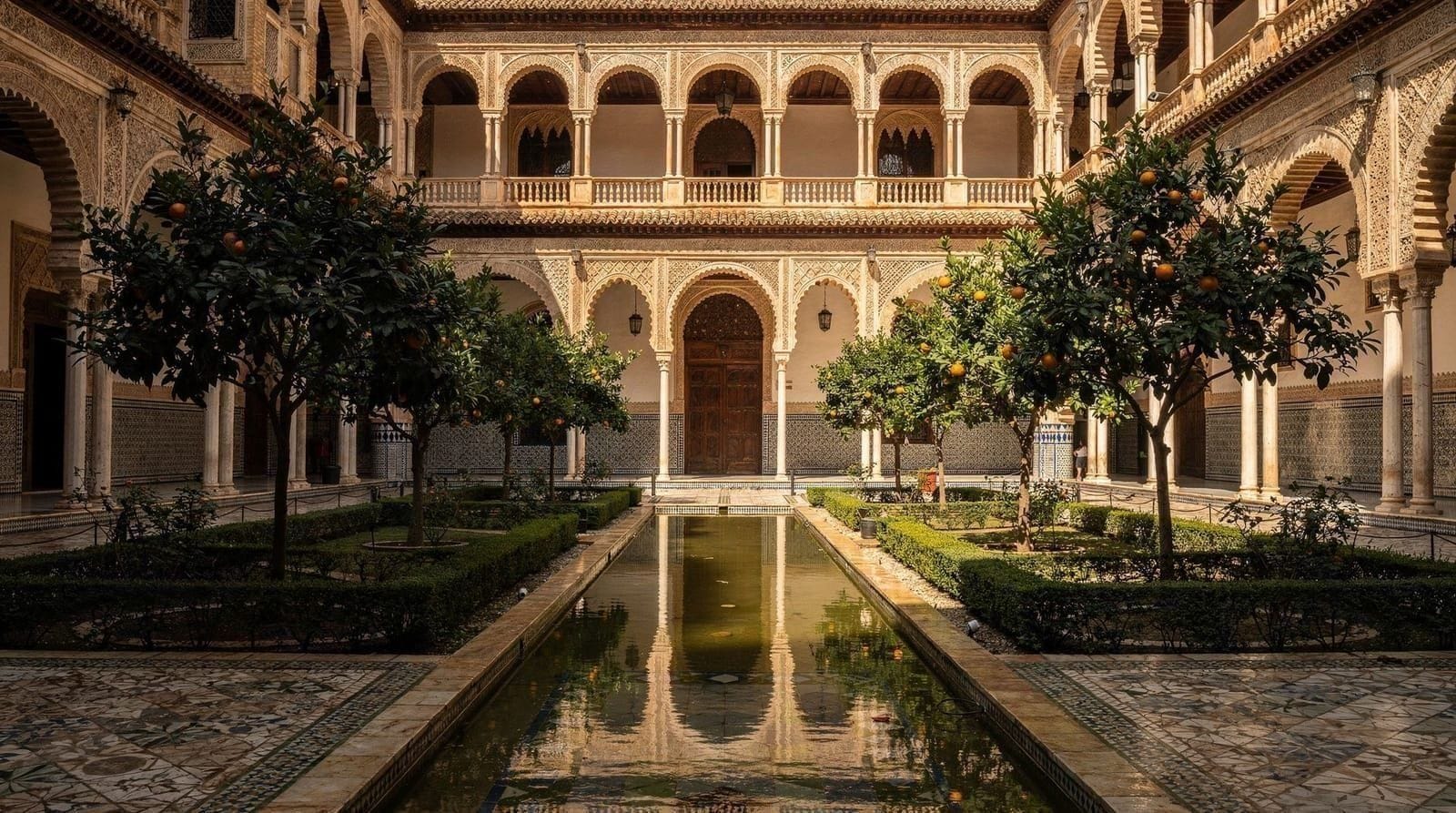
The mosque’s minaret — the Giralda — was retained. The original Almohad orange tree courtyard (Patio de los Naranjos) also survived and remains accessible today.
Room-by-room and section-by-section guide
The nave
Enter through the Puerta de San Cristóbal (south door) and stop. The nave is 135 metres long, 82 metres wide, and the vaulted ceiling reaches 56 metres at its apex. This is roughly the height of a 15-storey building, but experienced as a single continuous space rather than a stack of floors. The effect on first entry is visceral.
The nave is Gothic, but it is Andalusian Gothic: the light quality is different from northern European Gothic cathedrals. In the north, Gothic architecture was designed to maximize light through tall windows; in Seville, the main nave is deliberately dim, with light concentrated on the Capilla Mayor at the far end. This creates a processional effect — you move through shadow towards light.
Capilla Mayor (Main Chapel and Retable)
The high altar retable is the largest in the world: 13.6 metres wide, 28 metres tall, containing 45 scenes from the life of Christ and the Virgin in carved polychromed wood. It was commissioned in 1481 and completed in 1564 — 83 years of work by multiple artists. The gilding uses an estimated 2.5 kg of gold leaf.
The retable is kept behind iron grilles. Most of the panels are visible from a distance; close inspection requires the guided tour, which sometimes allows access to the lower sections.
Columbus’s tomb
The tomb of Christopher Columbus in the south transept is carried by four crowned bronze figures representing the kingdoms of Castile, León, Aragon and Navarra. The design was intended as a mark of posthumous honour; Columbus himself died in Valladolid in 1506 in reduced circumstances after his governorship of the Indies was revoked.
The coffin in the tomb is believed to contain most (though not definitively all) of Columbus’s remains. The complicated history of his remains — transferred from Valladolid to Santo Domingo to Cuba and finally to Seville in 1899 — and the 2006 DNA analysis are covered in the FAQ above.
The tomb is one of the most visited spots in the Cathedral. It is easy to find — in the south transept, clearly signposted — and the bronze figures are impressive regardless of your opinion of Columbus’s historical legacy.
Capilla Real (Royal Chapel)
Behind the high altar, the Royal Chapel houses the tombs of Alfonso X (Alfonso the Wise) and his mother Beatrice of Swabia, and the silver reliquary containing the remains of King Ferdinand III of Castile, who conquered Seville from the Moors in 1248 and was subsequently canonized. The chapel is active for worship; access may be limited during services.
The statue of the Virgen de los Reyes (Virgin of the Kings) in the chapel is one of the most venerated images in Seville. The Virgen is paraded during Semana Santa; the chapel functions as the heart of the Cathedral’s ongoing religious life.
The sacristy and treasury
The Main Sacristy (Sacristía Mayor) is a domed Renaissance space containing the Cathedral’s treasury: silverwork, vestments, and religious objects accumulated over five centuries. The Custodia — the processional monstrance used during Corpus Christi — is particularly notable: it is 3.2 metres tall and made of 4 tonnes of silver, paraded through the streets annually.
The Chapter Room (Sala Capitular) has an elliptical ceiling designed by Hernán Ruiz the Younger, who also designed the Giralda’s Renaissance belfry. The room contains Zurbarán’s painting of the Immaculate Conception.
The Giralda tower
Cathedral and Giralda guided tour with tickets — guide includedThe Giralda is entered from the northeast corner of the Cathedral interior. The climb is via 35 ramps — no stairs — and takes 15–20 minutes at a moderate pace. The ramps are wide enough for two people to pass.
The view from the top (70 metres) encompasses the entire historic centre of Seville. The Cathedral’s Gothic roofline is at eye level to the south. The Alcázar’s gardens are visible below and to the east. The Guadalquivir river is visible to the west. On clear days, the Sierra Morena mountains are visible to the north and the Sierra Nevada (above Granada) to the southeast.
The best photography light on the Giralda observation deck is in the morning (before 11 AM). By noon, the platform is crowded and the light is harsh.
The Patio de los Naranjos (Orange Tree Courtyard)
The original Almohad ablutions courtyard, with orange trees planted in rows along the original irrigation channels. Free to enter separately during certain hours; access from the north side. The trees are planted in the exact positions they occupied in the Almohad mosque’s courtyard — the irrigation channels beneath the ground have been continuously maintained for over 800 years.
Practical information
Address: Avenida de la Constitución, s/n, 41004 Seville.
Tickets: €13 online (€14 at the ticket office). Children under 13 accompanied by an adult: free. Audio guide add-on available. Full ticket guide: Cathedral and Giralda tickets guide.
Getting there: 5-minute walk from the Alcázar. No dedicated parking at the Cathedral.
Dress code: Shoulders and knees must be covered.
The rosemary scam: Women outside the Cathedral’s entrances offer rosemary and demand payment. Do not accept the rosemary. See Seville tourist traps to avoid for more context.
The Cathedral’s art collection
The Cathedral holds an extensive collection of paintings, sculpture, and religious objects accumulated over five centuries. Beyond the architectural experience, several specific works deserve attention:
Zurbarán’s “Santa Teresa de Jesús”: One of the finest examples of Zurbarán’s monastic portraiture, in the sacristy. The saint is depicted with the same psychological intensity he brought to his male religious figures — direct gaze, plain background, precise lighting.
Paintings by Murillo: The Cathedral holds several works by Bartolomé Esteban Murillo, who was born in Seville and worked extensively for the city’s religious institutions. His “San Antonio de Padua” in the baptistery is one of his most celebrated compositions — the composition shows Anthony’s vision of the Christ child appearing among a wash of angels. The painting was stolen in 1874, cut from its frame, and taken to New York; it was recovered and returned in 1875.
Goya’s “Saints Justa and Rufina”: A significant late painting (1817) by Francisco de Goya showing the two early Christian martyrs of Seville with the Giralda tower behind them. Goya was not primarily a religious painter, and the painting’s slightly restrained quality compared to his secular work reflects the commission context. The work is in the sacristy.
The retable: The main altar retable (Retablo Mayor) is worth returning to after seeing the rest of the Cathedral. On first entry, its scale overwhelms the detail. On a second look, the individual carved panels — 45 scenes from the life of Christ and the Virgin, arranged in a narrative sequence from the Annunciation to the Last Judgement — reveal themselves as a comprehensive devotional program. The panels at eye level are legible without magnification; the upper panels require binoculars to see properly.
The Semana Santa connection
The Cathedral is the physical and liturgical centre of Seville’s Semana Santa (Holy Week), which is one of the most elaborate religious observances in the Christian world. The 60 or so confraternities (brotherhoods) that organize the processions begin and end their routes at the Cathedral, entering through the Puerta de los Palos and exiting through the Puerta de San Miguel.
During Semana Santa, the Cathedral is used for religious purposes that take priority over tourist access. The timetable for tourist visits is significantly reduced during the week before Easter, and tourist access is not possible during procession ingress and egress times. If you are visiting Seville during Semana Santa, book the Cathedral early in the week (Monday or Tuesday) rather than later when the processional schedule intensifies.
The most significant confraternal step (palio) associated with the Cathedral is the Virgen de los Reyes — the Cathedral’s own Virgin, which exits in a procession of the Cathedral chapter on the last day of Semana Santa. This is one of the more austere and formally significant processions of the week.
The rosemary scam: specific details
The Cathedral entrances are surrounded by women who offer rosemary sprigs “for good luck” and then demand payment — sometimes aggressively. This scam has operated at the Cathedral for decades and is one of the most frequently reported issues in visitor accounts.
The correct procedure: do not make eye contact with anyone holding plant material. If someone approaches you directly, say “no, gracias” firmly and continue walking. If you have already accepted the rosemary, hand it back and do not reach for your wallet. The most persistent approach is to stop making eye contact and walk. There are no social obligations involved — the offer is not genuine; it is a commercial transaction being forced on you.
The scam operates primarily at the western entrance (Puerta de la Asunción) and along the south wall near the Puerta de San Cristóbal. The north entrance (Puerta de los Palos, from the Plaza Virgen de los Reyes) is less affected.
For the full context on tourist scams in Seville, see Seville tourist traps to avoid.
The Cathedral versus other great cathedrals in Spain
Spain has an extraordinary inventory of Gothic and Romanesque cathedrals: Burgos, León, Toledo, Salamanca, Santiago de Compostela, Barcelona. Seville’s Cathedral differs from these in specific ways:
Scale: Seville’s nave is wider than any of the others. The internal volume — the reason for the “largest Gothic building” claim — is achieved partly through this width and partly through the unusual absence of a defined structural choir in the centre of the nave (removed in the 19th century), which opens the vista from west to east.
Light: Seville’s latitude means lower winter sun than northern Spanish cathedrals. The building was designed with this in mind — the stained glass is concentrated in the clerestory rather than the nave walls, directing light to the upper vaults rather than flooding the nave floor.
The Giralda: No other Spanish cathedral has a minaret incorporated into its structure. The retention of the Almohad tower was a deliberate choice by the 15th-century chapter — they recognized its architectural quality and did not want to demolish it. This makes Seville’s Cathedral unique among Gothic buildings.
The collections: The treasury, the sacristy, and the chapter house together hold one of the richest collections of Renaissance and Baroque religious art in Spain. The Cathedral was lavishly funded by the colonial trade that passed through Seville in the 16th–17th centuries, and the donors expected visible results.
For ticket information and booking, see the Cathedral and Giralda tickets guide. For the question of whether to visit the Cathedral or Alcázar first, see Alcázar vs Cathedral which first.
What first-time visitors underestimate
Most first-time visitors budget too little time for the Cathedral relative to its scale. A quick pass through the nave and a photo at Columbus’s tomb takes 20 minutes, but it misses the Royal Chapel, the sacristy’s Zurbarán and Murillo paintings, and — most consequentially — the Giralda climb, which many rushed visitors skip entirely because they’ve already spent their planned hour. Budget the full 75–90 minutes even if you think you’ll move faster; the Cathedral rewards the extra time more than almost any other Seville monument.
The second common underestimate is queue time in peak season. Without a pre-booked ticket, April, May, September and October queues at the entrance can run 30–45 minutes on a busy morning. A ticket booked online, even for a walk-up time slot, moves you into a separate, faster-moving line.
If you would rather see the Cathedral and the neighbouring palace in one go, a skip-the-line tour covering the Alcázar, the Cathedral and the Giralda keeps the logistics in one booking. For a comparison of the different ticket types, see skip-the-line tickets decoded and the guide to combined Alcázar and Cathedral tickets.
Photography inside the Cathedral
Photography without flash is permitted throughout the Cathedral, including the Giralda climb, though tripods are not allowed. The nave’s dim lighting makes handheld photography of the retable and side chapels challenging without a reasonably capable camera or phone — expect grainy results in low light rather than crisp detail. The Giralda’s exterior viewing platform offers the best photography conditions in the building, with natural light and unobstructed views over the city; arrive before 11 AM for the clearest shots before the platform crowds and the midday sun flattens the light.
Combining the Cathedral with the rest of a first day
For most first-time visitors, the Cathedral anchors a first day in Seville alongside the Alcázar and a walk through the surrounding Santa Cruz neighbourhood. A realistic sequence: Alcázar in the morning while it’s cooler, Cathedral around midday when its shaded interior is a welcome break from the sun, then Santa Cruz’s streets in the late afternoon. For the fuller picture of how to structure a first day or first several days, see planning your Seville itinerary.
If your time is short, the one-day Seville itinerary shows how the Cathedral fits around the other essentials, while the first-timer’s itinerary spreads the main monuments over a more relaxed pace. After the Cathedral, the nearby Archivo de Indias is a quieter stop that continues the story of Seville’s colonial era, and the Real Alcázar guide covers the palace in the same detail as this page. If you are still deciding when to come, the best time to avoid crowds in Seville helps you pick quieter days, and Seville’s first-time travel tips cover the practical basics around the visit. Readers who prefer a personal account can also read how we spent 48 hours in Seville.
Frequently asked questions about Seville Cathedral
Is Columbus actually buried in Seville Cathedral?
Probably yes, though the history is complicated. Columbus died in Valladolid in 1506. His remains were subsequently transferred multiple times — from Spain to Santo Domingo to Cuba and back to Seville in 1899 following Spain's loss of Cuba. DNA analysis in 2006 confirmed a match between the Seville remains and his son Hernando. The Cathedral officially holds the claim, and the evidence supports it, though a small fraction of remains may be in the Dominican Republic.What are the opening hours for Seville Cathedral?
Monday–Saturday: 10:45 AM–7:00 PM. Sunday: 2:30–7:00 PM. The ticket office closes at 6:00 PM on both days. Hours may change on religious holidays. The Cathedral is an active place of worship — Masses are held regularly and access during services is limited to worshippers.Is the Giralda climb included in the Cathedral ticket?
Yes. The Giralda tower climb is included in the standard €13 admission. There are no stairs — the tower is accessed via 35 ramps, originally designed so the muezzin could ride a horse to the top when it was a mosque minaret.What is the dress code for the Cathedral?
Shoulders and knees must be covered. This is enforced at the entrance. If you arrive in shorts or a sleeveless top, you can buy a €3–€5 disposable cover from vendors outside, or carry a scarf or light layer.How long does a visit to the Cathedral take?
The essential visit (nave, Capilla Mayor, Columbus's tomb, Giralda) takes 75–90 minutes at a steady pace. A thorough visit including the sacristy, treasury, royal chapel, and all side chapels takes 2.5–3 hours. A guided tour covers the highlights in 1.5 hours.When was the Cathedral built?
Construction of the current Gothic cathedral began in 1401 and was largely complete by 1528, though additions continued into the 17th century. The decision to build was made by the chapter in 1401; the Cabildo minutes record their resolution: 'Let us build a church so great that those who see it finished will think us mad.' They were not wrong.Why is the Giralda a former minaret?
When the Almohads built the Great Mosque of Seville in the 12th century, the Giralda was its minaret — one of three great Almohad minarets built in this period (the others are the Koutoubia in Marrakesh and the Hassan Tower in Rabat). When the mosque was demolished in the early 15th century to build the Gothic cathedral, the minaret was retained. A Renaissance belfry and the Giraldillo weather vane (a bronze female figure representing Faith) were added to the top in the 16th century.Should I visit the Cathedral or the Alcázar first?
Either order works logistically since they're a 5-minute walk apart, but many visitors find the Alcázar's gardens and palace rooms more immersive first thing in the morning, before the day heats up, leaving the Cathedral's shaded, cooler interior for the warmer midday hours. See the dedicated Alcázar vs Cathedral guide for the fuller reasoning.Is the Cathedral wheelchair accessible?
The main nave and Capilla Mayor are accessible via ramps at the entrances, and the ground-floor sections are navigable for wheelchair users. The Giralda tower climb, despite using ramps rather than stairs, is steep and long (35 ramps over 70 metres) and is not practically accessible for most wheelchair users. Contact the Cathedral in advance for specific accessibility guidance.
Top experiences
Bookable activities with verified prices and instant confirmation on GetYourGuide.