Alcázar tickets and skip-the-line: complete 2026 guide
Seville: Royal Alcázar entry ticket
Do I need to book Alcázar tickets in advance?
Yes, strongly. The Alcázar sells timed-entry slots that run out days or weeks ahead in April, May and October. Walk-up tickets are sold in the afternoon when demand drops, but they offer no guarantee of entry. Book 1–2 weeks ahead during peak season.
The Alcázar of Seville is one of the most-visited royal palaces in Europe, and its ticketing system is a source of genuine confusion for first-time visitors. There are at least five different ways to buy access — timed entry, guided tour, audio guide bundle, combo with the Cathedral, and city pass — and choosing the wrong one can mean a longer queue, a worse experience, or money left on the table.
This guide cuts through the noise. Prices are correct for 2026. Booking recommendations are honest: some of the urgency you read elsewhere is exaggerated for affiliate purposes. Some is not.
| Where | Patio de Banderas, Santa Cruz — Puerta del León entrance |
| Cost | Around €15.50 standard entry; €25-€35 guided; around €20 audio-guide |
| Time needed | 2-3 hours, 1.5-2 hours if guided |
| Getting there | 5-10 min walk from the Cathedral / Plaza del Triunfo |
| Best time | Book 1-2 weeks ahead in April, May, October |
What the Alcázar ticket system actually looks like
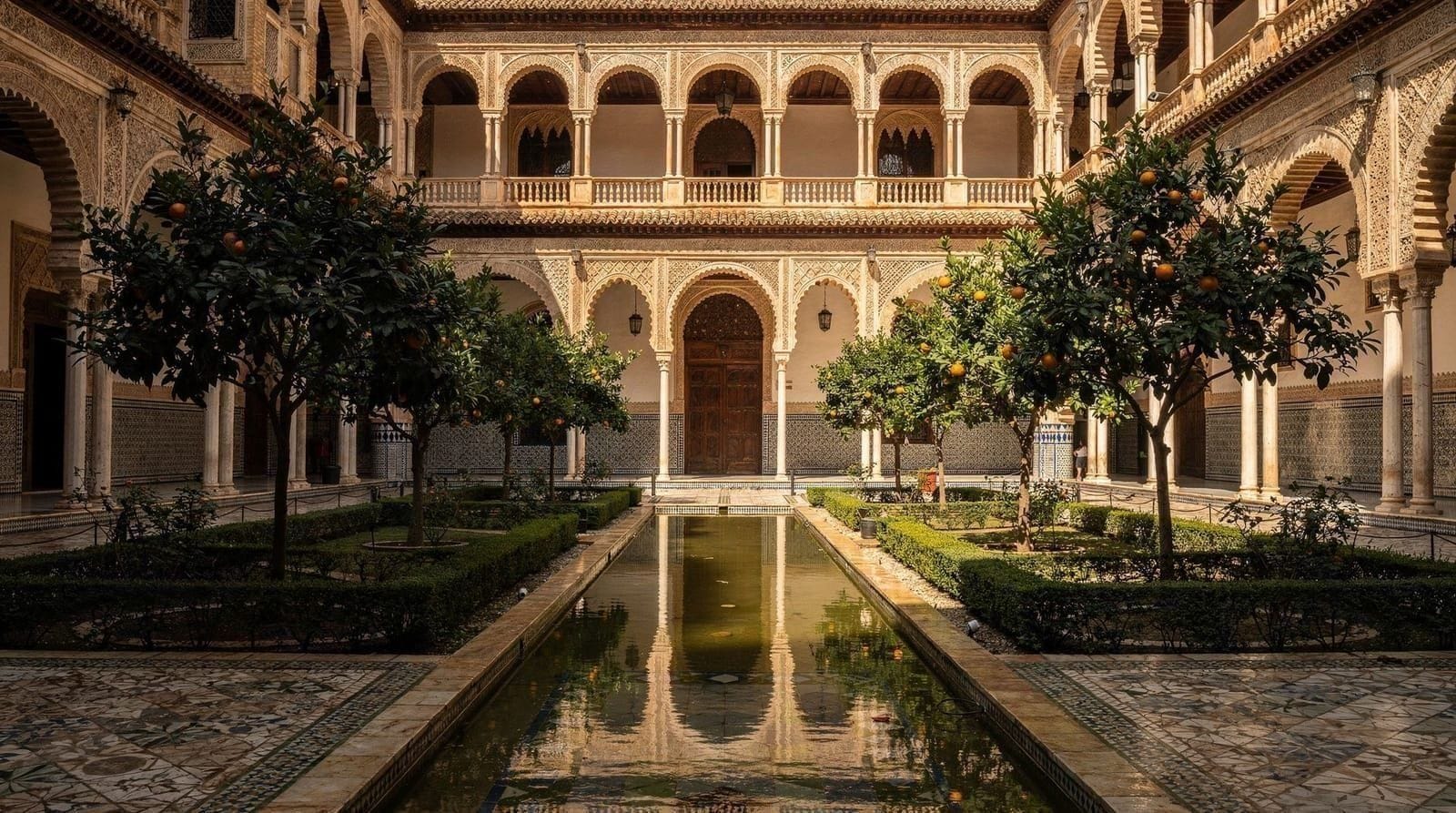
The Alcázar is a working royal palace. The upper floors are still used by the Spanish royal family when they visit Seville, which means a portion of the building is always closed to the public. What you access is the lower palace (Palacio Mudéjar, Palacio Gótico, Palacio del Yeso), the extensive gardens, and temporary exhibitions. The ticket price — €15.50 for adults — covers all of this.
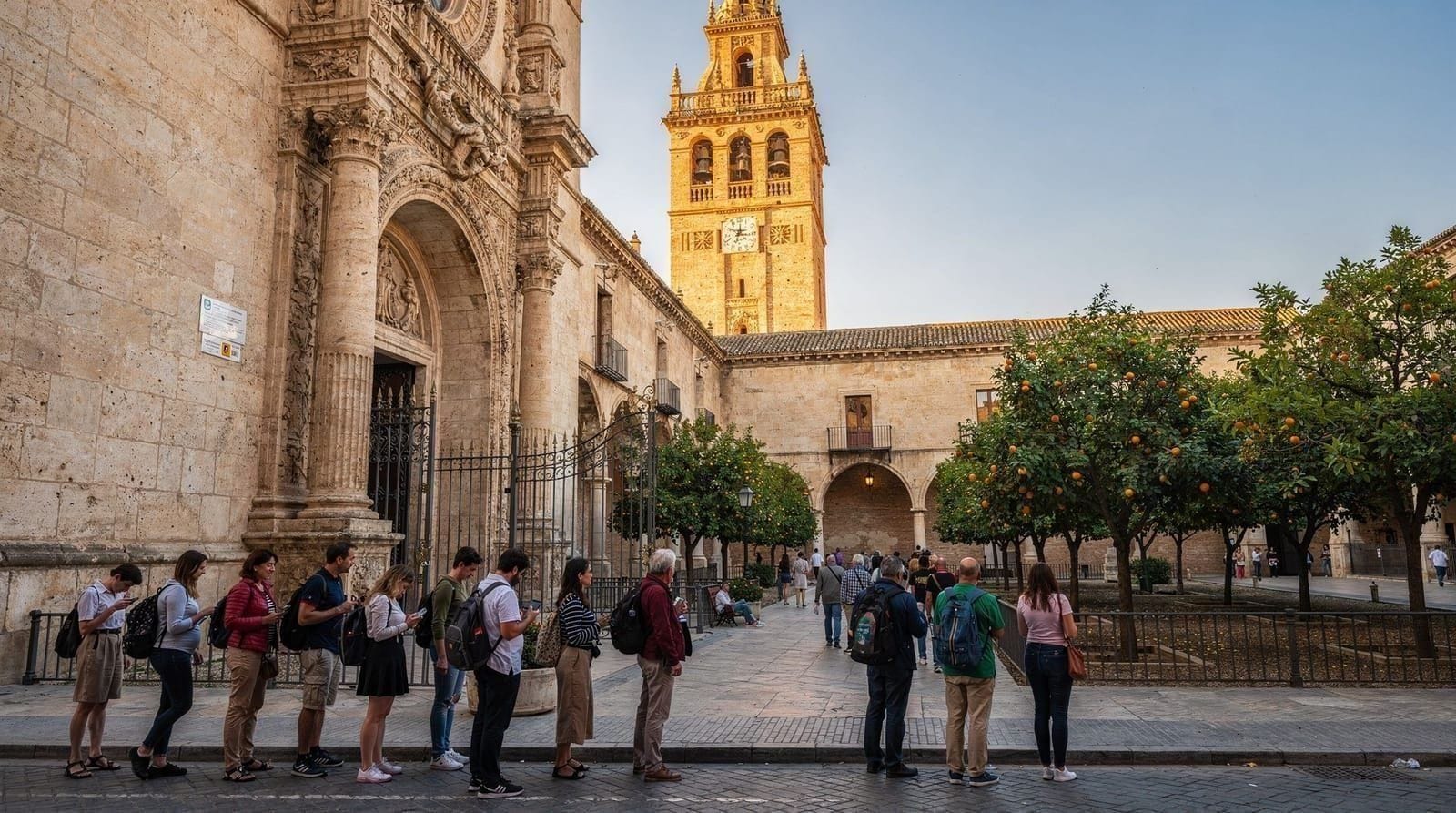
Tickets are time-stamped. You pick a one-hour entry window when you book, and you must arrive within that window. Once inside, you can stay as long as you like — the time restriction is only at the entrance gate. This matters because it means queues spike at the start of each hour-window, then dissipate. If you have flexibility within your window, arriving 20 minutes after the window opens is noticeably quieter.
Children up to 13 enter free when accompanied by an adult. This is a real, unconditional exemption — not a discount or a reduced-price ticket. You still need to reserve their place online when you book the adult tickets, but there is no charge.
Which ticket type fits which visitor
| Ticket type | Around | Best for | Skip if |
|---|---|---|---|
| Timed entry | €15.50 | Independent visitors, budget-conscious, families with young kids | You want context on what you’re seeing |
| Audio guide | €20 | Solo travellers and couples wanting structure without a group | You’re in a group larger than 4 |
| Guided tour (skip-the-line) | €25-€35 | First-time visitors, anyone with one shot at Seville | You already know the palace well |
| Small-group guided | €25-€35 | Visitors who want to ask questions and see less-crowded corners | Large families needing flexible pacing |
| VIP early access | €60-€90 | Photographers, atmosphere-focused visitors | Budget is a primary concern |
Timed-entry ticket: the standard option
Royal Alcázar timed-entry ticket — reserve your slot onlineThe baseline product. You pay €15.50, choose your entry window, and explore independently. No guide, no audio narration unless you hire one at the door (not recommended — the in-house audio guides are often overpriced and dated).
This is the right choice if you have prior knowledge of the Alcázar — for example, if you have read about the palace’s history or visited a similar Mudéjar site — and want to move at your own pace. It is also the right choice if you are travelling with young children who will not tolerate a 90-minute guided tour.
The honest limitation: the Alcázar’s labyrinthine architecture is genuinely hard to interpret without context. The Palacio Mudéjar in particular is a series of rooms whose significance is not obvious from the decoration alone. A good guide adds real value here.
When to book: In July and August, the Alcázar is actually less crowded than in spring because of the heat (temperatures above 38°C are common). April, May and early June, plus October and the first half of November, are peak-demand periods. Book 1–2 weeks ahead during these windows.
Audio-guide ticket: the middle ground
Royal Alcázar entry ticket with audio guide — self-paced narrationAround €20 for the ticket plus audio device. This is better value than it sounds: the audio guide is good (regularly updated, English/Spanish/French/German available), covers all the major rooms and gardens, and frees you from a group’s pace.
Recommended for solo travellers or couples who want structure without constraint. Not ideal for groups larger than four — headphone fatigue and coordination become issues.
Guided tour with skip-the-line access
Alcázar skip-the-line guided tour — licensed guide, priority accessThis is the highest-rated product on booking platforms for good reason. A licensed guide who knows the palace well will point out things that are genuinely easy to miss: the Roman-period remnants beneath the Patio del Yeso, the astronomical details in the muqarnas ceilings, the distinction between original Almohad stonework and 14th-century additions commissioned by Pedro I.
The small-group version (up to 10–12 people) is significantly better than the larger coach-group tours: the guide can take you into corners of the palace that large groups cannot reach, and you can actually ask questions.
Small-group Alcázar guided tour — max 10 people, priority accessPrice: €25–€35 depending on operator and group size. Worth it if this is your one visit to Seville.
Free public visits
The official Alcázar page does not list a free Monday session for EU citizens. It mentions only free public visits on days and times set by the commission, so check the official Alcázar website for any current free visits.
What about VIP early-access tours?
There are products that offer access before the regular opening time — typically 8:00 or 8:30 AM when the palace opens at 9:30 AM. These are expensive (€60–€90 per person) and deliver exactly what they promise: an empty palace, better light in the courtyards, and the sensation of being in a place that the Romans, Visigoths, Moors and Christian kings all used as a seat of power. For photographers and people who attach real weight to atmospheric solitude, this is worth the premium.
For most visitors on a normal budget, the standard guided tour with priority access achieves 90% of this experience at 40% of the cost.
Booking platform comparison
Tickets are sold through the official Alcázar website and through third-party operators on GetYourGuide, Viator and similar platforms. The official website sells only the basic timed-entry ticket. Third-party platforms sell the guided tours and audio-guide bundles.
Prices for equivalent products are generally identical across platforms. The difference is in customer service if something goes wrong: third-party operators tend to be more flexible with cancellation and rebooking than the official Alcázar box office.
Practical logistics
Address: Patio de Banderas, s/n, 41004 Seville. The main public entrance is the Puerta del León, on the south side of Plaza del Triunfo — the same square as the Cathedral’s south facade.
Hours (2026): April–September: 9:30 AM–7:00 PM. October–March: 9:30 AM–5:00 PM. Last entry one hour before closing.
Getting there: The Alcázar is in the Santa Cruz neighbourhood, a 10-minute walk from Seville’s city centre or 5 minutes from the Cathedral. There is no dedicated parking. Taxis can drop you at Plaza del Triunfo.
What to bring: The marble and tile floors are hard on your feet. Comfortable shoes matter. In summer, bring water — the gardens are beautiful but the heat in June–September is serious. The palace interior is cooler.
Related guides
For a deeper look at the palace itself, see the Real Alcázar complete guide. If you are trying to decide whether to visit the Alcázar or Cathedral first, that comparison is worth reading before you book.
For combo tickets covering both monuments, see combined Alcázar and Cathedral tickets. The full skip-the-line strategy for Seville — including which queues are genuinely dangerous and which are myths — is covered in the skip-the-line decoded guide.
Detailed timing strategy for the 9:30 AM slot
Arriving at the 9:30 AM opening requires planning that many visitors underestimate. The Puerta del León entrance is in Plaza del Triunfo, on the south side of the Cathedral. Most visitors are staying in the Santa Cruz neighbourhood or the historic centre, which is 5–15 minutes’ walk.
Important: the online ticket confirmation gives you a window, not a specific entry time. The convention is to arrive within the first 10–15 minutes of your window for the best access. Arriving at 9:45 AM for a 9:30 AM window is fine; arriving at 10:25 AM for a 9:30 AM window is technically valid but you will be in a busier palace.
Before you arrive: print or save the QR code offline on your phone. The gate scanners require the QR to be readable, and phone battery or data issues at the gate are a frustrating way to start the visit. Offline save in your photos app or a printed paper copy solves this problem.
At the gate: there is typically a scanner and a staff member. Present your QR. Children’s tickets (free) still require a confirmation — bring proof that you registered them when booking.
Inside the gate: the visitor map is distributed at the entrance. Take one. The palace’s internal layout is genuinely not obvious from the entrance — the map helps you orient between the main palace sections (Mudéjar, Gótico) and the various garden areas.
What first-time vs repeat visitors prioritise
The Alcázar rewards multiple visits. First-time visitors typically focus on the main courtyards (Patio de las Doncellas), the Salon de los Embajadores, and the main gardens. Repeat visitors often find more value in the sections that get less attention:
The Palacio del Yeso: The oldest surviving section, with 12th-century Almohad plasterwork. Less visited because it requires a short walk from the main Mudéjar palace section. Access varies depending on current restoration work.
The baths (Baños de Doña María de Padilla): Gothic vaulted baths beneath the Palacio Gótico. Evocative and quiet. Named after Pedro I’s favourite — a historically significant but contested figure. The relationship between Pedro and María de Padilla was one of the factors used to discredit him by the nobility who opposed him.
The outer gardens: Beyond the formal near gardens, the outer garden sections contain the English Garden, the Jardín del Retiro, and the vegetable plots (huerta). These are calmer and cooler than the main garden section because they see fewer visitors.
The Apeadero and courtyard area: The entrance courtyard before the Puerta del León (the Patio de Banderas — visible from outside, adjacent to the Alcázar) and the Apeadero (a large colonnaded hall used for carriages) are sometimes available for viewing at the beginning of the visit.
The Alcázar and Columbus: the historical connection
Ferdinand and Isabella used the Alcázar as their base during the period when Columbus was seeking royal backing for his 1492 voyage. The negotiations and the final agreement (the Capitulaciones de Santa Fe) were signed not in Seville but in the town of Santa Fe, near Granada — after the fall of Granada to Christian forces in January 1492.
However, Columbus returned to Seville and the Alcázar multiple times after his voyages. The Alcázar was effectively the administrative centre for the colonization of the Americas during the reign of Ferdinand and Isabella. The original documents signed by the king and queen authorizing Columbus’s second, third, and fourth voyages are in the Archivo General de Indias, 5 minutes’ walk from the Alcázar entrance.
For the full context on the colonial documents, see the Archivo de Indias guide.
Accessibility and what to do if plans change
The Alcázar’s ground-floor rooms and main garden paths are wheelchair-accessible, but some upper sections (notably parts of the Palacio Gótico) involve stairs with no lift alternative. If mobility is a concern, mention it when booking a guided tour — guides can usually adjust the route to skip stairs-only sections without missing the highlights.
Third-party operators generally allow free cancellation up to 24-48 hours before your slot, which is another reason the guided and audio-guide products through GetYourGuide-style platforms are often a safer choice than the official site for travellers whose plans might shift. Always check the specific cancellation window on the listing before booking.
Combining the Alcázar with the rest of Santa Cruz
Because the Puerta del León sits inside Santa Cruz, most visitors fold the Alcázar into a half-day that also covers the Cathedral and Giralda and a walk through the neighbourhood’s narrow streets. If you are undecided on order, Alcázar vs Cathedral: which first lays out the logistics in detail — the short version is that queues build faster at the Cathedral in the morning, so an early Alcázar slot followed by the Cathedral tends to work best. For the neighbourhood itself, see the Santa Cruz neighborhood guide.
Choosing the right slot for your season
The ticket you buy is only half of the decision; the season decides how the visit feels. If you are travelling in spring, the palace and gardens are at their most atmospheric but also at their busiest, so our Seville in spring guide is a useful companion when you are fixing dates. In the hottest months the logic reverses: an early slot and a long pause in the shaded courtyards make the visit far more comfortable, and the Seville in summer heat guide explains how to pace the rest of the day around it. For a month-by-month view of the palace specifically, read best time to visit the Alcázar, and for the wider picture of quiet and busy periods across the city, see best time to avoid crowds in Seville.
Fitting the Alcázar into your wider itinerary
Most visitors book the Alcázar first and build everything else around that fixed entry window. If you have a single day, the Seville in 1 day itinerary shows where a morning palace visit sits alongside the Cathedral and a lunch stop. With more time, the Seville in 3 days itinerary lets you give the palace its own unhurried block rather than rushing it between other sights. If you are still deciding how long to stay at all, how many days in Seville helps you decide, and the Seville destination page gathers everything else in one place.
Seeing the monuments side by side
Visitors weighing the palace against other great Andalusian monuments often ask how it compares. Alcázar vs Alhambra walks through the differences in scale, style and ticketing, which is helpful if you are also planning a day in Granada. For the Cathedral side of your plans, the Seville Cathedral complete guide covers what to see inside, and the Cathedral and Giralda tickets guide covers how to book it so the two visits do not collide.
Frequently asked questions about Alcázar tickets and skip-the-line
How much do Alcázar tickets cost in 2026?
The standard adult admission is €15.50. Children up to 13 enter free when accompanied by an adult. A guided tour with skip-the-line access typically costs €25–€35 depending on group size. Audio-guide bundles run around €20.Is there any way to get in for free?
The official Alcázar page lists no free Monday entry for EU citizens. Free public visits are offered only on days and times set by the Alcázar's commission, so check the official website.What is the difference between timed entry and a guided tour?
A timed-entry ticket lets you in at your reserved slot but you explore independently. A guided tour typically runs 1.5–2 hours with a licensed guide and often includes priority access that bypasses the queue entirely. Audio-guide tickets fall between the two: self-paced but with structured narration.Can I buy Alcázar tickets at the door?
There is a box office at the Puerta del León entrance, but availability is not guaranteed. In spring and autumn, same-day walk-in tickets are usually sold out by mid-morning. Online timed-entry is the only reliable option.What is the best Alcázar ticket for a first visit?
The skip-the-line guided tour is the highest-value option for a first visit: you get an expert interpreter, priority access, and guaranteed entry. If budget is a concern, a timed-entry ticket with audio guide is the next best thing.How long should I budget for the Alcázar?
Most visitors spend 2–3 hours on the palace and gardens. A guided tour takes 1.5–2 hours. If you want to linger in the Jardin del Estanque or the Jardin de las Flores, add 30–45 minutes.Are there combo tickets for the Alcázar and Cathedral together?
Yes. Several operators sell combined access to the Alcázar and Cathedral (and sometimes the Giralda bell tower) in a single booking. These cost slightly more than two separate tickets but save you from managing two separate queues and time slots.
Top experiences
Bookable activities with verified prices and instant confirmation on GetYourGuide.