Flamenco dance classes in Seville: what to expect and where to go
Seville: Flamenco dance lesson, 60-minute class
Can complete beginners take flamenco dance classes in Seville?
Yes. Multiple studios offer beginner-specific classes of 60-90 minutes that require zero prior dance experience. You will learn basic posture (braceo), simple hand movements (floreos), and introductory footwork patterns. Expect to sweat, struggle with rhythm, and find the first 20 minutes disorienting — this is normal and also entertaining.
| Cost | Around €15-35 for a single beginner session; €60-100/hour private |
| Duration | 60-90 minutes for a standard beginner class |
| Level | No experience required |
| Where | Santa Cruz (more convenient) or Triana (deeper heritage, less packaged) |
| Best paired with | A tablao show the evening before or after |
Attending a flamenco show gives you the experience of watching the art form. Taking a class gives you something different: a physical understanding of why it is difficult, what the performers are actually doing, and why the simplest things — keeping your back straight, flowing the arm from the shoulder not the elbow, producing a clean single-heel strike — require years to master.
This is not a contradiction. A one-hour beginner class in Seville will not make you a dancer. It will make you a better-informed audience member, and for most visitors, that is the more valuable outcome.
What happens in a beginner flamenco class
A standard beginner session of 60-90 minutes typically covers:
Posture and porte: The distinctive flamenco stance — straight spine, elevated sternum, chin slightly up — looks simple and is immediately demanding. Flamenco posture runs counter to the slightly slouched default of most bodies. The instructor will spend time on this because everything else builds on it.
Braceo (arm movements): The characteristic curved-wrist, flowing-arm movements of flamenco require shoulder mobility and conscious control. Beginners typically tense their elbows and wrists, producing jerky rather than fluid movement. The first goal is learning to initiate arm movement from the shoulder girdle.
Floreos (hand movements): The rotation of hands from wrists-forward through an arc — the “flower” movement — is practiced in isolation before integration. This is the element that most participants find unexpectedly difficult.
Basic footwork: Introduction to the golpe (flat-foot strike), tacón (heel strike), and punta (toe strike) as distinct percussion sounds. A simple sequential pattern combining two or three elements is typically the class endpoint. This is a meaningful achievement in 60 minutes — coordinating the feet to produce distinct sounds rather than just movement.
Most beginner classes do not cover the compás (rhythmic structure) in depth because the rhythmic complexity of flamenco palos takes significant time to internalise. Some classes use a simple 4-count structure as an entry point, which is a deliberate simplification.
The costume question
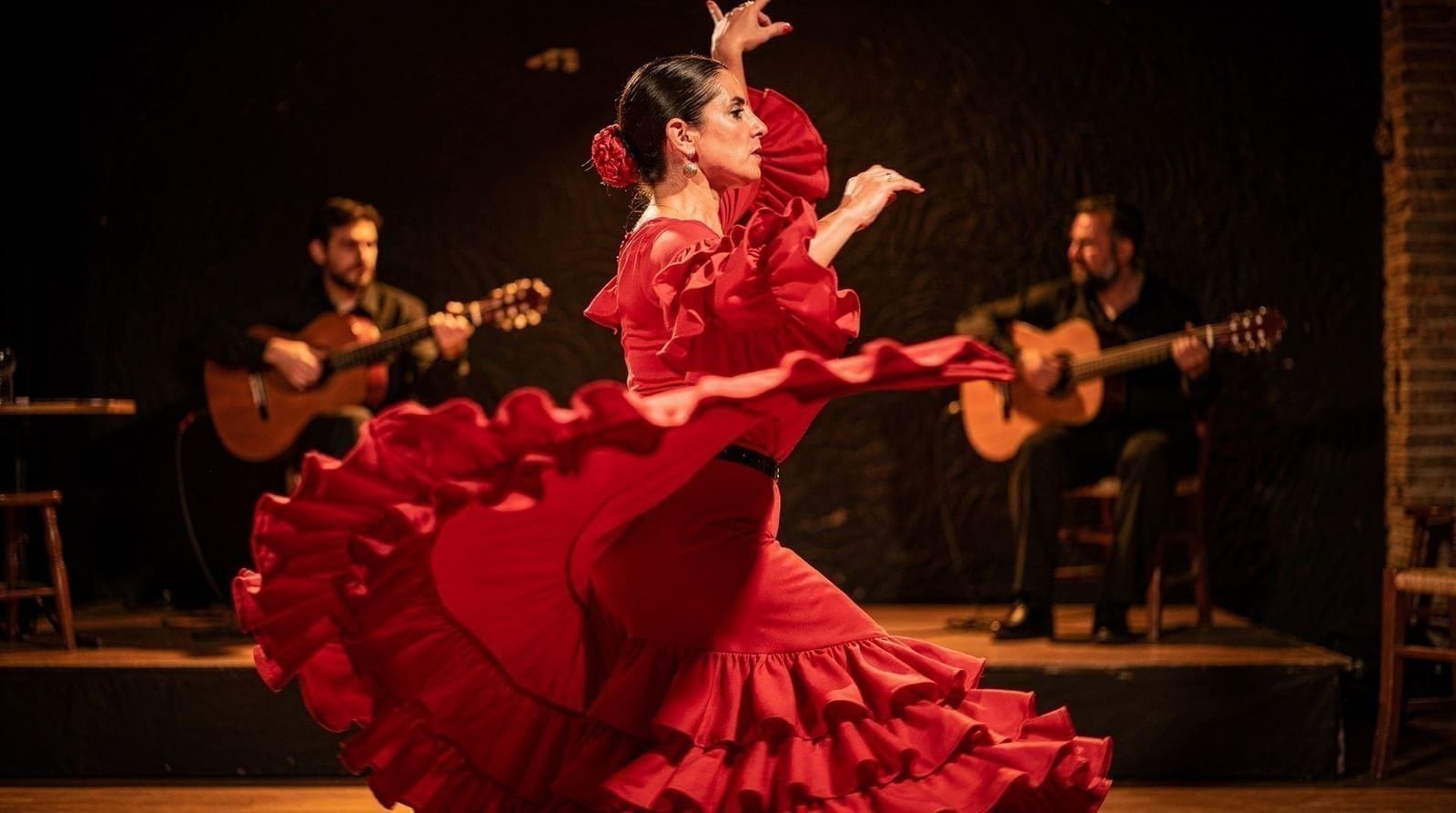
Several tourist-facing class packages include a rented bata de cola (the characteristic long-trained dress) and zapatos de flamenco (flamenco shoes). The experience of wearing the costume adds to the occasion and provides context for how the clothing affects movement — the bata de cola is a performance instrument as well as a garment. If this appeals to you, the costume-inclusive classes are worth the slightly higher price.
For a serious learning focus rather than a photo-oriented experience, a plain-clothes class with good instruction is more useful.
Book flamenco class with costume in SevilleClass formats in Seville
Tourist drop-in classes: Structured for mixed ability and language groups, typically conducted in simple Spanish and/or English. Found through booking platforms and hotel concierges. These are deliberately accessible and focused on producing a satisfying experience in a short time.
Studio drop-in classes: Available at established flamenco academies such as the Estudio Flamenco Belén Maya, Studio de Flamenco Gloria Osuna, and others. These classes are taught to a regular student cohort with occasional visitors. The level is typically higher than tourist drop-in classes; some have a minimum experience requirement.
Private instruction: Available from professional teachers at most studios. Expensive (€60-100/hour) but effective for focused skill development, especially for visitors who already have dance experience in other styles.
Residential courses: Several academies offer multi-day intensive courses (5-10 days) at prices from €300-800 depending on level and accommodation. These are oriented toward people serious about developing flamenco as a practice.
For most visitors wanting a one-time experience, the tourist drop-in classes available through GetYourGuide are the most practical option.
Book a 60-minute beginner flamenco classTiming your class relative to seeing a show
The most effective sequence is to watch a show first and take a class the day after. The class will clarify technical elements you saw the previous evening — the way a dancer uses different footwork sounds, the coordination between hand and foot movements, the effort required to produce the porte.
Doing it in reverse order also has merit: the class sensitises you to technique before you watch it deployed at performance level.
Both orders work better than doing only one and not the other.
Triana versus Santa Cruz: where to take a class
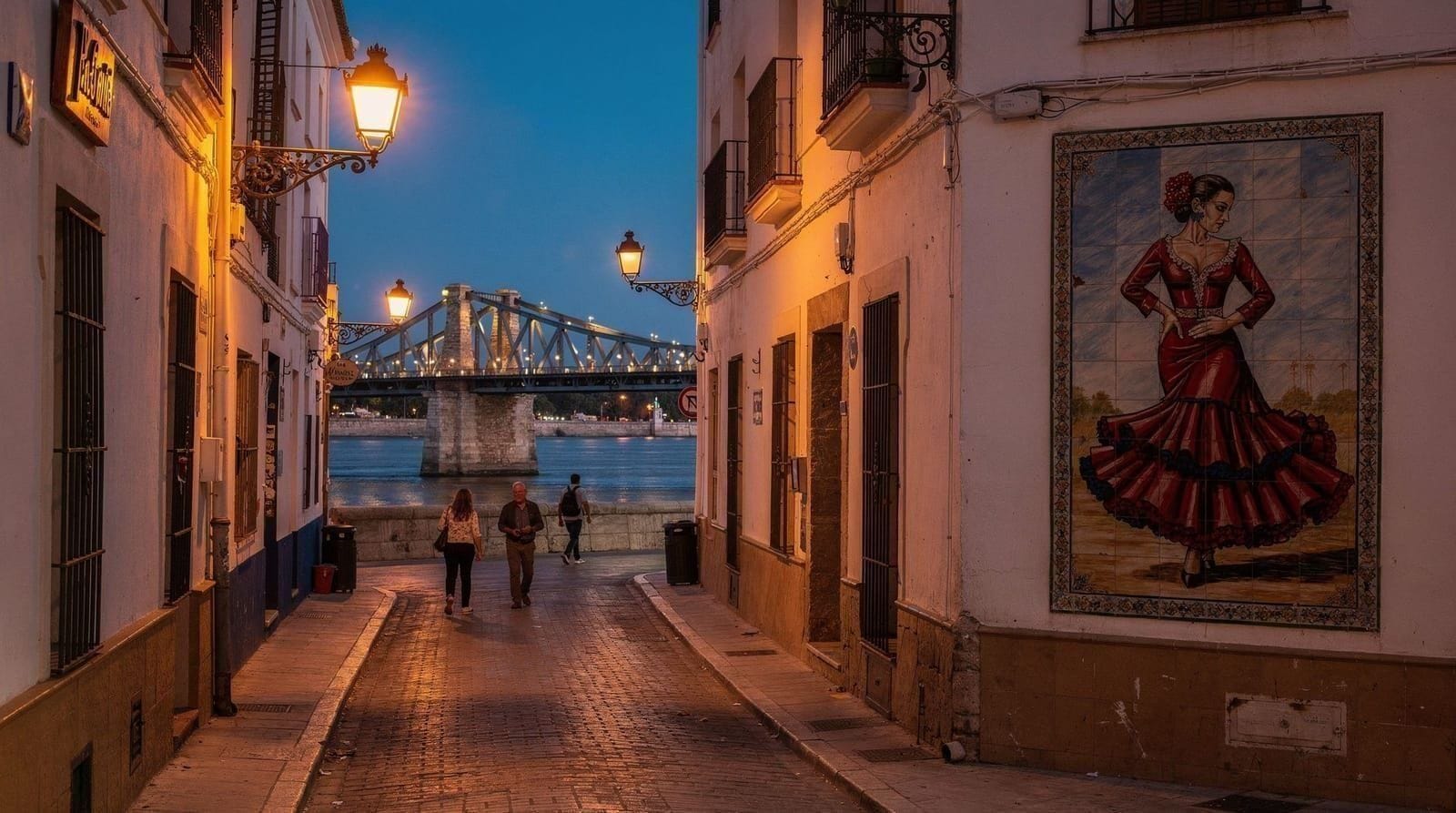
Triana has a deeper historical connection to flamenco practice and the studios there feel less packaged than the Santa Cruz options. If you are in Seville for multiple days and want to combine the class with neighbourhood exploration, the Triana guide covers the district’s flamenco landscape.
Santa Cruz options are more convenient if you are based in the city centre and want to combine the class with a tablao visit at Casa de la Memoria on the same evening. Whichever neighbourhood you choose, checking recent reviews matters more than the location itself — see authentic flamenco vs tourist show for the same underlying logic applied to choosing a class instructor as applies to choosing a show venue.
After the class: what next
A one-hour class provides a foundation, not a conclusion. If you find yourself wanting to continue:
Studio classes during your Seville stay: Most academies allow visitors to drop in on regular weekday classes at a per-session price. Check the academy schedule before arriving.
Online continuation: Several of Seville’s established teachers offer online classes — a practical option for continuing practice after returning home.
Understanding the tradition more deeply: The flamenco 101 guide covers the art form’s musical structure in enough depth to significantly deepen what you experience in both classes and shows. Reading it before a class or show is 15 minutes well spent.
The difference between flamenco and sevillanas
Seville is associated with both flamenco and sevillanas, and visitors frequently confuse them. A brief clarification before taking a class will help you understand what you are actually learning.
Sevillanas is a social folk dance from Seville, performed in couples, with four distinct choreographic sections (coplas). It is danced at the Feria de Abril, at weddings, and at social gatherings throughout Andalusia. The movements — partner-facing footwork, coordinated arm positions, turns at specific moments — are learnable in a few hours and are designed for social dancing rather than artistic performance.
Flamenco is an artistic tradition with complex musical structures (palos), improvised performance within structural conventions, and a depth that takes years or decades to develop at a professional level. It is not a couple’s dance — it is performed solo or in a cuadro (ensemble) with vocalist and guitarist.
Many Seville tourist-class sessions (particularly at festivals or group activities) teach sevillanas rather than flamenco, because sevillanas is more quickly achievable and more directly applicable at the Feria. If you see a group class offered for one evening with “flamenco” in the title that promises you will be dancing by the end, it is likely teaching sevillanas.
Both are worth learning. Knowing which one you are signing up for helps you set appropriate expectations.
What flamenco dance instructors actually teach
Experienced flamenco teachers in Seville will be specific about their artistic lineage — which style of flamenco they trained in, who their teachers were, and which palos they emphasise. Some teachers work primarily in the Seville school (characterised by restraint, groundedness, and emphasis on the soleá form); others in the Jerez school (associated with Gypsy rhythmic tradition) or the Cádiz school (more melodic, with alegrías emphasis).
For a single beginner class, this lineage distinction is largely irrelevant — you will be learning basic braceo, floreos, and simple zapateado regardless. But if you are planning multiple sessions or looking for a continuing teacher, understanding the teacher’s background helps you find appropriate alignment with your own musical interests.
Practical notes for beginners
What to expect physically: Flamenco technique places unusual demands on the lower back (from the porte), the wrists and forearms (from sustained braceo), and the calves and feet (from zapateado). After a first 60-minute class, you will likely have sore calves and forearms the following day — this is normal and a useful souvenir of having worked the right muscles.
Recording during class: Most instructors allow participants to record brief video clips of specific exercises for personal review after the class. Ask before recording, and use the footage for practice rather than for social media (which some instructors prefer not).
Shoes: If you are attending more than two or three sessions in Seville, investing in a basic pair of flamenco shoes (€30-60 from the shoe shops in the Nervión area or from specialists in Triana) is worthwhile. The reinforced heel and toe produce the correct percussion sounds that regular shoes approximate but do not replicate. For a single class, regular hard-soled shoes are fine.
Mirrors: Professional flamenco studios have floor-to-ceiling mirrors on at least one wall. Self-observation in a mirror is important for developing the porte — you cannot feel whether your back is straight, your chin is elevated, and your elbows are correctly positioned. If a studio has no mirrors, the visual feedback loop that professional training relies on is absent.
The Bienal de Flamenco and special classes
The Bienal de Flamenco (September-October in even years; 2026 edition runs 9 September to 3 October) brings additional class opportunities alongside the performance programme. Many major artists offer workshops during the Bienal period — intensive masterclasses of 2-4 hours in specific palos or techniques. These are typically aimed at intermediate and advanced students rather than absolute beginners, but the programme does include introductory workshops.
Prices for Bienal workshops range from €20 for an introductory session to €150+ for a full-day masterclass with a major artist. The programme is published on the Bienal’s website approximately one month before the festival opens.
See Bienal de Flamenco de Sevilla 2026: the complete visitor guide for the full context on Seville’s most important biennial flamenco event.
Making the class part of a bigger flamenco day
A dance class works best as one piece of a fuller flamenco day rather than an isolated activity squeezed between sightseeing. A common and effective sequence: read the flamenco 101 guide in the morning, take a class in the early afternoon while your body and attention are fresh, then attend a show that evening — the vocabulary and physical awareness from the class carry directly into what you notice on stage. If Triana is your chosen neighbourhood for the class, the flamenco in Triana guide covers how to combine it with the area’s market, riverside bars, and tablaos into a single afternoon-to-evening plan.
This sequencing matters more than it might seem. Visitors who take a class in isolation, disconnected from a show, tend to describe it as a fun but forgettable physical activity. Visitors who deliberately connect the class to a show — either before or after — consistently describe it as the single activity that most changed how they experienced Seville’s flamenco scene, because it converts an abstract appreciation of the art form into a felt, physical understanding of why it is genuinely difficult and why the best performers command such respect.
Choosing the show that follows your class
Once you have spent an hour trying to hold the posture, the choice of show matters more, because you will be watching for details you now understand. The best flamenco shows in Seville guide compares the main venues, and flamenco tourist traps explains which formats to avoid if you want the performance to match what your teacher described. For an intimate setting where the dancer’s feet and hands are easy to follow, the Casa de la Memoria review is a good place to start.
Fitting a class into your wider Seville plan
A class takes a small part of a day, so it slots easily into most itineraries. On a short stay, the Seville in two days plan leaves room for an afternoon activity, and the three-day itinerary gives you space to see a show and take a class on consecutive days, which is the sequencing described above. If you are still deciding how long to stay, how many days in Seville helps you weigh it up. For first-time visitors who want the wider picture before booking anything, the first-time travel tips cover the basics.
If you would like to read a visitor’s account of the evening side of this, the first-time flamenco experience blog post describes what it felt like to sit in front of a performance without any background.
Frequently asked questions about Flamenco dance classes in Seville
How much do flamenco classes cost in Seville?
Single beginner sessions run €15-35 depending on venue, group size, and whether costume is provided. Private classes are significantly more: €60-100 per hour. The GYG catalog classes in the €20-30 range offer the best value for one-time visitors. Studio drop-in classes, if you can find them, are often cheaper at €10-15.What should I wear to a flamenco class?
Regular activewear or comfortable clothing that allows movement. Dedicated flamenco shoes (zapatos de flamenco) with reinforced heel and toe are ideal but not required for a single class — hard-soled shoes or low-heeled boots work adequately. Some tourist-oriented class packages include a rented costume (bata de cola) and shoes; this is fun but not necessary for a genuine learning experience.How long does it take to learn flamenco?
Professional flamenco dancers typically train for 10-15 years before performing publicly. A single one-hour class will not teach you flamenco — it will give you a physical introduction to posture, basic arm positions, and simple footwork patterns. That is valuable and achievable. Realistic expectation: after 60 minutes, you will have better empathy for what you watch at a tablao.Are there classes specifically in Triana?
Yes. Several studios in Triana offer classes drawing on the neighbourhood's flamenco heritage. These tend to have a less tourist-packaged feel than Santa Cruz options. The Triana market area (Calle San Jacinto and surroundings) has several dance studios signposted. Quality varies; checking current reviews is advisable.Should I take a class before or after seeing a flamenco show?
Either order works, but watching a show first and taking a class the next day tends to clarify the most — you'll recognise specific footwork and hand movements from the class in what you saw the previous evening. Taking a class first sensitises you to technique before you watch it performed at full speed.
Top experiences
Bookable activities with verified prices and instant confirmation on GetYourGuide.