Cooking classes in Seville: what to expect, where to book, honest assessment
Seville: 3.5-hour Spanish cooking class and Triana market tour
Are cooking classes in Seville worth it?
Yes, for the right visitor — specifically those who want a hands-on food experience rather than just eating. Classes run 3-4 hours, cost €60-90 per person, and typically cover market shopping, cooking 4-6 dishes, and eating what you make with wine. The best classes are based at the Triana market. One honest caveat: most include paella despite paella being a Valencian dish, not Sevillano. Classes focused on tapas are more locally accurate.
Cooking classes in Seville are, for the right type of visitor, one of the better half-day activities available. They combine food market experience, hands-on cooking, a meal with wine, and genuine skill transfer — in three to four hours, you come away knowing how to produce several dishes that are not obvious to cook well at home.
| Cost | Around €60-90/person |
| Length | 3-4 hours |
| Includes | Market visit, cooking session, meal with wine |
| Best format | Triana market-based classes |
| Group size | 8-16 typical; 6-8 more hands-on |
This guide covers what is available, what you will actually do and learn, and a few honest caveats about what some classes claim versus what they deliver.
What happens in a Seville cooking class
Most classes follow a standard structure:
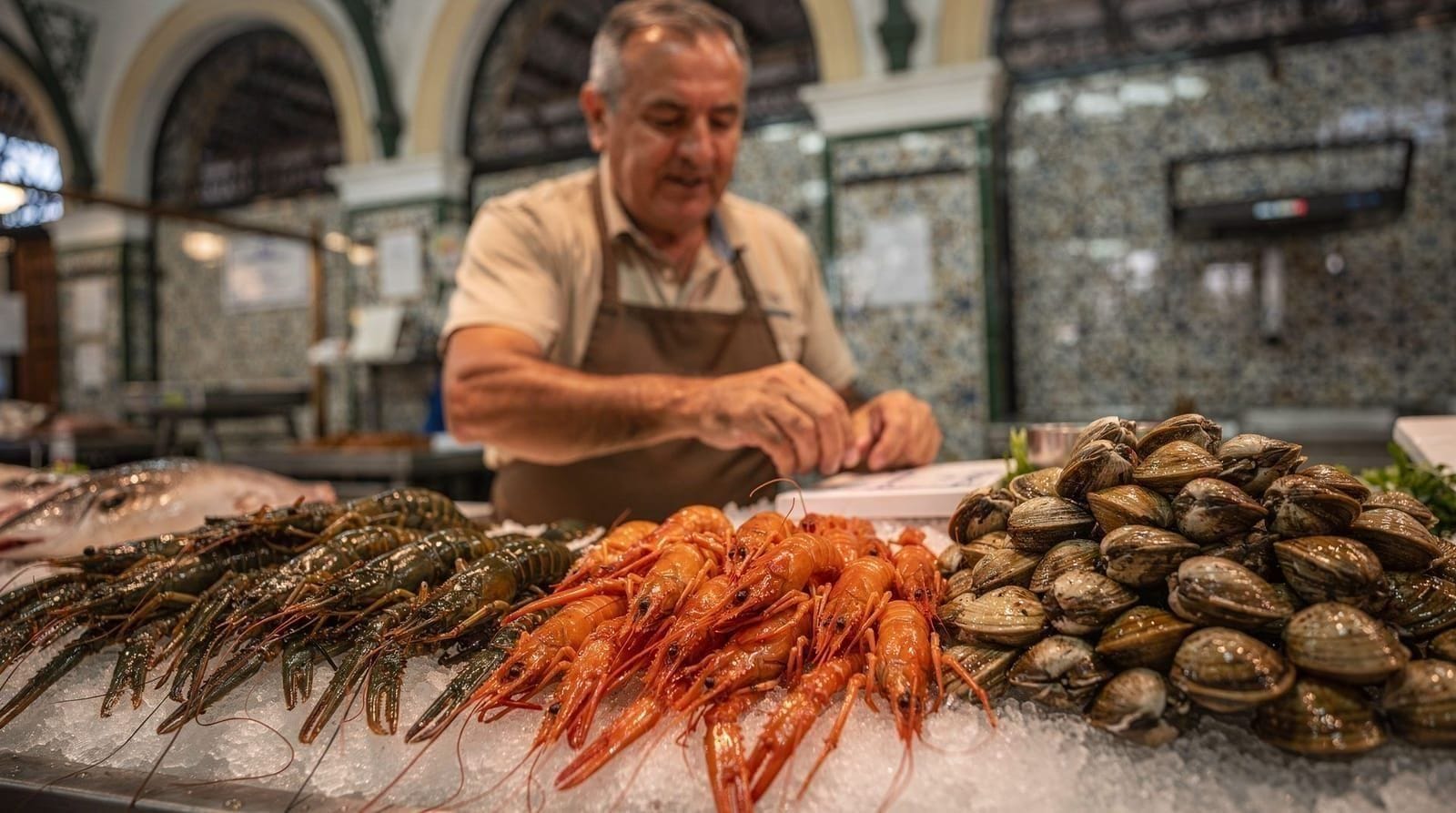
Market visit (45-60 min): The instructor leads the group through a market — ideally the Mercado de Triana, though some use the Mercado de la Encarnación or other venues. You select ingredients alongside the guide, who explains seasonal produce, quality indicators, and local suppliers. This is genuinely useful if the guide has real market relationships — vendors who respond to the instructor by name are a good sign.
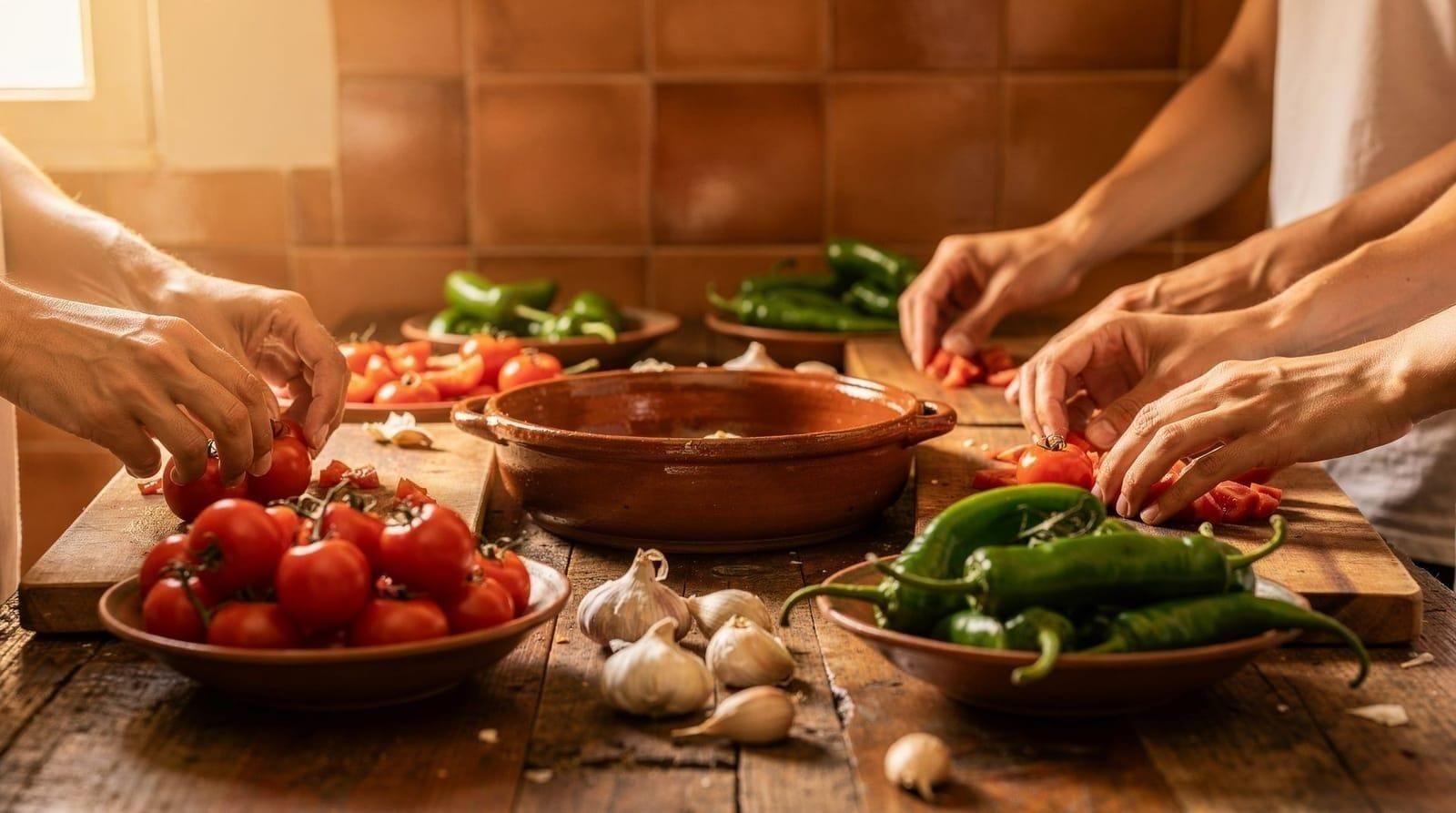
Cooking session (90-120 min): In a kitchen (sometimes a purpose-built classroom, sometimes a restaurant kitchen during off-hours, occasionally a rooftop terrace with a portable setup), participants cook 4-6 dishes with instruction. The level of hands-on participation varies significantly by class — some have everyone cooking actively, others are more demonstration-focused with occasional participation.
Meal (60-90 min): You eat what you cooked, with wine included. This is an important part of the experience — not just because the food is good, but because eating in the context of having just cooked it reinforces the learning.
Triana market classes: the best format
The Mercado de Triana is the most rewarding market context for a cooking class. Unlike the Mercado de la Encarnación (Setas de Sevilla), which has become partly tourist-oriented, the Triana market retains a significant local clientele. Arriving with a local instructor who knows the vendors gives you access to conversations and ingredient quality that self-guided visitors do not get.
The class structure that starts at the Triana market then cooks in a Triana kitchen — whether a dedicated kitchen space or a local restaurant’s facilities — produces the most immersive experience.
Book cooking class starting at Triana marketWhat you will learn
The core dishes covered in most Seville cooking classes are genuinely useful home cooking skills:
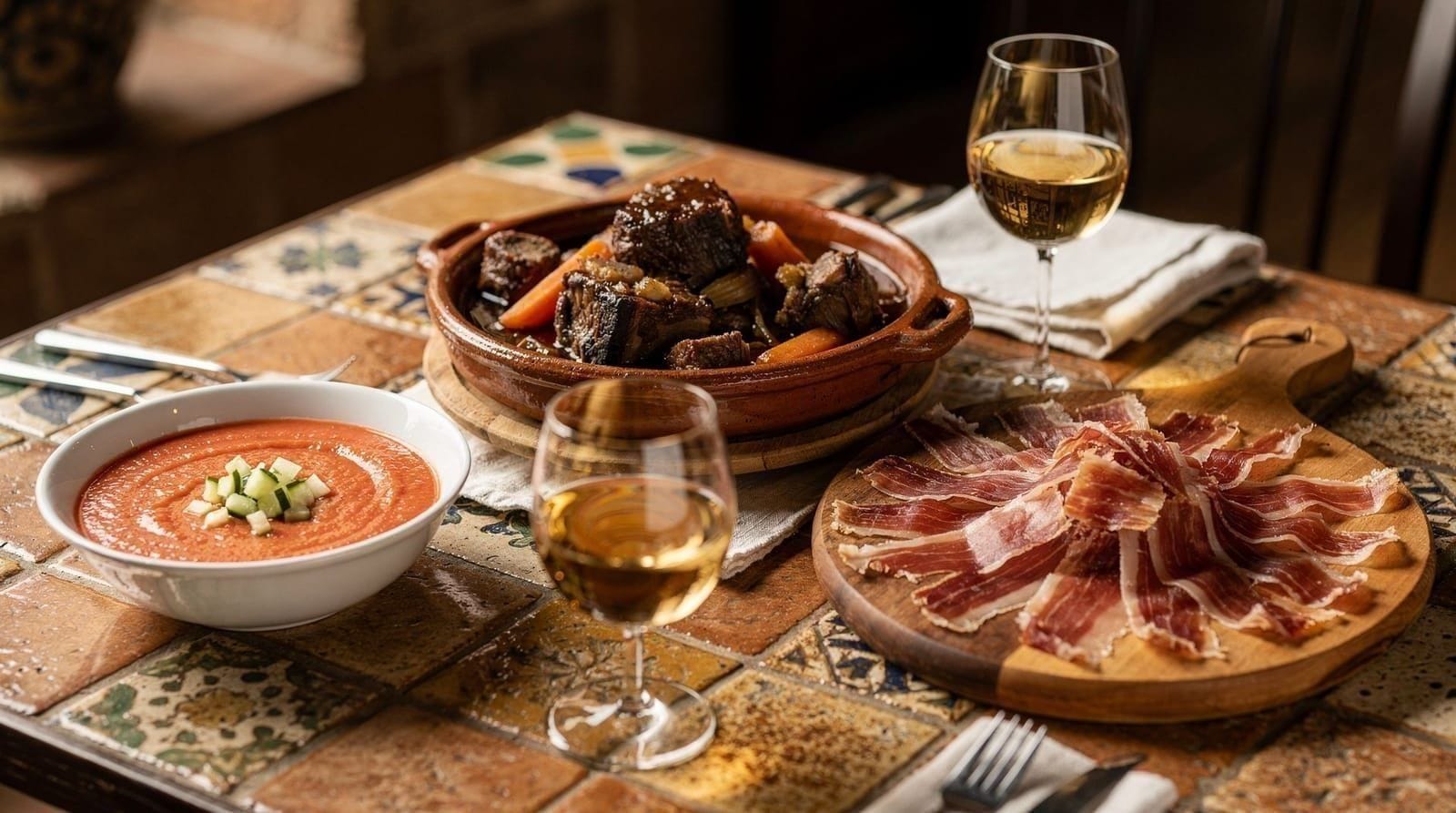
Gazpacho: Cold tomato soup made from blended raw tomatoes, pepper, cucumber, garlic, bread, sherry vinegar, and olive oil. Sounds simple; the balance of acidity, fat, and vegetable flavour is not. Learning the ratios and the texture (should be completely smooth) transfers directly to home cooking.
Salmorejo: A Córdoban cold soup thicker than gazpacho, made primarily from tomato, bread, garlic, and olive oil, topped with hard-boiled egg and jamón ibérico. Less well known to international visitors but arguably more interesting technically.
Tortilla española: The egg and potato omelette that constitutes one of Spain’s most consumed dishes. The technical challenge is the potato texture (cooked but not fried-crisp) and the flip — cooking both sides of a thick omelette requires the right pan and nerve. Understanding this at a class is more useful than a written recipe.
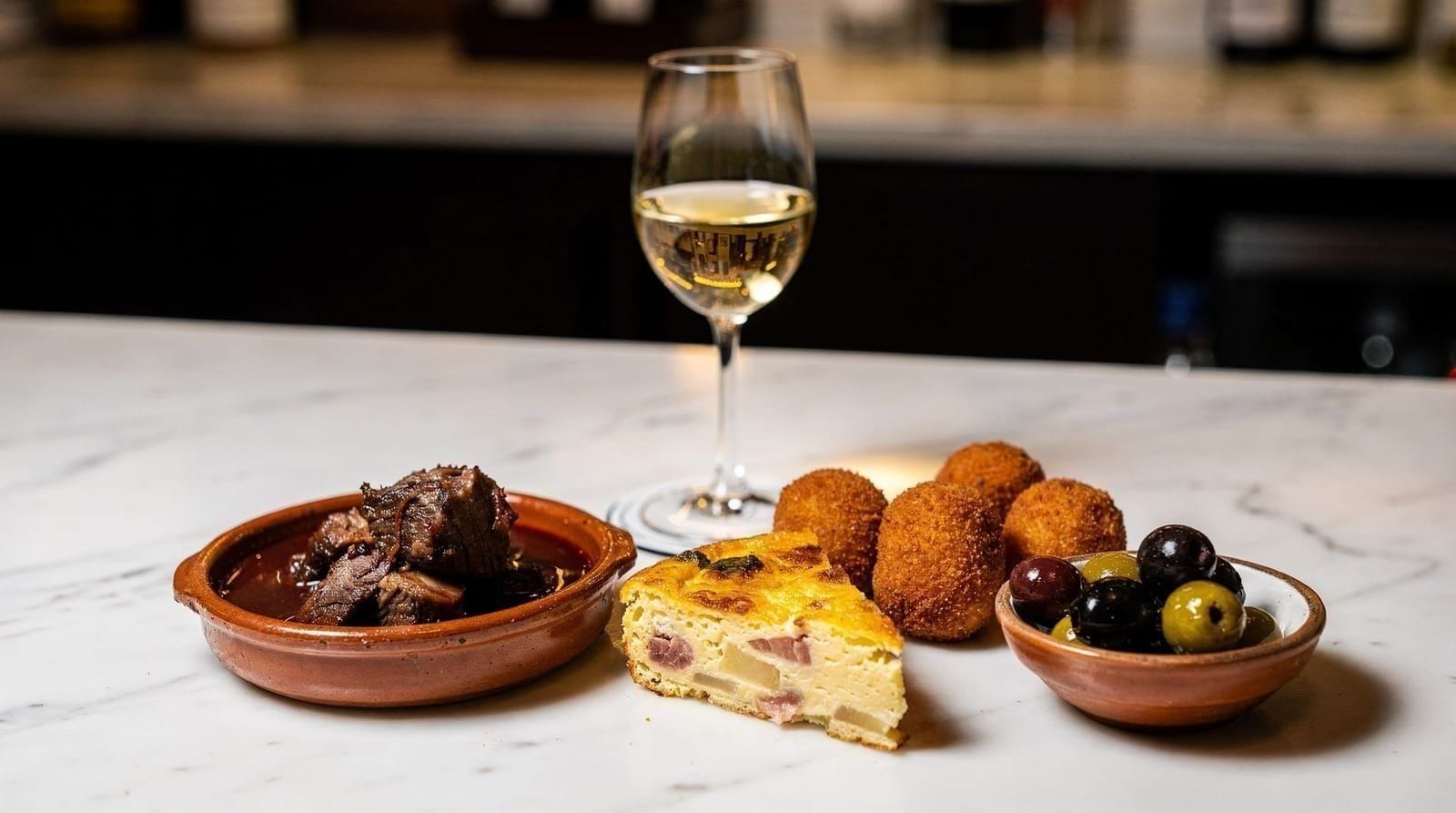
Tapas: Patatas bravas (fried potato with spicy tomato sauce and aioli), gambas al ajillo (prawns in olive oil and garlic), croquetas (béchamel croquettes), and one or two others depending on the class programme.
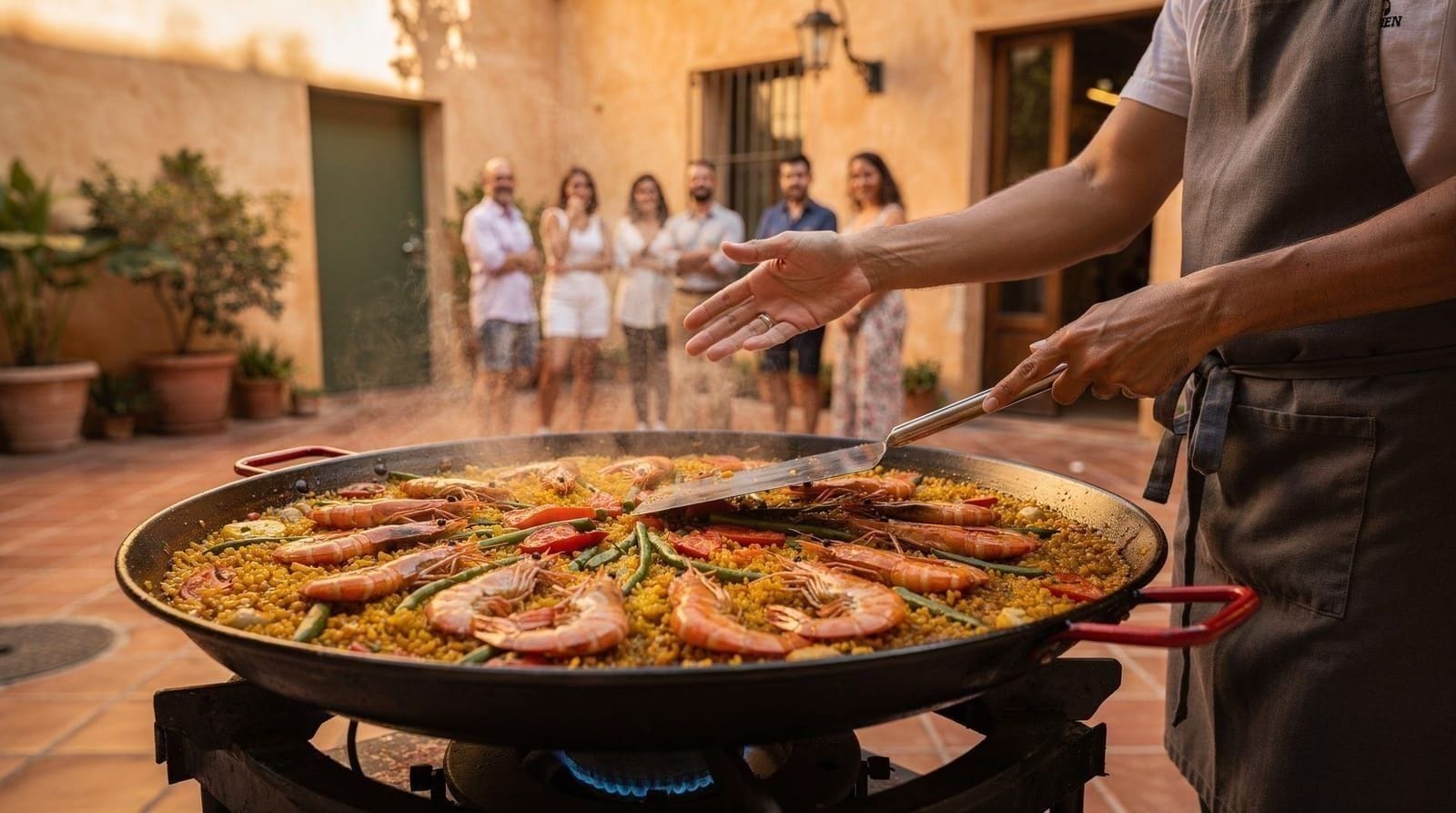
The paella question: Almost every tourist cooking class in Seville includes paella. As noted in the FAQ, paella is not a Sevillano dish — it is from Valencia. Classes that include it are responding to tourist expectation rather than local culinary tradition. The paella section is often the weakest part of Seville cooking classes for this reason — instructors are sometimes not particularly expert in it.
If you specifically want to learn authentic Sevillano food, look for classes that lead with tapas and explain that they are leaving paella out. If you want to learn paella, a dedicated paella class (see Paella cooking class in Seville: what to expect and honest context) teaches it with appropriate focus.
Class formats: what the different products actually are
Tapas-and-cooking classes: The most locally accurate format for Seville. Focus on tapas, gazpacho, and Andalusian dishes. Usually 3-3.5 hours.
Book tapas cooking class in SevilleFull cooking classes with dinner: Longer format (4 hours+), includes a full dinner rather than just tapas. More substantial as an evening activity.
Book Spanish cooking class with dinner in SevilleRooftop cooking classes: Cooking outdoors on a rooftop terrace with views of Seville. More photogenic, slightly less kitchen-focused. Good option in cooler months (October-May); hot and intense in summer.
Who benefits most from cooking classes
Cooking classes work best for:
- Visitors who cook seriously at home and want to understand the techniques behind dishes they have eaten
- Small groups (couples, families) who want a shared activity rather than passive tourism
- People on longer Seville stays (3+ days) who have already covered the major monuments
- Food-motivated travellers for whom markets and kitchens are natural environments
Cooking classes work less well for:
- Visitors with very limited time in Seville (a half-day on a 2-day trip is a significant commitment)
- People who cook rarely and will not replicate the dishes at home
- Anyone who strongly dislikes group activities with strangers
At €60-90 per person for 3-4 hours including market, cooking, and a meal with wine, cooking classes are broadly good value — the per-hour cost is competitive with most guided tours, and you end up with actual skills rather than just information.
The market component: what makes it meaningful
The Triana market is not a food hall arranged for tourists. It has a permanent fish hall (pescadería), a meat section, a fruit and vegetable area with seasonal produce that changes weekly, and a set of bar counters where local shoppers eat and drink between purchases.
Walking through it with a guide who can identify seasonal produce (the white asparagus in spring, the late-season tomatoes ideal for gazpacho, the variety of olive oil available from different producers) is genuinely different from walking through it as a tourist. The difference is the same as the difference between visiting a winery with a winemaker and visiting it as a self-guided tourist.
The Triana market food guide covers the market in more detail, including the bar counters and eating options if you want to visit independently.
Seasonal considerations for cooking classes
What you cook varies with the season, and this is a genuine advantage of Seville cooking classes over recipe-book learning:
Spring (March-May): White asparagus, broad beans (habas), artichokes, and late-season citrus. A spring cooking class in Seville might include habas con jamón (broad beans with ham) or an asparagus tortilla. The orange blossom on the city’s streets is edible — some instructors incorporate it into desserts.
Summer (June-August): Gazpacho season. Tomatoes are at peak ripeness (the variety grown in Andalusia’s hot dry summers concentrates sugar in ways that cool-climate tomatoes cannot match). Summer classes centre on the cold soups and fresh vegetable dishes that constitute a genuinely local summer diet.
Autumn (September-October): Mushroom season, game, and the transition to heartier dishes. Some instructors include arroz caldoso (the local wet rice dish) in autumn programmes.
Winter (November-February): Bean and pulse dishes, callos (tripe stew), and the richer cooked preparations that replace the cold soups of summer. A winter cooking class in Seville is more likely to include a slow-cooked stew than a cold soup.
The instructor question: what to look for
A cooking class is only as good as the instructor. Specific things to evaluate:
Market relationships: Does the instructor have actual relationships with vendors, or are they moving through the market as a tour guide? A vendor who recognises your instructor by name, saves them specific products, and gives them access to produce not on general display is a genuine market relationship.
Personal cooking background: Is the instructor a trained cook, a chef, or someone who teaches primarily for tourist classes? The best instructors are those who cook this food in their own homes and at restaurants — the class is an extension of their genuine culinary practice.
Language quality: An instructor whose English (or other language) is barely communicable may have excellent culinary knowledge but a limited ability to explain technique. The best class instructors are fluent enough in English to explain not just the steps but the why behind each decision.
Group dynamics: A skilled instructor manages a group of 10-12 people of varied skill levels, keeping everyone engaged and active. Watch reviews that mention specific techniques being explained badly or participants left waiting.
What happens if something goes wrong in the class
Cooking classes in Seville have a relatively low risk of genuinely bad experiences — the format is robust and the financial incentive to provide a satisfying outcome is strong for operators. But a few things occasionally disappoint:
The mise-en-place problem: Some classes provide completely pre-measured and pre-prepared ingredients (mise-en-place fully in place). This is convenient but reduces the learning value — measuring and preparing your own ingredients is part of understanding the proportions. Ask when booking whether you will be measuring ingredients or whether they are pre-measured.
Group size inflation: A class advertised for 10-12 participants that runs with 20 becomes a demonstration rather than a participatory experience. This is the most common source of negative reviews for Seville cooking classes.
The recipe card as substitute: A recipe card given at the end of the class is a useful supplement but should not be the primary learning mechanism. If the class relies on participants reading a card rather than the instructor demonstrating and explaining, the quality is lower.
Combining a cooking class with other food experiences
The most rewarding food-focused day in Seville might include:
Morning: Triana market visit (shopping for ingredients with an instructor or independently)
Late morning: Cooking class (11:00-14:00 typically)
Early afternoon: Eat what you cooked (the meal component of the class)
Late afternoon: Walk through the Arenal neighbourhood to some of the traditional tapas bars — El Rinconcillo (reportedly Seville’s oldest bar, 1670), Bodega Santa Cruz, or others with established reputations
Evening: A glass of fino or manzanilla at a traditional sherry bar before dinner
This structure gives you the market, the cooking technique, a made meal, and the context of eating out in Seville’s traditional bars — a reasonably complete picture of the city’s food culture in a single day.
For the tapas-specific recommendations: Best tapas in Seville: a guide to eating well without getting ripped off and Best tapas bars in Santa Cruz: where to eat in Seville’s tourist quarter cover the specific venues in detail.
The food tour alternative
Visitors who want to understand Seville’s food culture without cooking it themselves can take a food walking tour — 3-4 hours visiting multiple tapas bars and food markets with a guide who explains the history and character of each stop. Food tours are generally less expensive than cooking classes (€50-70 versus €65-90) and cover more of the city’s range of eating options. The skills are different: a food tour teaches you what to order and where; a cooking class teaches you how to produce it.
For food tours specifically, the Seville tapas tours guide compares the main options available.
Booking timing and what to expect on confirmation
Most operators confirm cooking class bookings quickly, but the actual meeting point and market logistics vary more than for a standard ticketed monument visit — some classes meet directly at the market entrance, others start at a separate kitchen location with a short walk to the market as part of the class. Read the confirmation email carefully rather than assuming; turning up at the wrong location is a genuine and avoidable way to lose the first 20-30 minutes of a class you’ve paid for. If in doubt, message the operator the day before to confirm the exact meeting point.
Morning vs afternoon classes
Most Seville cooking classes run as a late-morning session (roughly 10:00-14:00 or 11:00-15:00), which works well because it doubles as lunch and leaves the afternoon free for sightseeing or rest. A smaller number of operators run evening classes ending in dinner instead — useful if your mornings are already committed to monuments like the Alcázar or Cathedral. Evening classes tend to run slightly later into the night (finishing around 21:00-22:00), which is worth factoring in if you have an early departure the next day.
Vegetarian and dietary considerations
Most Seville cooking classes can accommodate vegetarians reasonably well — gazpacho, salmorejo (though traditionally topped with jamón, easily served without), tortilla española, and several tapas are naturally vegetarian or simple to adapt. Vegan and gluten-free adaptations are more variable between operators; it’s worth messaging the operator directly before booking rather than assuming. For a broader picture of how Seville handles dietary restrictions beyond the cooking-class format, see the vegetarian and vegan Seville guide.
Solo travellers and cooking classes
Cooking classes are one of the more sociable activities available to solo travellers in Seville — the shared table at the end of the class, eating what the group has cooked together, naturally produces conversation in a way that a solo restaurant meal doesn’t. If travelling alone and looking for a way to meet other travellers without a bar-crawl format, a mid-sized class (8-12 people) is a reliable option worth considering alongside more typical solo-traveller activities like walking tours.
How this compares to just eating well in Seville
Not every food-motivated traveller needs a cooking class to have a great food trip. If your time is limited, prioritising well-chosen meals — see where to eat in Seville and traditional Andalusian dishes — may deliver more food satisfaction per hour than a half-day cooking class. Classes are best reserved for travellers with the time to spare and a genuine interest in technique, not as a default “food activity” box to check.
Where a cooking class fits in your Seville plan
A cooking class sits most comfortably on a day that is otherwise light. If you are still shaping your stay, the Seville itinerary planning guide helps you decide which days can absorb a long, relaxed activity, and the 3 days for foodies itinerary shows one way to build a trip around eating, markets, and a class. Travellers working out how long to stay can start with how many days in Seville.
Because the class is based in or near Triana, it pairs naturally with an afternoon in the neighbourhood. The Triana neighbourhood guide covers what to see once the meal is over, and it is a gentle way to walk off lunch rather than heading straight back to a monument queue.
If you are travelling with children, ask the operator whether younger participants are welcome before booking; the Seville with kids guide has wider context on what suits families. And if you have decided you want a deeper, more dish-focused experience, the Spanish cuisine learning guide looks at other ways to learn Spanish cooking in the city.
Frequently asked questions about Cooking classes in Seville
What do you cook in a Seville cooking class?
Typical programmes cover gazpacho (cold tomato soup), salmorejo (thicker cold tomato and bread soup, from Córdoba), tortilla española (egg and potato omelette), various tapas (patatas bravas, croquetas, gambas al ajillo), and often a paella. Some classes substitute the paella with other rice or protein dishes. All classes include wine and the meal.Is paella authentically Sevillano?
No. Paella is a Valencian dish from the Valencia region on Spain's east coast. It is not a traditional Seville or Andalusian dish. Serving paella in Seville cooking classes is done to meet tourist expectations, not because it reflects local cuisine. If you want a genuinely Sevillano cooking experience, look for classes that emphasise tapas, gazpacho, salmorejo, and pescaíto frito (fried fish). Some classes flag this honestly.Where are cooking classes typically held in Seville?
The best classes are based at or near the Mercado de Triana, which gives the market-shopping component real substance — you shop for ingredients from actual vendors before cooking. Some classes are held at rooftop terraces in the city centre. Classes based in purpose-built kitchen spaces without a market component tend to be more generic.How large are cooking class groups in Seville?
Most tourist cooking classes run with 8-16 participants. Smaller classes (6-8) are more hands-on and more expensive. Classes of 12+ tend toward demonstration-style with less individual participation. If hands-on cooking matters to you, check the group size before booking.Is Spanish a barrier in Seville cooking classes?
No. All tourist-facing cooking classes in Seville are conducted in English (and often multiple languages). The chef/instructor will explain in English throughout. Having some basic Spanish vocabulary for market shopping is useful but absolutely not required.Should I book a rooftop cooking class or a market-based one?
Market-based classes at Triana give a more grounded, locally rooted experience and generally better ingredient quality, since you're shopping alongside the instructor. Rooftop classes trade some of that authenticity for atmosphere and views, which suits visitors prioritising a memorable setting over depth of local context. In hot summer months, a rooftop class can also be less comfortable than an indoor kitchen.
Top experiences
Bookable activities with verified prices and instant confirmation on GetYourGuide.