One week in Andalusia from Seville: 7-day itinerary
Seville: Royal Alcázar entry ticket
Why Seville makes the ideal base for a week in Andalusia
Seville sits at the geographical and cultural heart of Andalusia. From Santa Justa station, the AVE reaches Córdoba in 45 minutes and Málaga in under two hours. Cádiz is 1h40 by train; Jerez 1h10. Ronda is two hours by bus. Only Granada (2.5 hours) requires a longer journey — and it is worth it.
Staying in Seville throughout the week simplifies everything: one check-in, no bag-hauling across Andalusia, and a home base you understand well by the end of the trip. The alternative — moving hotels between cities — adds logistical friction without meaningful advantages for most itineraries.
This seven-day plan allocates three full days to Seville and four day trips. Days are structured to match travel times and energy levels: the most demanding day trips (Granada, Ronda) fall mid-week when you’re oriented but not yet tired.
| Where | Seville, with day trips to Córdoba, Granada, Ronda, Cádiz/Jerez |
| Duration | 7 days, one base, no hotel changes |
| Cost | around €750–1,000/person excl. flights (mid-range) |
| Getting around | AVE trains and buses from Seville, no car needed |
| Best time | March–May or October–November |
Compare this fixed-base plan against the Seville–Córdoba–Granada trip itinerary, which trades the single-base convenience for overnight stops in each city — useful if you’d rather sleep closer to the Alhambra than commute to it.
Day 1: Arrival and the monumental core
Practical first-day logistics
If you’re arriving by air, there is no train to the airport: the EA airport bus (€6 one way) takes about 35–40 minutes to the centre. Taxis take 15–20 minutes and cost €26–29.
Check into your accommodation in the historic centre (Santa Cruz, El Arenal, or Centro are all walkable to the Alcázar). Most hotels allow luggage drop before check-in time.
Morning (9:30–13:00): Alcázar
The Royal Alcázar is the essential first-day monument. Book a timed skip-the-line ticket before you travel.
Royal Alcázar skip-the-line entry ticket — €14.50Key rooms: Patio de las Doncellas, Salón de Embajadores, upper royal apartments. The gardens take 20–30 additional minutes. Allow a total of two to three hours.
Afternoon (14:30–18:30): Cathedral, Santa Cruz, and Plaza de España
Cathedral and Giralda entry ticket — €12Cathedral (90 minutes including Giralda tower climb). Then a walk through Santa Cruz — Callejón del Agua, Plaza de Doña Elvira — and south to Plaza de España. The 25-minute walk through María Luisa Park is excellent in the late afternoon light.
Evening: First tapas and flamenco
El Rinconcillo (Gerona 40) for aperitivos. Flamenco at Casa de la Memoria — book an evening session.
Casa de la Memoria flamenco showDay 2: Triana, river, and Seville neighbourhood life
Morning: Triana market and neighbourhood walk
Cross to Triana at 9:00. Mercado de Triana for breakfast. Walk Calle San Jorge and Calle Alfarería for ceramic workshops. Centro Cerámica Triana for context on the neighbourhood’s 500-year tile tradition.
Afternoon: River cruise and Macarena
Guadalquivir river cruise from Torre del Oro at 16:00.
After the cruise, head north to the Macarena neighbourhood: Basílica de la Macarena (free, the Virgen de la Esperanza Macarena), the Almohad walls, and the Metropol Parasol rooftop (from €16, 360-degree city views).
Evening
Eslava (Calle Eslava 3) for creative tapas. Or a quiet dinner at a local restaurant on Calle Feria.
Day 3: Córdoba by AVE
Córdoba is the easiest and most rewarding day trip from Seville. The 45-minute train journey makes it entirely comfortable.
Córdoba day trip with Mezquita by high-speed trainDepart Seville: 7:30–8:00 from Santa Justa by AVE.
9:00–11:00: Mezquita-Catedral (€15, book online). The hypostyle hall with 856 columns is unlike anything else in Europe. The Catholic cathedral built inside the mosque during the 15th century — straddling the precise centre of the Islamic prayer hall — is one of the most historically charged buildings in the world.
11:00–13:00: Jewish Quarter — the 14th-century Synagogue (free), Calleja de las Flores, Alcázar de los Reyes Cristianos with its Roman mosaic collection and gardens.
13:30: Lunch at Casa Mazal (Tomás Conde 3) or Bar Santos (Magistral González Francés 3).
15:30: Optional visit to Medina Azahara (10 km, bus from Glorieta Ibn Rushd). The 10th-century ruined palace city of the Umayyad Caliph Abd al-Rahman III. Worth it if you have time.
17:30: Return to Córdoba station. Back in Seville by 18:30.
Full guide: Córdoba day trip from Seville.
Day 4: Granada and the Alhambra
Granada is the longest day trip from Seville — about 2.5 hours each way by bus — but the Alhambra justifies the journey entirely. Book Alhambra tickets months in advance; the Nasrid Palaces sell out weeks ahead.
Granada day trip with Alhambra and AlbaicínDepart Seville: 7:00 by bus from Plaza de Armas station (ALSA bus), or take a guided tour. Bus tickets: approximately €25 return. Journey: 2.5 hours.
10:00–14:00: Alhambra complex. The Nasrid Palaces (your timed ticket determines which 30-minute window you enter — do not miss it or you lose entry). Then Alcazaba fortress, Generalife gardens. Allow four hours minimum.
14:30: Lunch in the Albaicín. The Moorish hilltop neighbourhood across the gorge from the Alhambra has several good restaurants. Try Arrayanes (Cuesta Marañas 4) for North African-inspired Andalusian food, or any mirador café with views over the Alhambra.
16:00: Walk the Albaicín. Narrow streets, whitewashed houses, the Mirador de San Nicolás for the best panoramic view of the Alhambra. Allow 90 minutes.
18:00: Depart Granada. Back in Seville by 20:30. Dinner locally.
Full guide: Granada day trip from Seville.
Day 5: Seville city — palaces and food culture
After two demanding day trips, Day 5 returns to the city at a slower pace.
Morning: Casa de Pilatos and the historic quarter
Casa de Pilatos (Plaza de Pilatos 1, €12) — the most underrated palace in Seville. Mudéjar-Renaissance hybrid, extraordinary lower court, significantly less crowded than the Alcázar. Allow 90 minutes.
Then walk through the Barrio de Santa Cruz at a slower pace than Day 1: sit at Plaza de Doña Elvira, visit the Hospital de los Venerables (check the official website for current prices, outstanding Baroque church with Valdés Leal frescoes).
Afternoon: Guided food tour
A guided tapas tour is the most effective way to understand Sevillano food culture — the bar tradition, the sherry culture, the seasonal produce of Andalusia.
Seville food tour — tastes, tapas, traditionsMost tours run 2.5 hours and cost €75–90 per person including all food and drink. Worth booking on a non-day-trip day.
Evening: Sherry tasting
Finish the evening with a structured sherry tasting: fino, manzanilla, amontillado, oloroso, and PX are all produced within 90 km of Seville. A guided session with food pairings takes 90 minutes and costs around €35–45.
Day 6: Ronda and the white villages
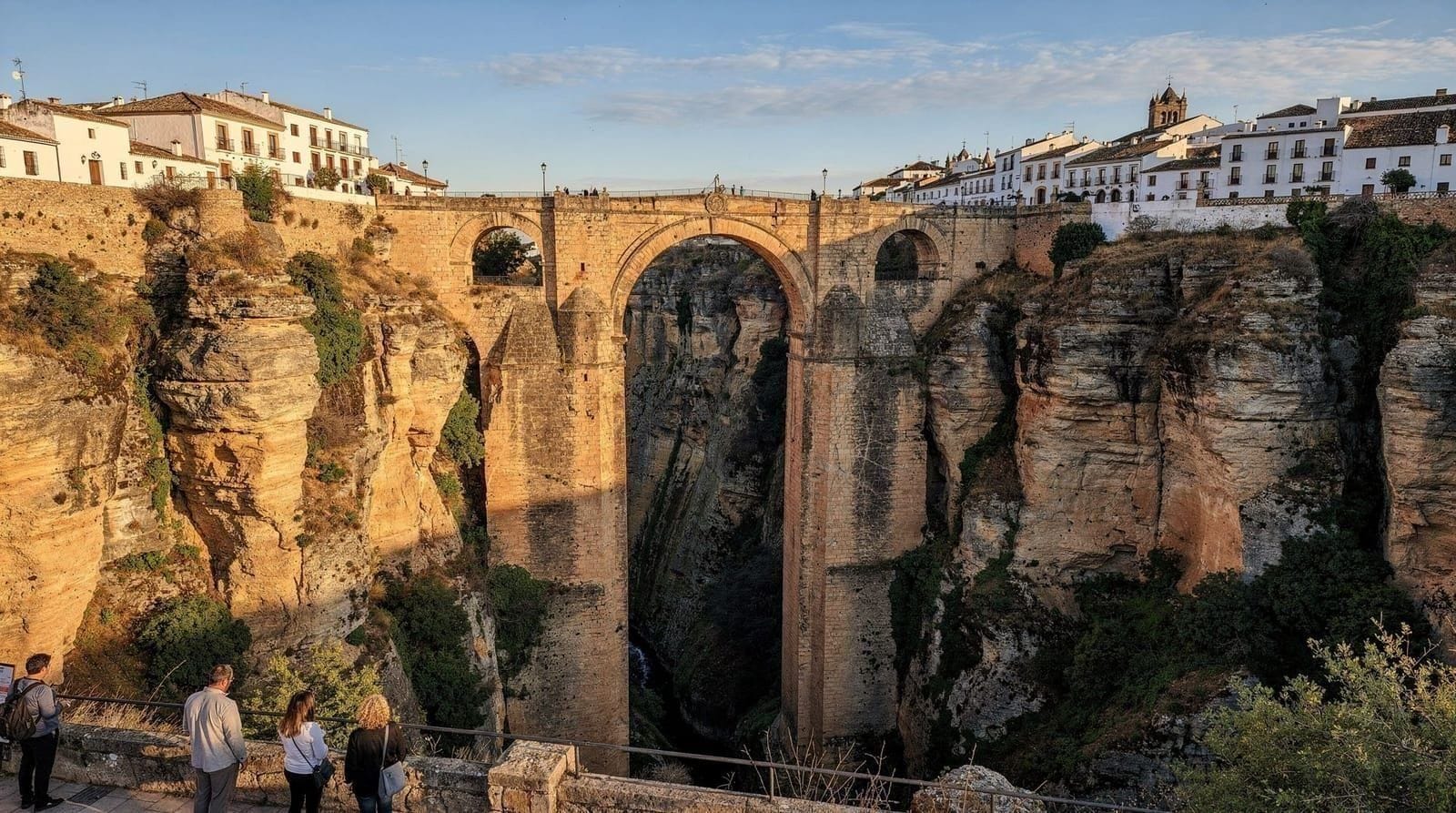
Ronda is built on the edge of a 120-metre gorge in the Serranía de Ronda. The dramatic landscape and the Puente Nuevo bridge make it the most visually distinctive day trip from Seville.
Ronda full-day trip from SevilleDepart Seville: 7:30 by bus from Plaza de Armas (Casal bus, €20 return), or join a guided tour.
9:30: Arrive Ronda. Walk directly to the Puente Nuevo — the views over the Tajo gorge from the bridge and from the gardens below are the reason most people come.
10:30–12:30: La Ciudad (old town) — Arab Baths (€4.50), Palacio de Mondragón (€3), the 18th-century Maestranza bullring (€10, oldest in Spain).
13:00: Lunch. Tragabuches (José Aparicio 1) for modern Andalusian. Pedro Romero (Virgen de la Paz 18) for traditional.
15:00: Alameda del Tajo gardens and cliff-top walk. The Serranía de Ronda valley stretches for 40 km in clear visibility. If the tour includes a white village stop (Setenil de las Bodegas is the most striking — houses built under a rock overhang), take it.
18:00: Return to Seville. Final dinner in town.
Full guide: Ronda day trip from Seville.
Day 7: Cádiz or Jerez — the Atlantic coast
For the final day, head southwest to the Atlantic coast. Cádiz and Jerez are different in character but both within easy reach.
Option A: Cádiz
Cádiz is one of the oldest continuously inhabited cities in Western Europe. The old city sits on a narrow peninsula extending into the Atlantic — the light, the sea air, and the architecture are completely different from the inland Andalusian cities. From the Tavira Tower observation deck, you can see both the Atlantic and the Bay of Cádiz simultaneously.
Train from Santa Justa to Cádiz: 1h40, fare on the Renfe website. Walk the old city: Catedral (€12), Mercado Central for lunch, the city beaches (Playa de la Caleta). Depart 17:00, back in Seville by 19:00.
Cádiz full-day guided excursion from SevilleOption B: Jerez de la Frontera
Jerez is the home of sherry wine and Andalusian horses. The Real Escuela Andaluza del Arte Ecuestre (Royal School of Equestrian Art) puts on a world-class horse show on Thursdays at 12:00 and occasionally on Tuesdays (check the current schedule). The González Byass bodega tour (€25, with tastings) is excellent. Train from Seville: 1h10.
Full guide: Cádiz day trip from Seville.
Full week logistics
Booking in advance
| What | Book when |
|---|---|
| Alhambra (Granada) | 2–3 months ahead, especially in spring |
| Alcázar Seville | 3–7 days ahead |
| Cathedral Seville | 2–3 days ahead |
| Casa de la Memoria | 3–5 days ahead |
| AVE trains | 2–4 weeks ahead for best prices |
| Food tour | 2–3 days ahead |
Where to stay
The historic centre of Seville (Santa Cruz, El Arenal) keeps you within 10 minutes’ walk of the Alcázar and Cathedral and a short taxi/bus to Santa Justa. Mid-range hotels: €90–130/night. The Macarena neighbourhood (north of centre) is 10% cheaper and still very walkable.
Getting around on day trips
Córdoba, Cádiz, and Jerez: AVE/train from Santa Justa. Granada and Ronda: Bus from Plaza de Armas station (or guided tour). All day trips are feasible without a car. See the getting around Seville guide for metro, tram, and bus options within the city.
For a more relaxed week that includes overnight stays in Córdoba and Granada, see the Seville–Córdoba–Granada trip itinerary.
Planning a week in Andalusia: what to know
The best day-trip order
The sequence in this itinerary — Córdoba Day 3, Granada Day 4, Ronda Day 5, Cádiz Day 6 — is designed around energy levels and logistics. Here is why:
Córdoba on Day 3: By Day 3 you know Seville well and are settled. Córdoba is the easiest day trip (45 min AVE each way) and the most reliably rewarding. It is a good confidence-builder after the first two city days.
Granada on Day 4: Granada is the longest journey (2.5 hours each way by bus) and the most demanding day (Alhambra + Albaicín is 5–6 hours of walking). Placing it mid-week, when energy levels are still good, makes sense. Don’t leave it for Day 6 or 7.
Ronda on Day 5: Two hours each way, 5–6 hours in the town. A good follow-up to Granada’s urban density — Ronda’s landscape is spacious and dramatic rather than architecturally complex.
Cádiz or Jerez on Day 7: The Atlantic coast day trip is the lightest logistically. The train journey (1h40 to Cádiz or 1h10 to Jerez) is shorter, the cities are manageable in half a day, and a late afternoon return leaves you energy for a final Seville evening.
Understanding what you will and won’t see
Seven days in Andalusia from Seville is excellent but not exhaustive. This itinerary does not include: Italica (Roman ruins 9 km from Seville — good half-day), Carmona (hilltop Roman city 33 km east — beautiful, overlooked), Doñana National Park (world-class bird reserve, half day), Aracena (mountain village with cave and jamón culture), Tarifa (kitesurfing, whale watching, Africa visible), Gibraltar (British territory, distinctive), Jerez (if you choose Cádiz on Day 7).
These are all excellent. They simply don’t fit a seven-day first-visit itinerary. If you’re returning to Andalusia or spending two weeks, these destinations are the natural second-tier additions. See the best day trips from Seville guide for complete assessments of all options.
Seville: what to prioritise across seven days
You’re spending 3 full days in Seville (Days 1, 2, and 5) plus fragments of Days 6 and 7. Over three full Seville days, the priority order is:
- Alcázar (Day 1 morning) — no substitute, non-negotiable
- Cathedral and Giralda (Day 1 afternoon) — non-negotiable
- Triana neighbourhood (Day 2) — the most authentic neighbourhood experience
- Guadalquivir river cruise (Day 2) — easy, pleasant, recommended
- Casa de Pilatos (Day 5) — the best underrated palace in the city
- Metropol Parasol (Day 2 or 5) — good rooftop views, quick visit
- Macarena (Day 2 or 5) — worth 90 minutes for the Basílica and walls
- Guided food tour (Day 5) — the most efficient way to understand local food culture
- Sherry tasting (Day 5 evening) — genuinely transforms the rest of the trip
How Seville fits Andalusia’s historical narrative
Visiting Seville, Córdoba, and Granada in sequence tells the story of Islamic Spain with extraordinary completeness. The three cities represent three distinct phases:
- Córdoba (8th–10th centuries): the Umayyad Caliphate of Córdoba was the most advanced civilisation in Western Europe. The Mezquita is its physical monument.
- Seville (11th–12th centuries): under the Almohad dynasty, Seville (Ishbiliya) became the capital of Islamic Spain. The Giralda tower was the Almohad minaret; the Alcázar was their palace.
- Granada (13th–15th centuries): the final Nasrid kingdom, surviving two centuries after the other Islamic states had fallen to Christian reconquest. The Alhambra was built during this period.
The Christian Reconquista overlaid its own architecture on all three: the Cathedral inserted into the mosque at Córdoba, the Christian palace built within the Alcázar, the cathedral built inside the Alhambra. Understanding this layering makes every building significantly more interesting.
Practical logistics for all day trips
| Destination | Transport | Journey | Return by | Book |
|---|---|---|---|---|
| Córdoba | AVE from Santa Justa | 45 min | 18:30 | renfe.com |
| Granada | Bus from Plaza de Armas | 2h30 | 20:30 | alsa.es |
| Ronda | Bus from Plaza de Armas | 2h | 19:30 | casal.es |
| Cádiz | Train from Santa Justa | 1h40 | 19:00 | renfe.com |
| Jerez | Train from Santa Justa | 1h10 | 19:00 | renfe.com |
All destinations except Cádiz and Jerez also have guided day tours departing from Seville. Guided tours are worth comparing against independent transport for Granada and Ronda specifically — the cost difference is often modest, and the guide adds historical context that significantly improves both visits.
Accommodation for a week
If staying in Seville throughout: mid-range hotels in the historic centre (Santa Cruz, El Arenal) run €90–120/night. A week costs €630–840 in accommodation alone. The Triana neighbourhood is approximately 10–15% cheaper and still excellent.
If you prefer variety: one night in Córdoba (after Day 2, before Day 3) adds a genuine second base and gives you an evening in the city to experience the Mezquita at dusk. The Córdoba medina at night — lit by amber streetlights, deserted after tourists leave — is genuinely memorable.
For more detail on each destination, see the individual guides: Córdoba destination guide, Granada destination guide, Ronda destination guide, Cádiz destination guide.
Week at a glance
| Day | Focus | Away from Seville |
|---|---|---|
| 1 | Alcázar, Cathedral, Santa Cruz, flamenco | No |
| 2 | Triana, river cruise, Macarena | No |
| 3 | Córdoba (Mezquita, Jewish Quarter) | Yes — 45 min AVE |
| 4 | Granada (Alhambra, Albaicín) | Yes — 2.5h bus |
| 5 | Casa de Pilatos, food tour, sherry | No |
| 6 | Ronda (Puente Nuevo, white villages) | Yes — 2h bus |
| 7 | Cádiz or Jerez (Atlantic coast) | Yes — 1h10–1h40 train |
If you’d rather trade a day trip for more time in a second base
Seven days of day-tripping from a single Seville hotel is efficient, but it is also a lot of transport — four round trips totalling roughly 12–14 hours on trains and buses across the week. An alternative structure, better suited to travellers who dislike repeated packing and unpacking less than they dislike commuting, swaps two of the day trips for one overnight stay in Córdoba or Granada. This adds an evening and an early morning in a quieter version of the city, after the day-trip crowds have left. The trade-off is one hotel change and slightly less time in Seville itself. See the Seville–Córdoba–Granada trip itinerary for the overnight-stop version of this same week.
If your priority is squeezing in more of Andalusia’s smaller towns rather than the big three cities, consider substituting a half-day for Carmona — a hilltop Roman town 33 km east of Seville — or Aracena, known for its cave and jamón culture, in place of one afternoon in the city. Both are covered as day trips in the best day trips from Seville guide.
Choosing which Andalusian cities to prioritise
Not every visitor wants all three historic cities. If time is genuinely tight and you have to choose between Córdoba and Granada, the Seville vs Granada vs Córdoba guide breaks down the trade-offs city by city. Broadly: Córdoba rewards visitors who want the single most extraordinary building (the Mezquita) with the least travel effort; Granada rewards visitors for whom the Alhambra is a genuine priority and who don’t mind the longer journey. For a broader look at how the different Andalusian cities compare beyond just these two, see which Andalusian city to visit.
Frequently asked questions about a week in Andalusia from Seville
Do I need a car for this itinerary?
No. Every day trip in this plan — Córdoba, Granada, Ronda, Cádiz, Jerez — is reachable by train or bus from Seville, and Seville itself is entirely walkable. A car adds parking costs and complexity in historic centres without saving meaningful time on these specific routes.
Is one week enough to also fit Doñana National Park or Tarifa?
Not comfortably alongside this itinerary. Doñana (bird and wildlife reserve) and Tarifa (kitesurfing, whale watching) are both worthwhile half- or full-day trips, but adding either means dropping one of Córdoba, Granada, Ronda, or the coastal day. See the best day trips from Seville guide for how they compare against the destinations in this plan.
Top experiences
Bookable activities with verified prices and instant confirmation on GetYourGuide.