Seville public transport guide: buses, tram, metro, and bikes
Seville: Alcázar skip-the-line ticket with guided visit
How does Seville's public transport work?
Seville has four modes: Tussam buses (city-wide network, €1.40/trip), MetroCentro tram (single central line, €1.40), Metro Line 1 (suburban/cross-city, not useful for the historic centre), and Sevici bike share (excellent for city cycling). A Tarjeta Multiviaje card reduces bus and tram fares to ~€0.69.
Seville’s public transport system is genuinely good for a Spanish city of its size. The Tussam bus network is comprehensive, the MetroCentro tram is useful for the central axis, the Sevici bike network is excellent, and the combined Tarjeta Multiviaje card makes it all cheaper. This guide covers every mode in practical detail.
| Standard fare | €1.40 cash, around €0.69 with Tarjeta Multiviaje |
| Historic centre | mostly walkable — transport is optional, not essential |
| Best value pass | Tarjeta Multiviaje if using transport 4+ times |
| Airport link | EA bus, €6, no tram or metro to airport |
| Bikes | Sevici (prices on the official Sevici website) |
Tarjeta Multiviaje — the transport card
Before covering individual modes, the key piece of advice: if you’re using public transport more than four times during your stay, get a Tarjeta Multiviaje (multi-journey card).
Cost: Each journey loaded onto the card costs approximately €0.69, compared to €1.40 cash per journey.
Where to get it: At MetroCentro and Metro stations, Tussam kiosks at major bus stops, and some tobacconists (estancos) in the city centre.
What it covers: Valid on Tussam buses. The Metro uses the separate card of the Consorcio de Transportes; check the official Tussam website to see whether the card is accepted on the MetroCentro tram.
Practical note: The card can be shared between two passengers on the same journey (swipe twice). For families or groups, one card can serve multiple people.
Tussam buses — the backbone of the network
Tussam operates Seville’s municipal bus network with around 40 lines serving the entire city and its periphery. The buses are modern, air-conditioned, and run on a reasonable frequency during the day (every 10–30 minutes depending on line and time).
Fare: €1.40 per journey (cash), ~€0.69 per journey (Tarjeta Multiviaje).
How to board: Enter at the front, pay the driver or tap the card reader, and receive or scan your ticket. Keep it — occasional inspections occur.
Hours: Check the current timetable of each line on the official Tussam website. Night buses (Búho lines) run at reduced frequency.
Useful lines for visitors:
| Line | Route segment useful for visitors |
|---|---|
| EA | Airport → Nervión → Plaza de Armas → Puerta de Jerez |
| C4 (circular) | Santa Justa → centre → Prado → back |
| 03 | Triana ↔ centre ↔ Nervión |
| 43 | Prado de San Sebastián ↔ Macarena |
Google Maps integrates Tussam timetables and is reliable for planning. The Tussam website (tussam.es) also has a journey planner.
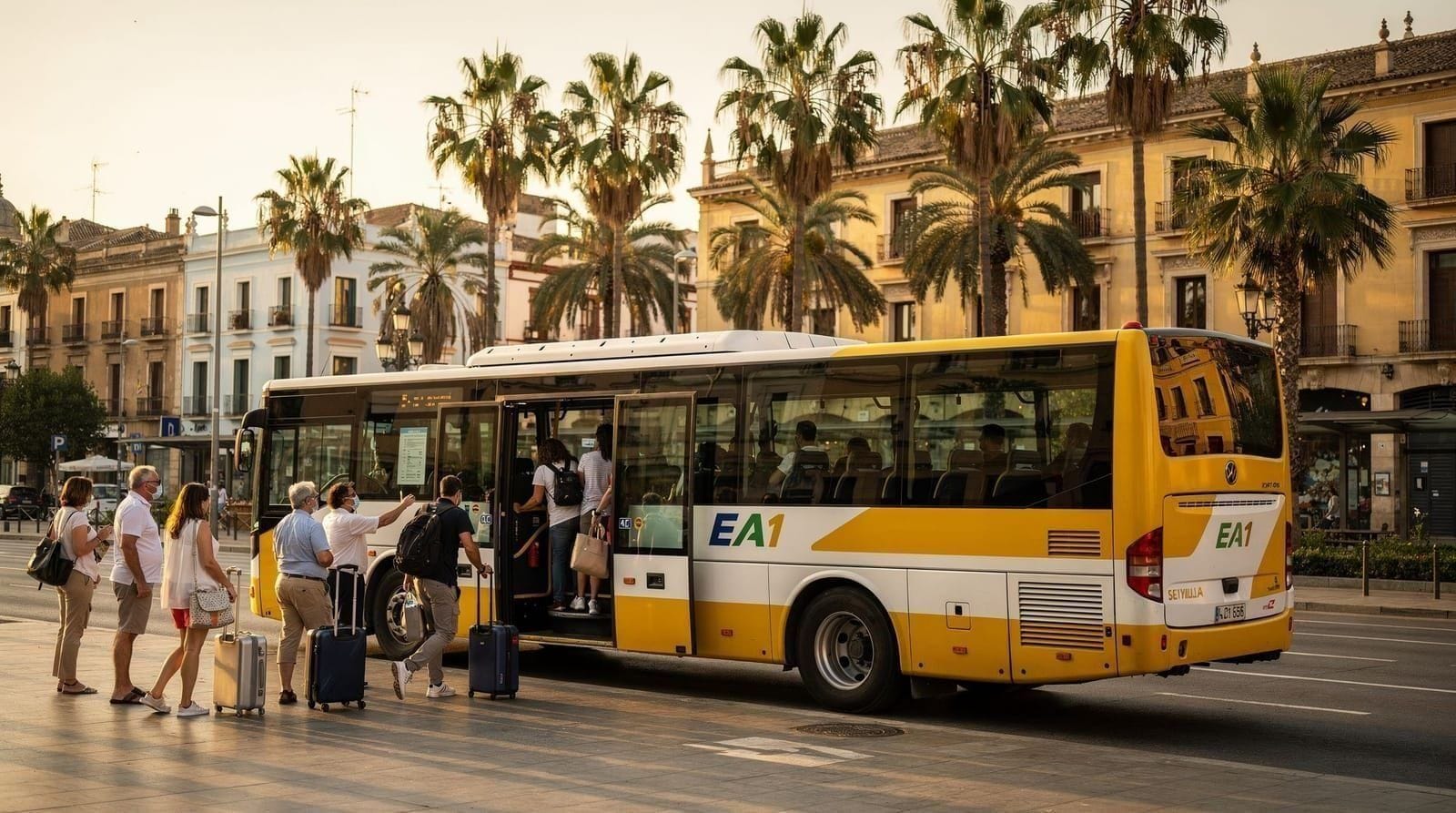
Airport bus (EA): The EA line is technically a Tussam route but is functionally the airport transfer. Fare: €6 (€1.50 with a Tarjeta Multiviaje). See Getting to Seville from the airport for specifics.
MetroCentro tram — the central axis
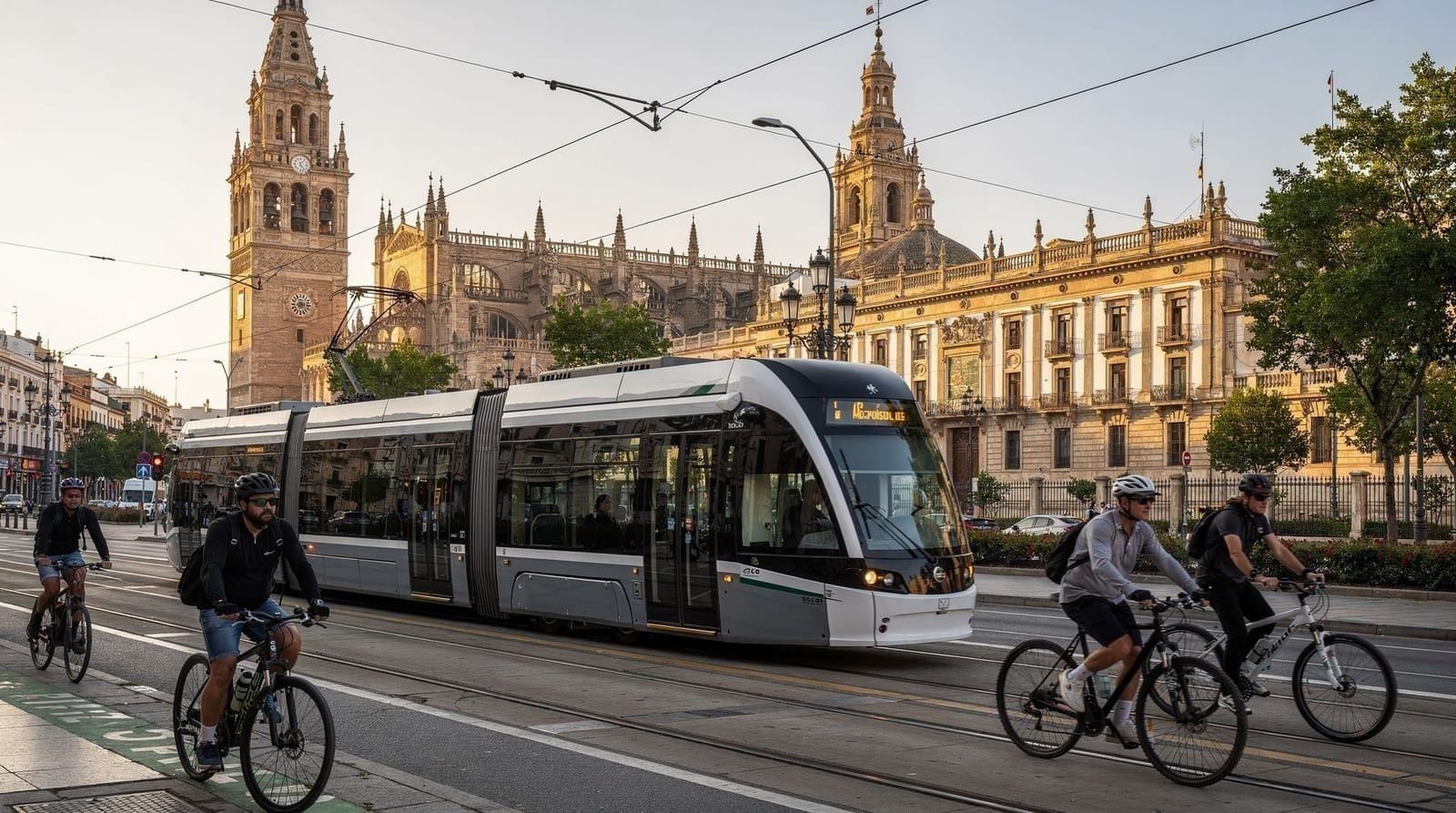
The MetroCentro is a single tram line running 1.4 km through the historic centre of Seville. It is not a full metro system — it operates at street level like a tram.
Route: San Bernardo → Archivo de Indias → Puerta de Jerez → Plaza Nueva → Campana
Fare: €1.40 per journey (same as bus), eligible for Tarjeta Multiviaje at €0.69.
Hours: see the official Tussam website for current MetroCentro timetables and frequencies.
When it is useful:
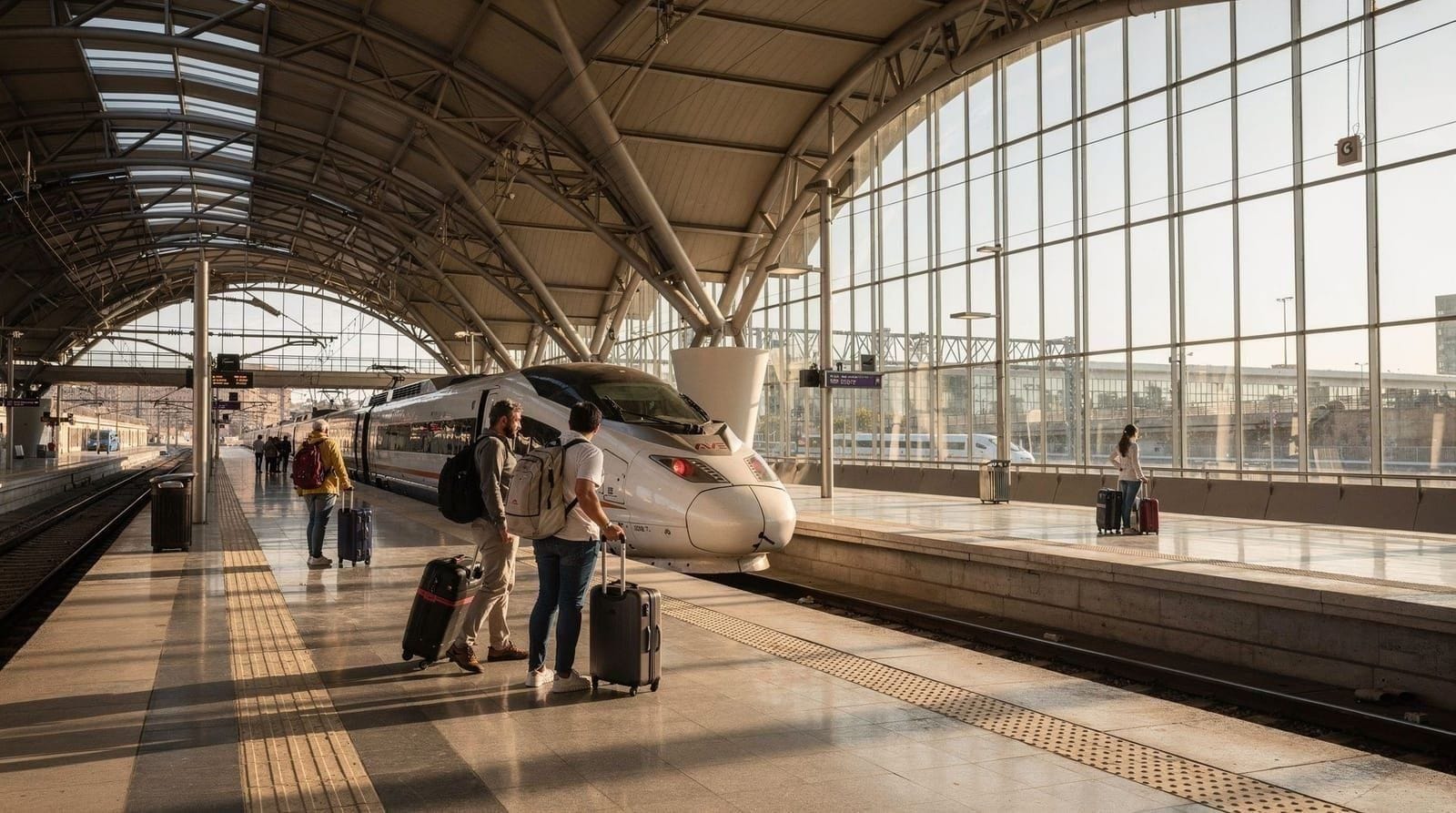
- Arriving from Santa Justa AVE station: walk or take a bus to San Bernardo, then MetroCentro to Puerta de Jerez (near the Alcázar area)
- Moving along the central axis quickly when your feet are tired
When it isn’t useful: For most cross-city journeys, the buses are faster. The MetroCentro’s value is specifically the historic-centre axis.
No tram to airport: The MetroCentro does not reach the airport. Use the EA bus or taxi for airport transfers.
Metro Line 1 — suburban reach
Seville’s Metro has one operational line (Line 1, the green line) running southwest to northeast across the city. It opened in 2009 and is modern, clean, and air-conditioned.
Route: Olivar de Quintos (southwest suburbs) → Ciudad Expo → Mairena del Aljarafe → [city centre] → Nervión → [continues northeast]
Fare: see the official Metro de Sevilla website for current fares and timetables.
Stations closest to tourist sights:
- Puerta Jerez: Near the historic centre, Alcázar area (but the MetroCentro tram or walking is often more practical)
- San Bernardo: Near Santa Justa train station
- Nervión: Near the main commercial area and El Corte Inglés
When the Metro is useful for visitors:
- Getting to or from the Nervión shopping district
- Reaching the Feria grounds in Los Remedios during Feria de Abril (Blas Infante or Dr Marañón stations)
- Connections to western suburbs
When the Metro is not useful: For the historic centre sightseeing circuit (Alcázar, Cathedral, Plaza de España, Triana, Macarena). Walking is faster for most tourist-to-tourist journeys within the old city.
Sevici bike share — the practical cycling option
Seville has invested heavily in cycling infrastructure — around 175 km of dedicated bike lanes — and Sevici (the bike share system) has around 260 docking stations and 2,500 bikes distributed across the city.
Pricing:
- Short-term passes (1, 3 and 7 days) with unlimited 30-minute trips: current prices on the official Sevici website
Trips over 30 minutes incur extra charges; check the current rates on the official Sevici website. For typical tourist use (riding between sights, crossing to Triana, cycling along the Guadalquivir), 30-minute slots are sufficient for most individual trips.
Sign up: At any Sevici docking station terminal (English language available), online at sevici.es, or via the Sevici app. You need a credit card for the subscription.
Helmets: Not provided with Sevici. Helmet hire is available from some bike rental shops near the river on both banks.
Key cycling routes for visitors:
- Along the Guadalquivir on both banks (flat, pleasant, continuous bike path)
- From the Triana bridge south to María Luisa Park and Plaza de España (15 minutes cycling)
- From the centre to Macarena neighbourhood (10–15 minutes)
- To Italica (ambitious — about 9 km each way, mostly flat but requires using road sections outside the dedicated lanes)
The Seville by bike covers cycling routes in detail.
Comparing Sevici to a guided bike tour: Sevici is better for flexible independent exploration. A guided tour adds historical context and a planned route — particularly useful on a first visit. For a structured guided cycling experience, see Seville by bike.
Comparing transport costs
| Journey | Walking | Bus (Multiviaje) | Sevici | Taxi |
|---|---|---|---|---|
| Alcázar → Plaza de España | 20 min | Not significantly faster | 10 min | 5 min |
| Centre → Triana | 15 min | Not shorter | 5 min | 5 min |
| Santa Justa → Alcázar | 20 min | 10 min / €0.69 | 10 min | 5 min |
| Airport → Centre | Not practical | 35 min / €6 | Not practical | 15 min |
Night transport
Public transport frequency drops late in the evening. For late evenings:
- Búho buses (night buses): Run on reduced-frequency night routes. Routes, stops and timetables at tussam.es — check the Búho service map.
- Taxis: Available throughout the night. Official taxis from ranks at Plaza Nueva, Puerta de Jerez, Nervión. Or call via the FreeNow / Cabify app.
- Walking: The historic centre is safe to walk at night and distances are short.
Accessibility
Modern Tussam buses are equipped with low floors and ramps. The MetroCentro tram is fully accessible. Metro Line 1 has lifts at all stations. Sevici docking stations are at pavement level. The main accessibility challenges in Seville are the cobblestone streets of the historic centre and the Alcázar’s uneven garden paths — both of which are outside the transport network’s control.
For full transport detail on getting from the airport specifically, see Seville airport to city centre and Getting to Seville from the airport.
Do you actually need public transport?
For most first-time visitors staying in or near the historic centre, the honest answer is: only occasionally. The Alcázar, Cathedral, Plaza de España and Santa Cruz are all within a compact walkable core, and even Triana is a 15-20 minute walk from the centre across the river. Transport becomes genuinely useful for the airport transfer, reaching Santa Justa station, visiting Nervión, or on hot summer days when you’d rather not walk the full distance. See getting around Seville for the broader picture of when to walk versus when to ride.
Day trip transport from Seville
For day trips, Seville’s public transport network stops at the city limits — Santa Justa station and the Plaza de Armas bus station are your departure points for everywhere else. The AVE and regional trains from Santa Justa reach Córdoba in about 45 minutes, while long-distance coaches from Plaza de Armas serve Ronda, Cádiz and other Andalusian destinations. Budget 15-20 minutes to reach either station from the historic centre using the tram or a short taxi ride. See best day trips from Seville for which destinations are easiest by public transport versus which benefit from a guided tour.
Using transport with luggage
Both the MetroCentro tram and Metro Line 1 are step-free and manageable with luggage, making them reasonable options for arriving from Santa Justa station with bags rather than committing to a taxi. Tussam buses are also low-floor, though boarding with a large suitcase during a busy period can be awkward. If you’re travelling with more than a carry-on-sized bag, a taxi or private transfer directly to your accommodation is usually the least stressful option for that specific leg — see getting to Seville from the airport for the cost comparison.
Planning a sightseeing day around the network
The most useful way to think about Seville’s transport is as a tool for linking the clusters of sights, not as something you ride between every stop. The Alcázar, the Cathedral and Santa Cruz sit almost on top of each other, so a morning there needs no transport at all; the Real Alcázar complete guide and the Santa Cruz neighbourhood guide show how much ground you can cover on foot. Where the tram earns its keep is the stretch between the Archivo de Indias area and the busier shopping streets, especially when your feet are tired after a long visit.
Because the palace is the one sight most visitors build a day around, it helps to sort your entry ticket before you think about getting there. Timed entries reward punctuality, so leave a generous margin if you are coming from further out by bus. If you prefer context over wandering alone, a guided visit with skip-the-line entry removes the queue question entirely, and our skip-the-line decoder and Alcázar tickets guide explain how the different ticket types compare. Whichever you choose, check the best time to visit the Alcázar so your transport and your entry slot line up.
For a day that pairs two monuments, combined entry to the palace and the cathedral keeps the logistics simple, since both are a short walk apart and no ride is needed between them. The combined Alcázar and Cathedral tickets guide and the Seville Cathedral complete guide cover the details.
Matching transport to your neighbourhood
Where you sleep changes how much of this guide you will actually use. Staying in Santa Cruz or the Cathedral area means you can ignore most of the network until you leave the city. Staying in Triana, El Arenal or Nervión makes a bus, a bike or the tram more natural for the daily commute into the centre. Our best neighbourhoods in Seville and where to stay in Seville guides explain these trade-offs, and the Triana neighbourhood guide and Nervión guide are worth a look if you are weighing a base further from the old town.
If you are building a trip around several days, the Seville in 3 days itinerary and the first-timer’s itinerary show which days lean on walking and which genuinely benefit from a bus or bike. Budget travellers will also want the Seville on a budget itinerary, where the transport card is part of the savings.
Hot weather and tired legs
In the hottest months, a short tram or bus hop between shaded stretches can make the difference between enjoying an afternoon and enduring it. Plan your walking for early morning and evening, and use the air-conditioned vehicles as a break in between. The Seville in summer heat guide goes into pacing in more depth, and the Seville packing list covers what to carry for long days outdoors. Sevici is pleasant in the cooler parts of the day, but heat and a dock-to-dock rule can make it less relaxing at midday.
Practical habits that save time
- Check the route in a maps app before you leave, and have the card topped up so you are not fumbling for cash at the door.
- Keep your ticket or card handy until you have left the vehicle, in case of an inspection.
- Watch your belongings on crowded buses and at busy stops; the is Seville safe guide has the honest picture on pickpockets.
- When in doubt about a short hop, walk. The Seville common mistakes guide lists over-reliance on taxis and buses among the habits that cost visitors time.
Frequently asked questions about Seville public transport guide
What is the Tarjeta Multiviaje in Seville?
The Tarjeta Multiviaje is a rechargeable public transport card for Tussam buses (the Metro uses the separate card of the Consorcio de Transportes). A single journey costs approximately €0.69 with the card versus €1.40 cash. Available at bus kiosks and some tobacconists.Which bus goes from the Cathedral area to Santa Justa train station?
The MetroCentro tram line runs from the historic centre (Puerta de Jerez stop) to San Bernardo, which is close to Santa Justa. From San Bernardo, Santa Justa is a 10-minute walk. Several Tussam lines also serve this route.Is there a direct bus from the Cathedral to Plaza de España?
Plaza de España is only 1.5 km from the Cathedral — an easy 20-minute walk through the Jardines de Murillo. No bus is necessary. If you prefer, the C4 circular bus passes near both points.Does the Metro serve the historic centre of Seville?
No. Metro Line 1's closest station to the historic centre is Puerta Jerez (near the tram stop of the same name). The Metro is more useful for getting to the Nervión shopping area, the southern university campus, or the Mairena del Aljarafe suburbs.How do Sevici bikes work?
Sevici is Seville's bike-share system. Sign up at any docking station terminal or via the Sevici app. Short-term passes include unlimited journeys of up to 30 minutes; check current prices on the official Sevici website. Return the bike to any docking station before 30 minutes to avoid extra charges.