Metropol Parasol (Las Setas) guide: the full picture
Seville: Setas de Sevilla (Metropol Parasol) entry ticket
What is the Metropol Parasol in Seville?
The Metropol Parasol (nicknamed 'Las Setas' — the Mushrooms) is a large contemporary wooden canopy structure in Plaza de la Encarnación, built between 2005 and 2011. It houses a panoramic walkway (from €16), a basement archaeological museum with Roman ruins, and a market, bar and restaurant at ground level.
The Metropol Parasol occupies a place in Seville’s self-image that is still being negotiated, more than a decade after it opened. The structure — a vast lattice of bonded laminated timber shaped like six interconnected umbrellas or, as the locals immediately named it, a cluster of mushrooms — dropped into the centre of Plaza de la Encarnación in 2011 and permanently changed the visual character of one of the city’s oldest squares.
| Where | Plaza de la Encarnación, La Macarena border |
| Cost | From €16 |
| Time needed | 1-1.5 hours |
| Getting there | 15-minute walk from the Cathedral; bus lines C3, C4 |
| Best time | Sunset, booked 2-3 days ahead |
Understanding it requires understanding the square it replaced, the archaeological find that complicated the project, and the engineering challenge that made it expensive. Whether you love the building or hate it, it is genuinely interesting.
The project history
Plaza de la Encarnación had been a fairly unremarkable square in the heart of the La Macarena neighbourhood — slightly faded, used as a local market. In 2005, the city decided to redevelop it. The winning design, by German architect Jürgen Mayer H. working with the Arup engineering firm, proposed a large contemporary parasol structure that would create shade and public space while hiding a market, museum and car park below grade.
Then the excavations began. Archaeologists found a significant 1st-century Roman site beneath the square — an intact domestic complex with mosaic floors, commercial buildings, and Moorish-period remains stacked on top. The design had to be fundamentally rethought to preserve the site. This added years and tens of millions of euros to the project.
The final building cost approximately €102 million against an original estimate of around €50 million. The contract was extended multiple times. The project became a symbol of municipal overreach for critics of the local government. The structure finally opened in March 2011.
The structure itself: what makes it notable
Las Setas entry ticket — panoramic walkway and Antiquarium includedThe Metropol Parasol is built from bonded laminated timber — Douglas fir panels glued together in layers, then coated in polyurethane. At the time of construction, it was the largest wooden lattice structure in the world. The six canopy “mushrooms” span an area of approximately 150 by 70 metres at ground level. The highest point of the walkway is 26 metres.
The choice of timber was structural and aesthetic: the engineers calculated that steel would have required more complex foundations given the archaeological site below, and timber could span the necessary distances while appearing visually lighter. The polyurethane coating protects the wood from the Sevillano climate (summer heat, winter humidity) and gives the structure its characteristic golden-amber colour.
What to see: the four levels
Underground: Antiquarium museum. The 1st-century Roman site, preserved in situ and accessible via glass walkways. The main feature is a Roman domus — a domestic residence — with intact mosaic floors showing geometric and figurative patterns. The scale is modest but the preservation quality is excellent. This is one of the best-preserved Roman archaeological sites in Seville, made more remarkable by the circumstances of its discovery. 20–30 minutes to see properly.
Ground level: Market and bar. The Mercado de la Encarnación (market) occupies the ground floor beneath the canopy. This is a working food market, primarily serving local residents. The bar at ground level is more tourist-facing. The canopy provides effective shade — sitting at the bar on a summer afternoon in full shade while the surrounding streets are in direct sunlight makes the practical value of the structure clear.
First level: Gastronomic space and restaurant. A restaurant and event space occupy the intermediate level, accessible by stairs or lift.
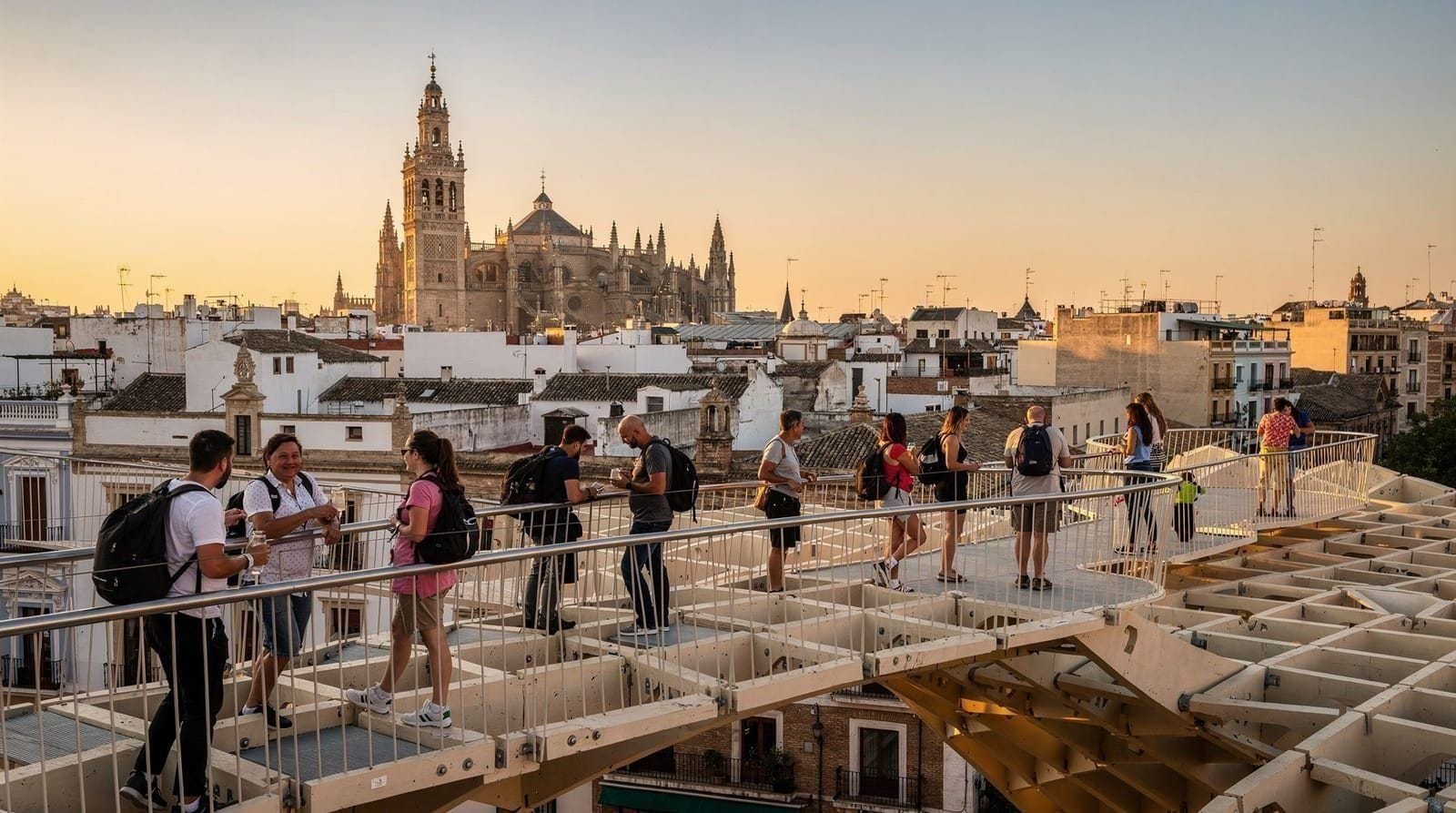
Top: Panoramic walkway. The main visitor attraction. A wavy promenade runs along the tops of the six canopies, providing 360-degree views. The walkway is enclosed by a curved rail — not glass, so wind at altitude is noticeable — and lit at night by LED strips embedded in the wooden surface. The Setas Bar at the top serves drinks.
Sunset: the best single thing to do here
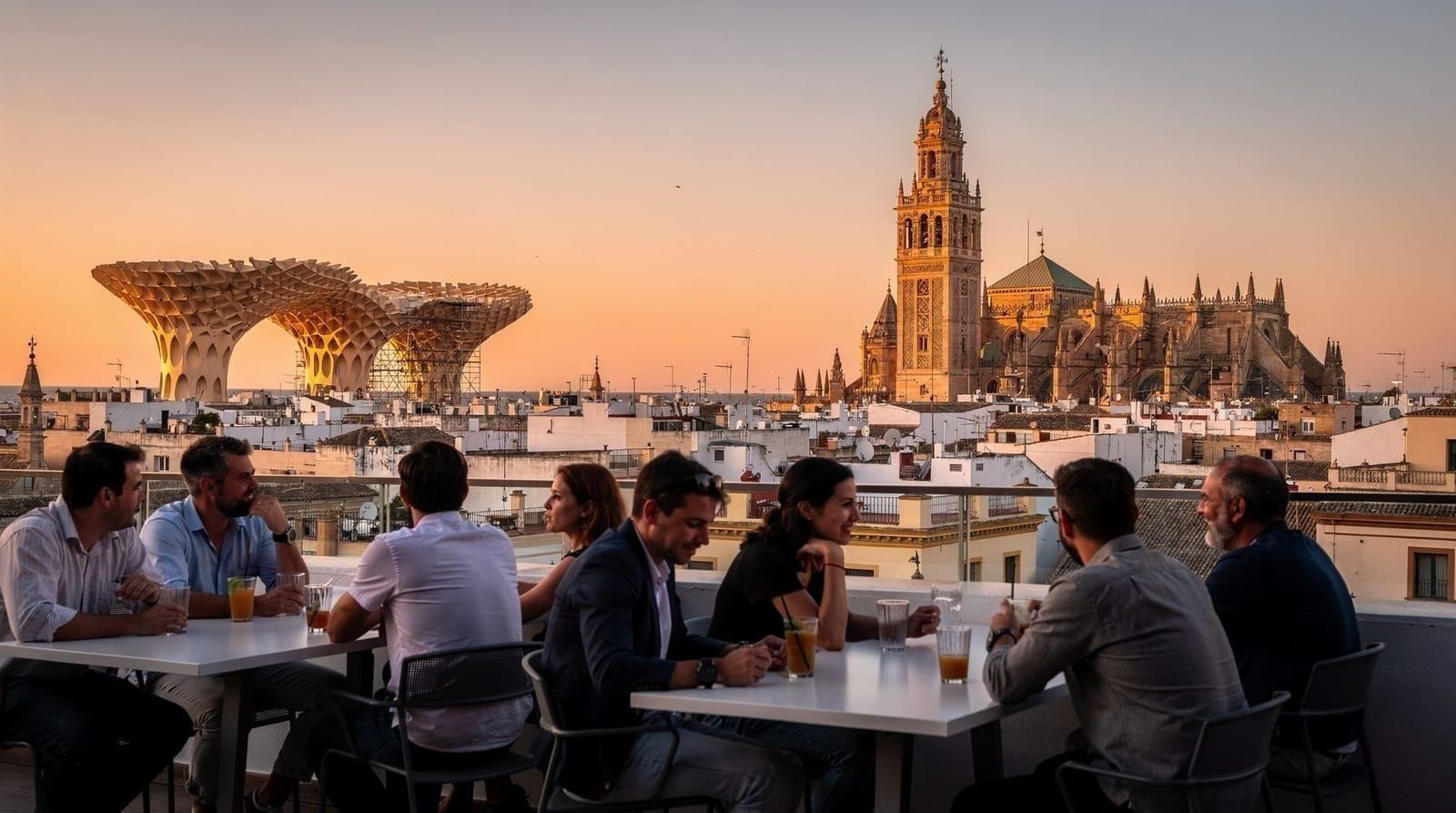
Walking tour combining Palacio de Las Dueñas, La Macarena and Las SetasSunset at Las Setas is genuinely one of the more memorable casual experiences in Seville. The western aspect of the walkway faces the Guadalquivir river direction; as the sun sets behind the flat Andalusian plain, the orange light hits the wooden canopy from below and from the side simultaneously, turning the walkway amber. The silhouette of the Giralda appears to the south.
Book 2–3 days ahead for sunset slots. In high summer (July–August), sunset is around 9 PM, giving you the option of combining an evening walk through La Macarena with the views. In autumn and winter, sunset is earlier (6–7 PM) and the sky conditions are often clearer.
Las Setas vs the Giralda, for views:
| Las Setas | Giralda | |
|---|---|---|
| Height | 26m | 70m |
| Price | From €16 (separate ticket) | Included in Cathedral ticket (€13) |
| View style | Broad city panorama, including Macarena and the river | Close-up over the Cathedral roof and Alcázar gardens |
| Best for | Sunset, open-air rooftop feel | Central historic-quarter perspective |
For more rooftop and viewpoint options across the city, see the rooftop bars and views guide.
The Macarena neighbourhood context
Las Setas sits at the junction of several neighbourhood characters. The immediate area around Plaza de la Encarnación is a local shopping zone — Calle Feria, running north, is one of the city’s best surviving traditional market streets. The Mercado de Feria (a smaller market, further north) is worth 20 minutes. The La Macarena neighbourhood proper — named for the famous Virgin whose basilica is 10 minutes’ walk north — is the least touristy of Seville’s central areas.
For visitors who want to move away from the tourist circuit while staying close to the centre, an afternoon in the Macarena quarter — the Palacio de Las Dueñas, a walk up Calle Feria, the Basilica de la Macarena, and Las Setas at sunset — is one of the best half-days the city offers. See the La Macarena neighbourhood guide for the full circuit.
Practical information
Address: Plaza de la Encarnación, s/n, 41003 Seville.
Hours: daily from 9:30 AM, closing at 1:00 AM in summer and midnight in winter (last admission 30 minutes before closing). The walkway is open late — evening visits are an option beyond sunset.
Getting there: 15 minutes’ walk from the Cathedral. City bus lines C3 and C4 stop nearby. Sevici hire bikes have a station near the plaza.
Ticket: From €16 per person.
Payment and queues: Cards are accepted at the ticket desk and online. Booking online in advance is worth doing in peak season (spring and early autumn) to skip the walk-up queue, which can build in the late afternoon before sunset slots.
For ticketing-specific advice, see Las Setas tickets guide.
The engineering of the structure
The Metropol Parasol’s construction attracted specialist attention when it was built because of the specific engineering challenge of creating large free-spanning curved structures from timber at this scale. Most large timber structures are either straight (traditional post-and-beam) or gently curved (modern laminated arches). The Metropol Parasol’s six canopy forms — each a different organic shape, all connected, all structurally interdependent — required computational modelling techniques that were not available even 20 years earlier.
The primary structural material is bonded laminated timber (BLT) — Douglas fir planks glued together under pressure in layers, with the grain direction varying between layers for structural strength. Each structural panel was cut by computer-controlled milling machines from large BLT blocks. The panels interlock without metal connectors in most areas — the geometry of the interlocking joints provides the structural connection.
The polyurethane coating that covers the exterior serves two purposes: it protects the wood from the Sevillano climate (high summer temperatures, occasional humidity) and gives the structure its unified visual appearance. Without the coating, the individual wood panels would be visible at close range; the coating turns the surface into a continuous amber-coloured skin.
The structural system had to be designed around the archaeological site below. The six column bases are positioned specifically to avoid the Roman ruins; the column footings were designed to transfer loads around the preserved mosaic floors rather than through them.
The debate over Las Setas’ aesthetic legacy
A decade after completion, the debate about whether the Metropol Parasol was a good decision for Seville has not fully resolved. The positions:
In favour: The building has become a landmark in its own right, is regularly used by Sevillanos (the market at ground level is a functioning commercial space, not a tourist attraction), has created a genuinely high-quality public space in a formerly neglected plaza, and has proven structurally sound. The Antiquarium is an unexpected bonus. Architecturally, it represents a serious engagement with the challenge of inserting contemporary architecture into a historic city.
Against: The cost overrun (from €50m to €102m) represents a significant misuse of public funds. The aesthetic is divisive and does not respect the visual context of the surrounding historic buildings. The plaza was previously open and democratic; the current structure requires a ticket for the most interesting access. Several established architects have described the building as a poor example of “starchitecture” that prioritizes formal novelty over urban context.
The practical visitor perspective: Whatever your architectural opinion, the walkway is worth visiting once, particularly at sunset. The Roman ruins below are genuinely interesting. The debate about the building is part of Seville’s contemporary self-understanding in a way that makes learning about it worthwhile.
Weather and timing considerations
The walkway is entirely outdoors and unshaded at the top level, which changes the calculus by season. In summer (June-August), the midday walkway can be genuinely uncomfortable in direct sun — a morning visit before 11am or the evening sunset slot are both better choices than midday. In winter, the walkway can be windy at height; the curved rail provides some shelter but not full protection, so a warm layer is worth bringing for an evening visit between November and February. Rain closures are rare but the wooden surface can be slippery when wet, so check conditions if visiting during an unusually rainy spell.
Calle Feria and the surrounding neighbourhood
The streets around Plaza de la Encarnación are the most genuinely local area close to Seville’s centre. Calle Feria — the street running north from the plaza — is one of the city’s best-preserved traditional market streets: a succession of small shops selling second-hand goods, hardware, clothes, and food. The weekly flea market (El Jueves, every Thursday) has been held on Calle Feria for centuries.
The contrast with the Santa Cruz quarter — which has been almost entirely converted to tourist economy — is instructive. In the streets around Las Setas, the bars serve primarily local residents. The menus are in Spanish. The prices are Seville prices rather than tourist prices. A tapa at the barra costs €1.50–€2.50. A glass of beer or tinto de verano costs €1.20–€1.80.
This price gap is not a minor detail — it reflects a genuinely different relationship between the business and its customers. A bar aimed at locals has to compete on repeat visits from people who live nearby and know the going rate; a bar aimed at one-time tourists has no such discipline. Seeking out the Calle Feria bars over the Santa Cruz equivalents is one of the simplest ways to eat and drink well in Seville without paying the tourist premium.
This neighbourhood character is one of the arguments for spending time in the Macarena area rather than staying entirely within the tourist circuit. The monuments (Alcázar, Cathedral) are worth every minute they take. But the experience of sitting at a bar counter in a neighbourhood without a tourist in sight, eating something that costs less than €2, and watching Sevillanos go about their afternoon — that is also part of what the city is.
Practical itinerary combining Las Setas with the Macarena
A morning-to-evening itinerary for the Las Setas and Macarena area:
9:30 AM: Las Setas walk-up ticket. Visit the Antiquarium first (30 minutes, Roman ruins, uncrowded in the morning). Then the walkway (20–30 minutes).
11:00 AM: Walk north on Calle Feria. Stop at any local bar for a coffee and a tostada (toasted bread with olive oil and tomato — the Sevillano breakfast, €2–€3).
12:00 PM: Basilica de la Macarena (free to enter, 20 minutes). The Virgen de la Macarena in the museum section requires a small entrance fee. The basilica itself is free.
1:00 PM: Lunch on Calle Feria or in the Alameda de Hércules. The Alameda — a tree-lined boulevard 5 minutes’ walk from the basilica — has a good mix of cafes and restaurants with terrace seating.
3:00 PM: Palacio de Las Dueñas (45–75 minutes, €15–€26). The palace is 5 minutes from the Alameda. See the Palacio de las Dueñas guide for what’s inside.
Late afternoon / evening: Return to Las Setas for the sunset slot (pre-booked). Finish with tapas in the Macarena neighbourhood.
For advice on booking this and other skip-the-line tickets efficiently, see the skip-the-line Seville decoded guide.
Fitting Las Setas into a wider Seville plan
Las Setas works best as a counterweight to the heavy monument days. If you have already queued for the Cathedral and the Alcázar, the walkway is a lighter, open-air change of pace. The Cathedral and Giralda tickets guide and the complete Cathedral guide cover the other big viewpoint, and the Alcázar versus Cathedral comparison helps you decide how to sequence the historic centre before heading north to the Encarnación.
For a first visit, the Seville first-timers itinerary and the one-day Seville itinerary show where an evening at Las Setas can slot in without crowding the day. If you are still deciding how long to stay, the how many days in Seville guide and the Seville itinerary planner put the plaza in context alongside the rest of the city.
Getting there and moving on
The plaza sits just outside the tightest part of the old centre, so it is easy to reach on foot and pairs naturally with a longer walk. For buses, bikes and the metro-and-tram question, see the getting around Seville guide and the public transport guide. If you are choosing a base with the Macarena side of town in mind, the best neighbourhoods in Seville compares the options, and the Seville destination page gives the wider overview.
After the walkway: eating nearby
Once you come down from the canopy, resist the first terrace you see. The barra versus terrace pricing guide explains why standing at the counter is the better deal, and the Alameda de Hércules guide points to a lively area for a longer evening meal a short walk away. Timing matters too: the best time to visit Seville and the summer heat guide explain why the cooler end of the day suits an unshaded walkway so well.
Frequently asked questions about Metropol Parasol (Las Setas) guide
What does 'Las Setas' mean?
Las Setas is Spanish for 'the Mushrooms.' The nickname was given by Sevillanos who felt the canopy's organic, bulbous form resembled a cluster of giant fungi growing from the ground. The official name — Metropol Parasol — comes from its function as a metropolitan parasol (sunshade) at the scale of the city.Is the Metropol Parasol controversial?
Yes. The project was significantly over budget (final cost approximately €102 million versus an original estimate of €50 million) and years behind schedule. Many Sevillanos objected to inserting a large modern structure in a historic plaza. Others have come to appreciate it as a genuine piece of architecture. The debate continues. The building itself is a serious piece of engineering regardless of aesthetic opinion.What are the Roman ruins below Las Setas?
The Antiquarium — a basement museum — was created to preserve Roman and Moorish ruins discovered during excavation for the Metropol Parasol's foundations. The site preserves a 1st-century Roman domus (house) with intact mosaic floors, commercial premises (tabernae), and remains from the Moorish period.Is the Metropol Parasol worth visiting if I only have limited time?
If the Alcázar and Cathedral are already on your list, Las Setas adds a different perspective — literally. The panoramic walkway gives an overview of the city that neither the Giralda nor any other vantage point quite replicates. If time is very tight, prioritize the Alcázar and Cathedral and visit Las Setas only if you have an evening free. Sunset here is genuinely special.What is the difference between Las Setas and the Giralda for views?
The Giralda (70m) is higher and more centrally placed within the historic quarter — views look down onto the Cathedral roof and across to the Alcázar gardens. Las Setas (26m) gives a broader city-level panorama, including the Macarena neighbourhood and the river. The Giralda is included in the Cathedral ticket (€13); Las Setas costs from €16 separately. Both are valid viewpoint choices.Is Las Setas suitable for visitors with limited mobility?
The Antiquarium and market level are step-free or lift-accessible. The panoramic walkway is reached by lift, and the walkway surface itself is flat, though it undulates gently in profile. Check with the ticket office about current lift access before visiting, as maintenance schedules can occasionally affect availability.
Top experiences
Bookable activities with verified prices and instant confirmation on GetYourGuide.