Italica — Roman ruins and Game of Thrones locations
The city that built emperors
Two Roman emperors were born at Italica: Trajan (53 CE) and Hadrian (76 CE). This alone makes the site historically significant in a way that most Roman sites in Spain cannot match — you’re standing in the town that produced arguably the two greatest emperors of the Principate period, the men who expanded the empire to its greatest extent and stabilised it for a century.
| Where | Santiponce, about 9 km north of Seville |
| Cost | Around €1.50 entry |
| Time needed | 2–3 hours for a thorough visit |
| Getting there | M-170A bus from Plaza de Armas, or a guided tour |
| Best time | Morning, before the midday sun and any tour groups |
The ruins themselves are about 9 km north of Seville, in the modern town of Santiponce. Getting there is absurdly easy: the M-170A bus from Plaza de Armas in central Seville takes about 30 minutes. Alternatively, guided tours from Seville include transport and context:
From Seville: Game of Thrones and Roman empire Italica tourThe site itself has a €1.50 entry fee (EU citizens free, which is the case for residents but may not apply to tourists — check current policy at the gate). Opening hours are Tuesday to Saturday 9 am–6 pm from late September to March (hours change by season), Sunday 9 am–3 pm, closed Monday.
Italica also has its own destination page if you want the short version before you go, and the wider Seville destination page is the best starting point for planning how the visit fits around your time in the city. If you are still deciding how many days to give the whole trip, how many days in Seville helps you see where a half-day at the ruins can slot in.
The amphitheatre: bigger than you expect
The first thing you see when you enter the main archaeological zone is the amphitheatre — and it’s the thing that makes you stop. Italica’s amphitheatre had a capacity of approximately 25,000 spectators when it was completed in the early 2nd century CE, making it the third largest amphitheatre in the Roman Empire at the time (after the Colosseum and the one at Carthage). Only the Colosseum’s current crowds exceed it.
What’s remarkable about the Italica amphitheatre is its state of preservation. The outer wall is largely gone — its stones were robbed for later buildings throughout the medieval period — but the interior structure is surprisingly complete. You can walk through the underground chambers (the hypogeum) where the gladiators waited and the animals were kept before being released into the arena, and look up at the open oval above. The scale of what a 25,000-person crowd would have looked and sounded like becomes viscerally comprehensible standing on the arena floor.
The Game of Thrones connection is specific to this space. Season 7 Episode 7 (“The Dragon Pit” sequence) was filmed partly in the amphitheatre — the scene where Daenerys meets Cersei and the Lannister forces, watched over by a chained Drogon, took place here. The geography is not immediately obvious because the production design transformed the space substantially, but the curvature of the seating tiers and the entrance arches are recognisable if you’ve watched the scene recently.
The residential city: mosaics at ground level
Beyond the amphitheatre, a pathway leads through the excavated residential quarter of the “Nova Urbs” — the expansion of Italica that Hadrian commissioned in the early 2nd century CE. This is where the city’s patrician class lived, and their houses are extraordinary by Roman provincial standards.
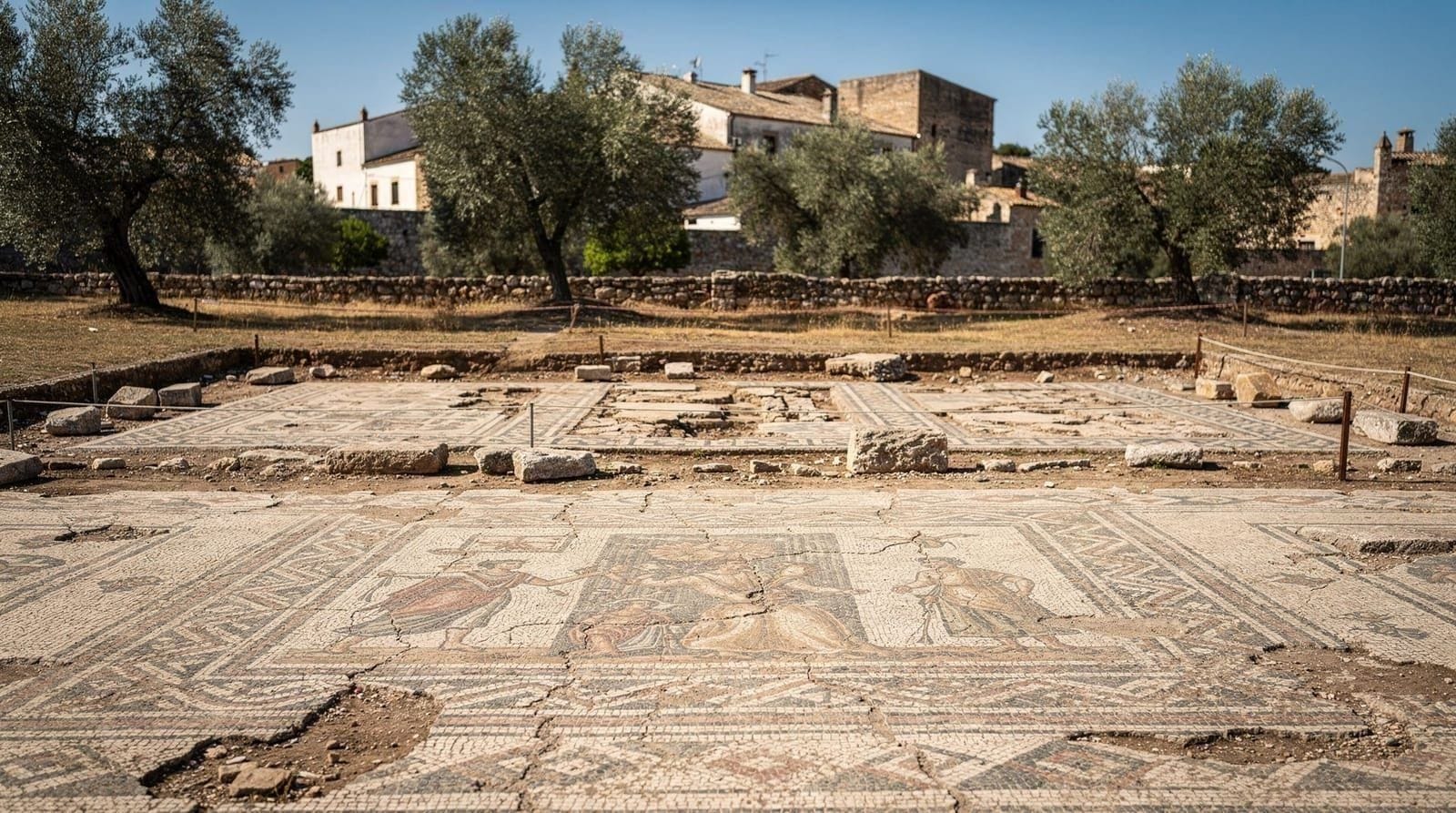
The Casa de Neptuno has a complete preserved floor mosaic of the sea god surrounded by sea creatures, visible at ground level through a protective enclosure. The Casa de los Pájaros has a bird mosaic — dozens of species depicted with botanical accuracy around a central medallion. The Casa de Hylas shows the mythological scene of Hylas abducted by water nymphs. These are not fragments or reconstructions; they’re the original floor material, in situ, essentially as the Roman residents walked on them.
What makes Italica unusual among Roman sites is this accessibility. At Pompeii, the great mosaics are in the Naples Archaeological Museum; at Mérida, the major pieces are in a dedicated museum building. At Italica, much of the significant material is still in the ground where it was found, visited by relatively few people, and you can lean over the barriers to photograph them without a crowd.
A practical thought on pacing: the mosaics reward slow looking, so resist the urge to rush back to the bus. Walk the residential quarter once for orientation, then loop back to the houses that caught your eye. Visitors who have already spent a morning at the Real Alcázar often find Italica a welcome contrast — open sky and long sightlines instead of tiled courtyards and gardens.
The town of Santiponce
The archaeological zone is surrounded by the modern town of Santiponce, which has the slightly melancholy character of a place that exists mainly because the Romans chose this hillside. The local bar on the main road near the archaeological entrance does a good menú del día (€11, three courses) for a pre- or post-visit lunch.
Also in Santiponce: the Monasterio de San Isidoro del Campo, a 14th-century Gothic monastery built partly using Roman materials from Italica. It has a history of its own — the translation of the Bible into Spanish by Cipriano de Valera (the Reina-Valera Bible, still in common use in evangelical churches throughout the Spanish-speaking world) was printed here in the 16th century. Visits are limited to guided tours on specific days; check the Santiponce tourism website for current schedule.
If Roman Spain interests you beyond a single site, the Córdoba day trip from Seville guide covers a very different, larger-scale Roman-and-Moorish city an hour away by train.
Fitting Italica into a Seville itinerary
Because the ruins take only part of a day, Italica works best as a morning outing that leaves the afternoon free. Our 3-day Seville itinerary and the day trips itinerary both show how a short excursion can sit alongside the main sights without exhausting you. If you are building something longer, planning a week in Andalusia puts Italica among the other trips you might add.
Getting to the bus stop and finding your way around town is easier with a little preparation, so getting around Seville is worth a look before you set off. And if you would rather skip the logistics, the half-day guided options are a sensible choice — for instance a guided tour of the Roman ruins and city keeps the explanation and the transport in one booking.
Italica in the context of day trips from Seville
Italica is the cheapest and most accessible day trip from Seville by a significant margin. The bus is cheap, the entry is €1.50 or free, and the site can be covered in 2–3 hours without rushing. Compare this to Córdoba (4+ hours), Granada (5+ hours), or even Cádiz (3.5+ hours), and Italica’s value is obvious.
The disadvantage is that it’s a specialist site — there’s no beach, no cathedral, no tapas scene, no vibrant city culture. It’s a Roman archaeological site with good mosaics and an impressive amphitheatre. If that’s what you want, it delivers completely. If you want a place to spend a full day including lunch and shopping, it doesn’t have that.
The site is best combined with: a morning in Italica followed by an afternoon back in Seville (easily done given the short bus journey), or combined with the Monasterio de San Isidoro del Campo if you’re interested in the medieval layer on top of the Roman site.
For a more complete picture of how Italica fits into the broader day-trip calendar, the best day trips from Seville guide ranks all the options from closest to furthest, and the dedicated Italica day trip from Seville guide has a fuller logistics breakdown than fits here. If you’d rather see a second Roman-and-medieval site the same week without needing a car, Carmona is the closer comparison — a walled hilltop town with its own necropolis, reachable more easily than a combined Italica-Carmona day.
Italica vs Carmona: which Roman-adjacent day trip
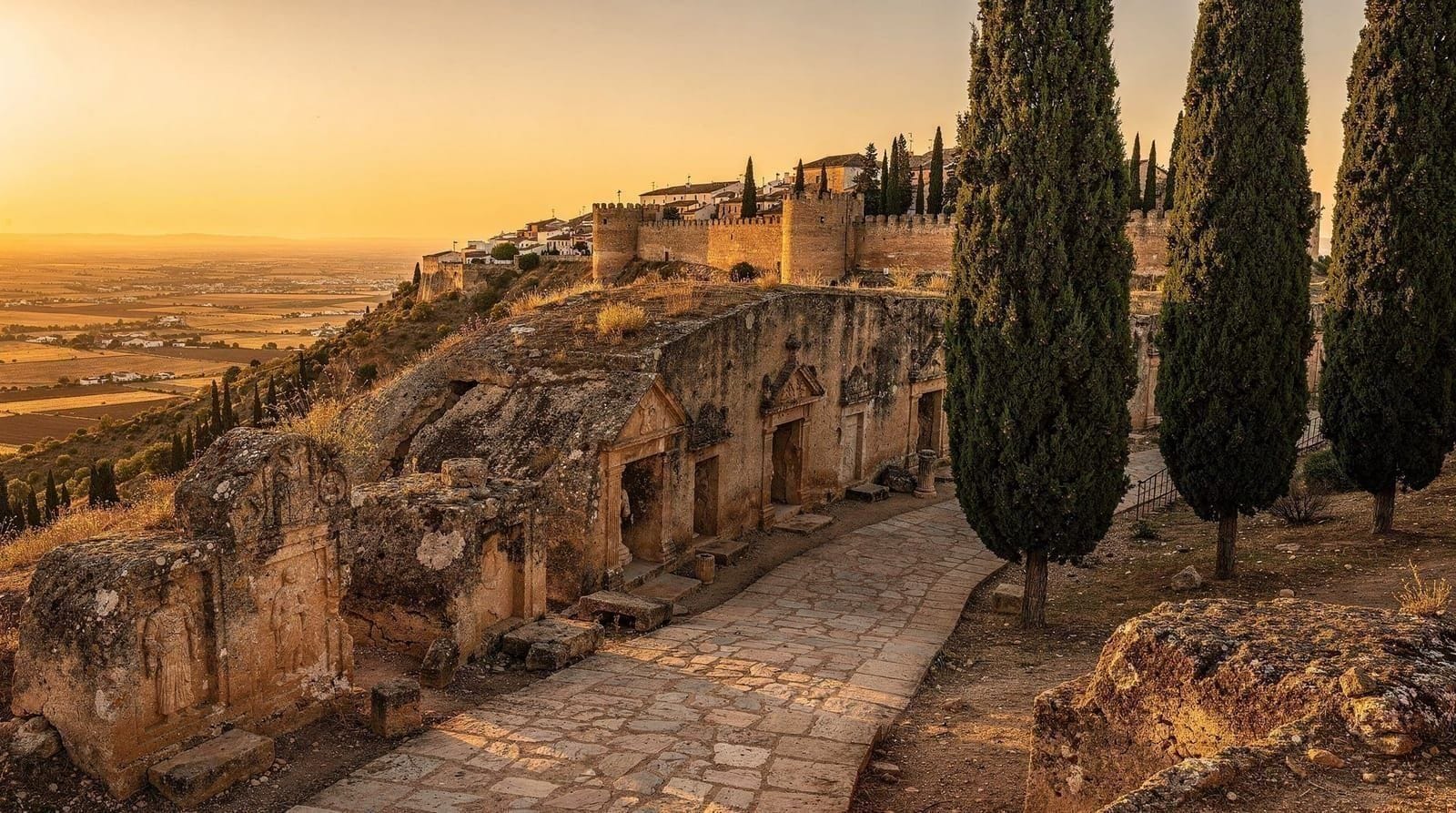
Both sites sit north and east of Seville and both get compared as the “smaller, cheaper” alternative to Córdoba. They’re not really substitutes for each other, though: Italica is a single-period Roman archaeological zone with the amphitheatre as its centrepiece, while Carmona layers a Roman necropolis underneath a still-inhabited medieval walled town, which gives it a different, more textured feel. If you only have time for one, choose Italica for the amphitheatre and the Game of Thrones connection, and Carmona if you want somewhere to also eat lunch and wander an actual town centre afterward.
The Game of Thrones tour: is it worth it?
Several operators run specific Game of Thrones tours of the Seville area, covering both Italica (the Dragon Pit) and sites within the city (the Cathedral chapter house, used as the Hall of the Small Council; the Real Alcázar, used for Dorne). These tours are well-executed for fans of the series — the guides know the specific episodes and angles, they bring reference photographs, and they contextualise the filming choices within the production design.
For non-fans who are primarily interested in the history, the standard historical guided tour gives you more depth and less screenshot comparison. The combination tour that covers both the Game of Thrones and Roman history angles is probably the right choice for most visitors who want both.
What’s interesting about the filming location is the production decision itself: the amphitheatre was chosen because the semicircular seating arrangement and the enclosed ground level matched the script’s requirements, and the Andalusian location offered weather, logistics, and a pre-existing agreement with the regional government. The amphitheatre’s actual scale — 25,000 spectators — gives the filming location a grandeur that purpose-built sets would struggle to achieve.
Practical notes
Getting there: M-170A bus from Plaza de Armas, Seville (30 minutes). Or guided coach tour from Seville.
Entry: €1.50 general, check EU resident and student discounts at the gate. Open Tuesday–Sunday, closed Monday. Hours vary seasonally.
What to bring: Sun hat and water are essential in any season — the site is open-air with minimal shade. Comfortable walking shoes for uneven stone surfaces.
Photography: Permitted throughout. The best light for the amphitheatre is morning (from the east side) or late afternoon (golden hour on the west-facing sections).
Time needed: 2 hours minimum to cover the amphitheatre and main residential mosaics. 3 hours for a thorough visit including the smaller houses.
Combined with Carmona: Both sites are north of Seville and can theoretically be combined in a long day, though you’d need a car — the bus routes don’t connect them directly.
Frequently asked questions about Italica
Which Game of Thrones scenes were filmed at Italica?
Primarily the Dragon Pit scenes from Season 7 Episode 7, where the major character alliance takes place. Some additional scene elements from Season 7 were filmed nearby.
Do I need to book in advance?
No advance booking required for standard visits. The guided tours from Seville require booking. EU citizens may need to show ID at the gate for discounted entry.
Is the site suitable for children?
Yes, particularly for children aged 8 and up. The amphitheatre and the underground hypogeum are engaging for children interested in Roman history or gladiatorial combat. Younger children may lose interest during the mosaic sections.
How does Italica compare to other Roman sites in Spain?
Among the best for in-situ mosaics and the scale of the amphitheatre. Less complete as an overall urban site than Mérida (Extremadura), which has theatre, amphitheatre, bridge, and museum in a single concentrated area.
Is there a museum at Italica?
There are some explanatory panels and a small visitor centre on site. The major finds from Italica (statues, inscriptions, removed mosaics) belong to the Archaeological Museum of Seville, whose building in the Parque de María Luisa is closed for renovation (check the official museum site for news).
If you’re weighing Italica specifically as a family outing, our Seville with kids trip report covers how our own family visit to the amphitheatre and hypogeum went down with younger children, including what held their attention and what didn’t.
Book a half-day Italica tour from Seville