Gibraltar day trip from Seville: Rock, macaques, and what to know
From Seville: Full-day trip to Gibraltar
How do you get from Seville to Gibraltar?
The quickest option is an organized tour from Seville (2.5-hour coach each way). Alternatively, drive or take a bus to La Línea de la Concepción (the Spanish town bordering Gibraltar) and walk across the border. Gibraltar is British Overseas Territory — bring your passport.
Gibraltar is a 6.8-square-kilometre British Overseas Territory on the southern tip of the Iberian Peninsula. The Rock — a 426-metre limestone promontory — is visible from 50 kilometres away and has been a strategic military asset since Moorish forces took it from the Visigoths in 711 AD. Today it is a British enclave flanked by Spain and the Strait of Gibraltar, home to 33,000 people, 200 Barbary macaques, and a complex of tunnels, caves, and fortifications built over 300 years of siege warfare. It is an unusual destination by any measure. This guide helps you decide whether the day trip makes sense and how to maximize it if you go.
| Where | Southern tip of Spain, via La Línea de la Concepción |
| Cost | Tour price varies by operator; Nature Reserve ticket £30 adult |
| Time needed | Full day (2h30 each way by tour or car) |
| Documents | Valid passport required (EU ID accepted but riskier) |
| Best time | Weekday, spring or autumn — avoid summer weekends |
Getting from Seville to Gibraltar
By organized tour (most convenient): Coach tours from central Seville take approximately 2h30 to Gibraltar’s border crossing at La Línea de la Concepción. Tours typically include transport, a local guide on the Rock, cable car or minibus to the Upper Rock, and visits to St Michael’s Cave, the Apes Den, and the siege tunnels. Full day return by 8-9 PM in Seville.
By public transport (complex): Interbus or Comes coaches from Seville’s Plaza de Armas run to Algeciras (2h30-3h). From Algeciras, take a local bus or taxi to La Línea de la Concepción (10 minutes). Walk across the border (10-30 minutes without queue, up to 2 hours in peak season). Total time from Seville: 3.5-5 hours depending on border queues.
By car: Drive to La Línea (2h30). Parking in La Línea or Campamento areas (Spanish side, free or minimal cost). Walk across the border. Driving into Gibraltar is possible but adds border processing time and parking is expensive.
From Seville: Full-day trip to Gibraltar with guideTour or independent: how to choose
The honest trade-off is control against convenience. An organized tour removes every logistical decision: you board in Seville, the driver deals with the drop-off point, and the guide knows which parts of the Upper Rock to prioritize when time is tight. The cost is a fixed schedule, so if the border is slow, your time on the Rock shrinks and nobody waits for you to linger at a viewpoint. Going independently gives you freedom to eat where you like, skip what bores you and stay for the light late in the day, but you carry the risk of missed connections and of working out the cable car and Nature Reserve tickets on the spot.
If this is your first cross-border day trip, a tour is the lower-stress choice, and you can read about getting around Seville and Seville public transport to plan the early-morning leg to your pickup point. If you are comfortable with buses and border queues, the independent route works well and leaves the evening open. Travellers who prefer a smaller, more flexible format can look at a day trip to Gibraltar from Seville and compare what each option includes before booking.
If you are still deciding between destinations, which Andalusian city to visit and the day trips itinerary help you place Gibraltar against the other long excursions.
The border crossing: what to expect
The border crossing between Spain (La Línea de la Concepción) and Gibraltar is a genuine international frontier. You pass through Spanish exit border control, cross the airport runway (Gibraltar Airport’s main runway crosses the only road linking Gibraltar to Spain — aircraft have priority), and enter British border control.
In peak season: Weekend crossings in July-August can have queues of 1-2 hours in each direction. Weekday mornings are shorter. On days with major events in Gibraltar, queues are worse. Budget time accordingly.
Required documents: Valid passport (EU ID cards work but a passport is more reliable). Ensure your passport has at least 6 months’ validity.
Currency: The Gibraltar Pound is the official currency but is not accepted in Spain. Euros are accepted almost everywhere in Gibraltar (though you’ll get change in Gibraltar pounds, which are useless outside). British pounds sterling are also widely accepted.
The Upper Rock: cable car, macaques, and views
The 426-metre summit of the Rock is accessible by cable car (ticketed separately; currently closed for refurbishment, check the official Gibraltar cable car site before you go) or by walking up St Michael’s Road (steep, 45-60 minutes, not recommended in summer heat). Most visitors combine cable car up with some walking on the Upper Rock.
The cable car: Runs from Grand Parade, near Casemates Square, to the summit. Takes 6 minutes. From the summit station, the views extend over both the Strait of Gibraltar (the 14-kilometre channel separating Europe and Africa) and the Bay of Gibraltar. On clear days, the Moroccan coast and the Rif Mountains are visible.
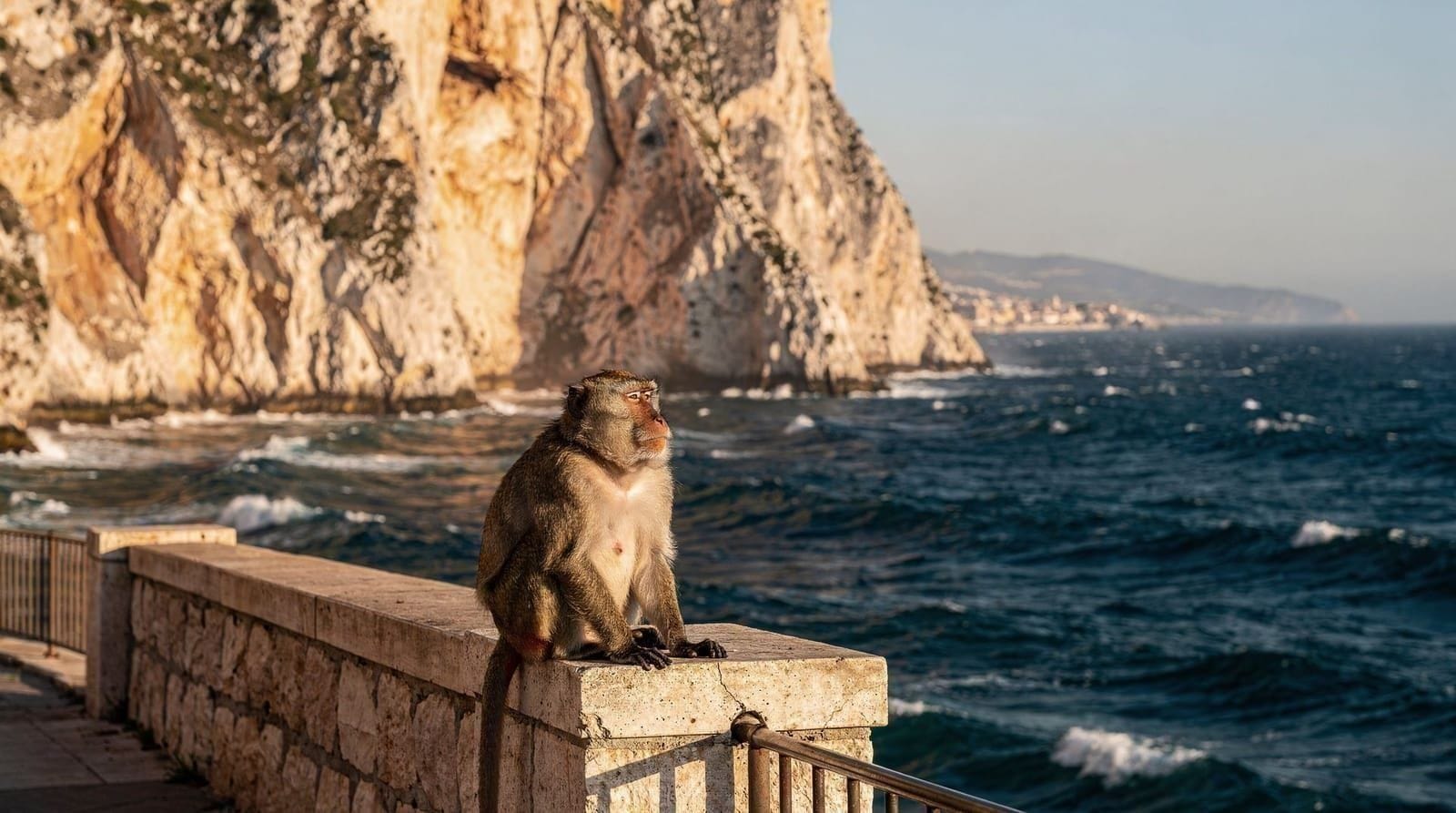
Barbary macaques: The only wild non-human primates in Europe. The colonies (approximately 200 individuals) live on the Upper Rock in several social groups. The Apes Den, midway up the Rock, is where a large group is reliably found. They will approach you, sit near you, and attempt to steal anything accessible. Do not feed them (illegal), do not put your face close, keep bags closed. They are genuinely entertaining despite the hazards.
A folk tradition (almost certainly invented by British military command as a morale story) holds that if the macaques ever leave Gibraltar, British rule will end. Winston Churchill allegedly ordered the colony reinforced during WWII when numbers fell. The truth: the Royal Gibraltar Regiment actually manages the population, provides veterinary care, and prevents the colony from declining.
St Michael’s Cave
A natural limestone cave system in the upper Rock, opened as a visitor attraction since the 19th century. The main chamber has been converted to an auditorium used for concerts; the stalactite and stalagmite formations throughout are impressive. Entry included in Upper Rock Nature Reserve ticket (£30 adult, covers cave, macaques, and siege tunnels). Allow 30-45 minutes.
The deeper cave system (Lower St Michael’s Cave) requires separate permits and is not open for casual visitors.
The Great Siege Tunnels
Between 1779 and 1783, Gibraltar’s British garrison withstood a 4-year combined Spanish-French siege — the 14th and longest siege of Gibraltar. The British solved the problem of defending the northern Rock face by tunnelling directly into the limestone to create artillery emplacements. The Great Siege Tunnels (also called the Upper Galleries) are cut through solid rock; the cannon emplacements overlook the isthmus with Spain at near-vertical angles.
The tunnels are perhaps the most historically significant site on the Rock — a genuine feat of military engineering under extraordinary pressure. Well-maintained, guided or self-guided. Allow 30-45 minutes.
Main Street and the city
Main Street is Gibraltar’s main commercial thoroughfare — duty-free electronics, tobacco, alcohol, and the concentrated British pub and fish-and-chips culture that makes Gibraltar feel like Hastings transposed to the Mediterranean. It is not subtle. If you came expecting a culturally complex experience, Main Street will disappoint. It is shopping and tourist infrastructure; nothing more.
More interesting: the historic residential quarter around the Jewish Quarter (Gibraltar has had a Jewish community since the 17th century; two working synagogues), the 18th-century Moorish Castle ruins on the west face, and the stretch of beach at Catalan Bay on the east side of the Rock (a different world from the crowded commercial town centre).
Planning the day: a realistic pace
A long day like this works best when you decide in advance what the one non-negotiable is. For most people it is the Upper Rock: the views, the macaques and the tunnels together make the strongest case for the trip, so protect that block of time and let everything else flex around it. Go up first, while you are fresh and before the middle of the day, then come down to Main Street for lunch and a short wander if the clock allows. Doing it in the reverse order means climbing in the hottest hours and meeting the biggest crowds at the top.
Pack light but sensibly: water, sun protection, comfortable shoes for uneven stone paths and tunnel floors, and a bag that closes properly because of the macaques. Keep your passport somewhere accessible, since you will show it more than once. Charge your phone, because you will take far more photos than you expect, and keep it zipped away when the monkeys are close.
Think also about the energy you will have at the end. The return leg is long, and the Rock involves a lot of standing and walking. If you are travelling with children, the Seville with kids guide has ideas for pacing long days, and the heat advice in the Seville summer heat guide applies just as much on the Rock as in the city. For a first-hand account of how the day felt, the Gibraltar day trip blog post is a useful companion to this guide.
Is the Gibraltar day trip worth it?
Honestly: for the right visitor, yes. The Rock’s combination of military history, extraordinary views, and the macaques is genuinely different from anything else on this list. The experience of walking from Spain into British territory has a pleasantly surreal quality.
The caveats: the border queue is the main variable that can ruin the day (a 2-hour queue each way cuts the time on the Rock to very little). Main Street is disappointing. The full cable car + Nature Reserve experience is expensive relative to comparable attractions. In July-August, the combination of heat, queues, and crowds is not great value.
Combining Gibraltar with dolphin watching
The Strait of Gibraltar, the 14-kilometre channel separating Europe from Africa, is one of the more reliable places in Europe for dolphin sightings — common and striped dolphins are seen on the large majority of trips, with occasional pilot whales and seasonal orcas. Some operators combine a Gibraltar day trip with a boat excursion out of Tarifa, making for a longer but genuinely varied day that pairs the Rock’s history with marine wildlife on the water.
From Seville: Gibraltar and Tarifa dolphin-watching day tripFood and where to eat
Gibraltar’s food scene reflects its odd cultural mix: British pub classics (fish and chips, Sunday roast) sit next to Spanish-influenced tapas and dishes with roots in the territory’s Genoese and Jewish communities. Casemates Square has the highest concentration of restaurants and pubs, most aimed squarely at day-trippers — prices run noticeably higher than equivalent food across the border in La Línea. If lunch matters more than convenience, eating in La Línea before or after crossing the border stretches your euro further; if you want the full “British pub in the Mediterranean” experience, Casemates delivers it without irony.
Comparing Gibraltar with Seville’s other day trips
Gibraltar is unlike anything else on Seville’s day-trip roster — the closest comparison is Tangier, another cross-border excursion with its own documentation requirements and a very different cultural flavour (Morocco rather than Britain). Cádiz, by contrast, is a straightforward Spanish coastal city with none of the border logistics. If your time is limited to one cross-border day trip, decide based on what draws you more: military history, the Rock, and British pub culture (Gibraltar), or the medina, mint tea, and North African atmosphere (Tangier). See Tangier day trip from Seville and Cádiz day trip from Seville for the alternatives.
If the Strait appeals more than the Rock, the nearby Tarifa page explains what the departure town offers, and the Tangier destination page covers the Moroccan side. Both are worth reading before you commit a full day to one side of the Strait.
For the Gibraltar destination page, see Gibraltar. For an overview of all day trips, see best day trips from Seville. For passport and documentation basics before any cross-border day trip, see Seville first-time travel tips.
From Seville: Guided day trip to Gibraltar with cable car and Rock tourFrequently asked questions about Gibraltar day trip from Seville
Do I need a passport for Gibraltar?
Yes. Gibraltar is a British Overseas Territory, not part of the EU customs union. All visitors must pass through Spanish and Gibraltarian border controls on foot or by vehicle. A valid passport is required. EU ID cards are accepted at the border but a passport is more reliable.What is the best way to see Gibraltar in a day trip?
The Rock of Gibraltar cable car gives the fastest access to the Upper Rock. Alternatively, a guided tour from the Casemates Square area covers St Michael's Cave, the Apes Den (where the Barbary macaques live), the siege tunnels, and the views. A self-guided walk up the Rock is possible but takes 3-4 hours and is very hot in summer.Are the Barbary macaques safe to approach?
The macaques are wild animals and can be aggressive. Do not attempt to feed them — it is illegal and makes them more aggressive. Do not put your face close to them or make sudden movements. They will often approach you and may try to take bags or sunglasses. Keep your belongings secured. Children should stay close to adults around the macaque colonies.Is Gibraltar worth visiting as a day trip?
Honestly, it depends on expectations. The Rock and macaques are unique, the views from the top are excellent, and the experience of crossing into British territory from Spain has an undeniable novelty. But in high season the border queues (often 1-2 hours) and the very touristic Main Street (duty-free shops and British pubs) can feel anticlimactic after the scenery. Midweek in spring or autumn is the best time.Is Gibraltar in the EU?
No. Gibraltar voted 95.9% to Remain in the 2016 Brexit referendum but left the EU with the United Kingdom. Post-Brexit, Gibraltar is a British Overseas Territory outside the EU single market and customs union. The border crossing between Spain and Gibraltar is an active international border. Currency in Gibraltar is the Gibraltar Pound, but British pounds sterling and euros are widely accepted.Can I combine Gibraltar with dolphin watching?
Yes. Some tours combine the Gibraltar day trip with a dolphin- or whale-watching boat excursion on the Strait of Gibraltar, typically departing from Tarifa. The Strait is a genuinely good spot for sightings — common and striped dolphins are frequent, with occasional pilot whales and, in season, orcas. It makes for a longer day but adds a distinct experience to the Rock visit.What should I eat in Gibraltar?
Gibraltar's food culture reflects its British-Mediterranean mix: fish and chips and Sunday roasts sit alongside Spanish-influenced tapas and Genoese-style dishes from the territory's Italian heritage. Main Street and Casemates Square have the highest concentration of pubs and cafés; prices are generally higher than equivalent food across the border in La Línea.
Top experiences
Bookable activities with verified prices and instant confirmation on GetYourGuide.