Tangier from Seville — crossing to Africa in a day
Crossing to another continent as a day trip from Seville sounds implausible until you’ve done it. Here’s the practical shape of the day before the full account of what Tangier is actually like.
| Total day length | around 14 hours (7am–9pm) |
| Time in Tangier itself | 4–5 hours |
| Ferry crossing | About 1 hour, Tarifa–Tangier |
| Cost, guided day trip | check current tour pricing; lunch usually included |
| Best for | a taste of Morocco, not a substitute for a real trip |
What you’re actually signing up for
A Tangier day trip from Seville is a long day — longer than most people expect. The city of Tangier is across the Strait of Gibraltar, but the journey from Seville’s city centre to the Tangier medina takes approximately 3.5–4 hours in each direction when you account for the coach to Tarifa (or Algeciras), the ferry crossing (about 1 hour), and the port processing on both sides. You arrive in Tangier with perhaps 4–5 hours of usable time before the return journey begins.
That’s enough time to see the medina, the Grand Socco and Petit Socco squares, the Kasbah, and eat lunch. It’s not enough time to do much more than this. If your expectation is a meaningful engagement with Morocco, a day trip from Seville is a superficial introduction. If your expectation is a genuinely different sensory and cultural experience tacked onto a week in Andalusia, it works well.
I went in May 2024 with deliberately modest expectations, and I came back having found it considerably more interesting than I’d anticipated.
The logistics
We booked a guided day trip that handles everything: the coach from Seville, the ferry, the local guide in Tangier, and lunch:
From Seville: Tangier day trip with local guide and lunchPickup from Seville at 7 am. Coach to Tarifa (about 1.5 hours on the A-4 and A-381). Ferry from Tarifa to Tangier (about 1 hour, FRS Maroc operates this route). Arrival in Tangier port approximately 11:30 am. Return ferry around 5 pm. Back in Seville around 9 pm.
The advantage of the guided tour over the independent approach is the local guide in Tangier — someone who knows which parts of the medina are actively trying to pressure-sell tourists, which route avoids the most aggressive touts, and where the non-tourist restaurant is. We also crossed the border as a group, which makes the process considerably faster than individual queuing.
The ferry crossing itself is worth noting: on a clear May day, the sensation of leaving the European coast and approaching Africa — the Rif mountains appearing through the haze, the density of Tangier rising from the port — is its own experience. The Strait of Gibraltar is only 14 km wide at its narrowest; you’re crossing between continents in about an hour.
Arrival and first impressions
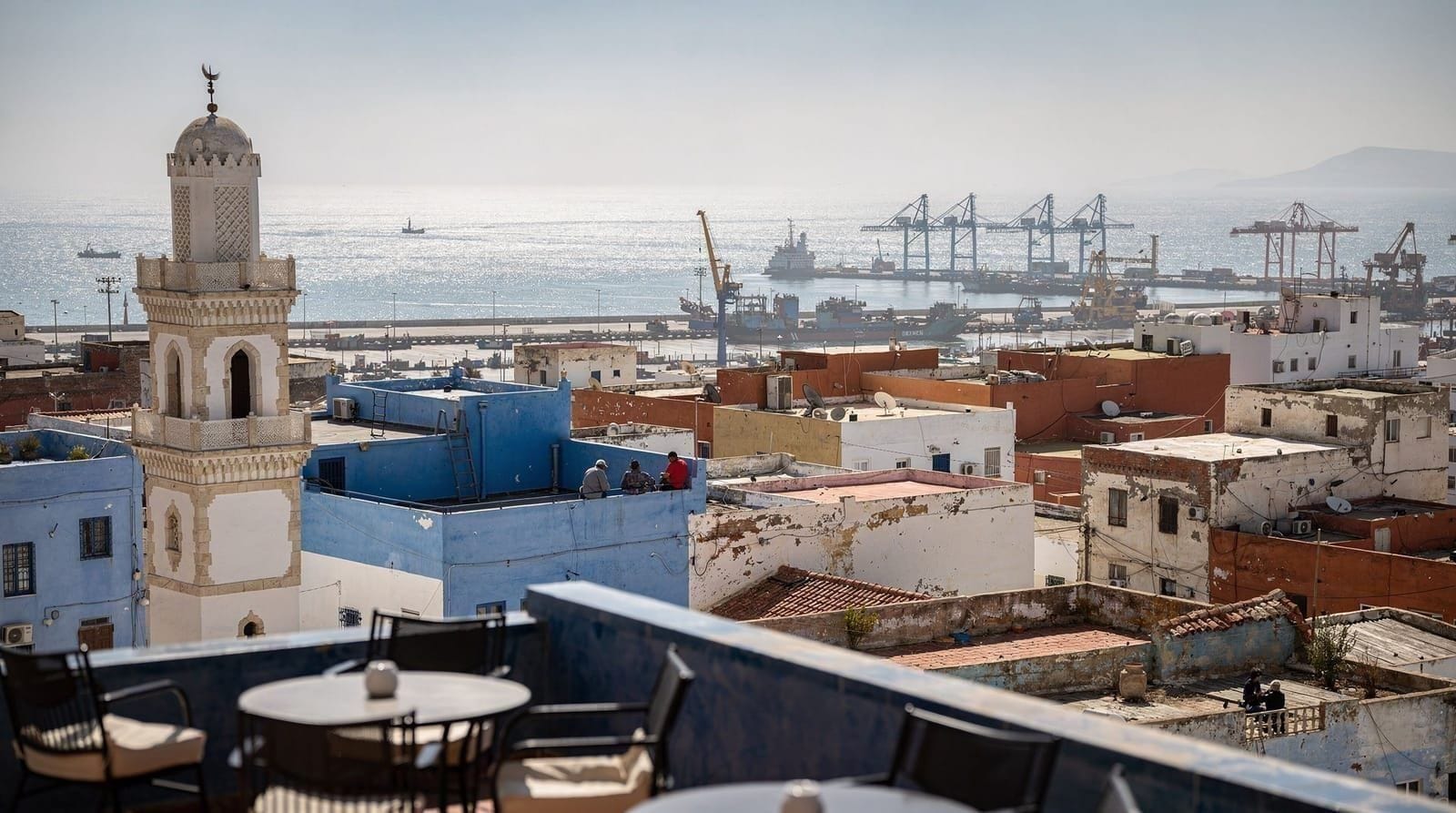
Tangier port is industrial and slightly chaotic, which is fine — most ports are. The medina begins almost immediately beyond the port gates, and the transition from the ferry terminal to the old city is abrupt and striking.
The Grand Socco (officially Place du 9 Avril) is the main square between the medina and the more modern city. It’s a working square — not tidied up for tourists, with a fruit and vegetable market on its edges, teenagers on scooters, older men in djellabas watching from the café terraces. Our guide walked us through it quickly and then into the medina itself.
The Tangier medina is smaller and less overwhelming than Fès or Marrakech — this is not necessarily a criticism, since being lost for six hours in a medieval maze is not everyone’s ideal. It’s possible to understand the layout within 30 minutes: the souks are arranged roughly by trade (textile merchants in one section, leather goods in another, spice vendors near the Grand Socco), the residential areas begin as the commercial noise drops off, and the Kasbah sits at the top overlooking the strait.
What I noticed that I hadn’t expected
The light. Mediterranean-Atlantic Tangier has a specific quality of light in May — stronger than Spain but not yet the bleached white of high summer, and the combination of the whitewashed walls and the blue strait is striking.
The café culture. The Petit Socco (Zoco Chico) is a small square inside the medina that was famous as a meeting place for European writers and artists in the 1950s and 1960s (Burroughs, Bowles, Ginsberg, Kerouac all spent time in Tangier). The cafés around it are genuinely nice places to sit — mint tea is €0.80–1.20, pastilla (the sweet pigeon pie) is available in a few restaurants — and the square has an atmosphere that feels lived-in rather than tourist-curated.
The touts. Yes, they exist. Young men will approach the group and offer to guide you, sell you things, take you to their cousin’s carpet shop. They’re persistent but not dangerous, and the standard response (polite but firm: “La shukran” — no thank you) works reliably. Our guide was good at running interference.
The food. Lunch was at a rooftop restaurant near the Kasbah with views of the strait — the kind of place that’s obviously partly tourist-oriented but uses good ingredients and doesn’t charge tourist prices for the quality. We had harira (lentil and tomato soup with lemon), bastilla, and a tagine of chicken with preserved lemons and olives. Mint tea at the end. €12–15 per person for three courses and tea. Compared to equivalent tourist-restaurant pricing in Seville, this is very good value.
The Kasbah and the museum
The Kasbah is the old fortress district at the top of the medina, with a museum inside what was once the palace of the Moroccan sultans (the Dar el-Makhzen). The museum houses Roman mosaics from nearby Volubilis, Islamic art, and a good collection of objects relating to Tangier’s 20th-century international period (1923–1956, when Tangier was administered by an international zone and attracted artists, spies, and various categories of person seeking to operate outside normal national jurisdiction).
The Kasbah museum charges a small entry fee (check the current price and opening days on site), and the views from the ramparts over the port and the strait are some of the best in the city.
The terrace of the Café Hafa, just outside the medina walls with direct views over the strait to Spain, is worth the walk. It’s been open since 1921, it has no food (just mint tea and a few snacks), and it was a favourite of Paul Bowles and the Rolling Stones, facts that are now displayed on every available surface. Despite the tourism-of-nostalgia, the terrace itself remains beautiful.
The uncomfortable parts: touts and pressure selling
I want to be specific about this because it’s the thing that most concerns first-time visitors to Morocco. The Tangier medina has people whose job is to direct tourists to specific shops and receive a commission. They will approach you as a friendly local, ask where you’re from, offer to show you something interesting, and end up guiding you to a carpet or leather shop where the owner will demonstrate products for 20 minutes while someone else prepares tea.
This is not dangerous. It is pressure-selling of a type that most Western tourists find uncomfortable. The solution is either to have a guide who knows which streets to avoid, or to be comfortable saying “no thank you” repeatedly without guilt. The guided tour from Seville manages most of this by keeping the group together and moving purposefully.
If you decide to wander independently from the group, which is fine and produces some of the best medina moments, be clear about what you’re doing: when someone says “I’ll just show you something, no obligation,” there is always an obligation in their framework even if not in yours.
Is it worth doing?
For a traveller who won’t make a separate Morocco trip, this day trip is the most efficient way to have a genuine — if abbreviated — encounter with Morocco. The cultural distance between Seville and Tangier is real and striking: the muezzin call from the mosques, the smell of cumin and ras el hanout in the spice souks, the Arabic and Darija of the streets, the mint tea ceremony — these are authentically different from anything on the Spanish side of the strait.
For a traveller who will spend time in Morocco separately, this day trip is redundant — Tangier is one of Morocco’s less representative cities (it was heavily shaped by European influence during the international period) and you’d be better served going directly to Fès, Marrakech, or the coast.
The Tangier day trip guide covers all the logistics in depth if you’re planning ahead.
Where Tangier fits in a longer Andalusia trip
A crossing to Africa works best when it is one deliberate break in a trip that is otherwise built around Seville itself. If you are still deciding how long to stay, our how many days in Seville guide helps you see how much room a long day away leaves for the city. The Seville 4 days itinerary and the Seville 5 days itinerary both have the kind of slack where a full day out of town makes sense, while a Seville 2 days plan really does not.
If you would rather stay on the Spanish side, the other long excursions are easier on the body. The Córdoba day trip from Seville and the Granada day trip from Seville both give you a big historic monument without a border, and Córdoba in particular suits travellers who want Islamic heritage without the early start and the ferry. For a wider view of how these options stack up, the Seville day trips itinerary lays out how to space them across a week, and planning a week in Andalusia is our own account of doing exactly that.
If the Islamic architecture is what draws you to Tangier, it is worth seeing what Seville already offers before you go. The Real Alcázar complete guide covers a palace built in the same Moorish tradition, and many travellers find that visiting it first makes the medina and the Kasbah easier to read. Our Gibraltar day trip report is the honest companion piece if you are still torn between the two crossings, and the Tangier destination page gathers the background on the city in one place.
Practical notes
Currency: Morocco uses the Moroccan dirham (MAD). The guided tour handles most costs in advance, but bring €20–30 in local currency for personal purchases (the guide can usually change money at a fair rate).
What to wear: Seville in May is shorts-and-t-shirt weather; the medina warrants slightly more coverage, not for strict religious reasons but because it’s more comfortable in the sense that you attract less attention.
Photography: The medina is photographable, but ask before photographing individuals — some will ask for a small payment, which is reasonable.
Visas: EU, UK, US, Canadian, and Australian citizens can enter Morocco visa-free for stays up to 90 days (terms subject to change — verify current requirements).
Health: Morocco’s food is safe to eat at established restaurants. Tap water quality in Tangier is fine by Moroccan standards; stick to bottled water if in doubt.
Frequently asked questions about Tangier from Seville
How long does the trip take?
Allow a full day: 7 am departure from Seville, arriving back around 9 pm. Approximately 4–5 hours in Tangier itself.
Do I need a visa to visit Tangier?
Most Western nationalities (EU, US, UK, Canada, Australia) can enter Morocco visa-free for short stays. Check current requirements before travel.
Is Tangier safe for tourists?
Yes. Tangier is one of Morocco’s most visited cities and is generally safe. The main issue is persistent attention from touts and commission-sellers in the medina, not physical safety.
Can I visit Tangier independently without a guide?
Yes. Take the ferry from Tarifa independently, navigate the medina on your own. It’s manageable, but a guide substantially reduces the stress of navigating the medina and dealing with touts.
What currency do I need?
Moroccan dirhams (MAD). Some tourist shops accept euros, but at a poor rate. Bring some local currency for souvenirs and personal spending.
How it compares to Gibraltar as a day trip
Tangier and Gibraltar are the two “somewhere completely different” day trips from Seville, and they’re often weighed against each other:
| Factor | Tangier | Gibraltar |
|---|---|---|
| Travel time from Seville (each way) | 3.5–4 hours | 3–3.5 hours |
| Border crossing | Ferry + Moroccan customs | UK land border |
| Cultural distance | Significant (different country, language, continent) | Moderate (British enclave, English-speaking) |
| Best for | A genuine taste of Morocco | An easy, low-friction different-country stamp |
| Physical demands | More walking, more sensory intensity | Less demanding, more compact |
If your week has room for only one of these, Tangier gives the bigger cultural shift; Gibraltar is the easier half-day-feeling option with less logistics stress. The Gibraltar day trip from Seville guide covers that alternative in full, and our best day trips from Seville guide puts both in context against Córdoba, Cádiz, and Ronda.
Tarifa: worth a stop either direction
Tarifa, the departure point for the ferry, is worth a mention on its own — it’s mainland Europe’s southernmost town, a windsurfing and kitesurfing hub with its own laid-back character, and visible from the Tangier side across the strait. If you have flexibility, some tours allow a short stop in Tarifa’s old town on the return leg; ask when booking, since not all itineraries include it. Independent travellers doing the crossing themselves can build in an hour or two in Tarifa before or after the ferry without much extra planning.
Seville: private Gibraltar and Tangier day trip