Christmas markets in Seville — what to actually expect
Not German Christmas markets
Let me set expectations immediately: Seville’s Christmas markets are not the Nuremberg or Strasbourg model — no mulled wine (though you can find similar), no identical wooden stalls in a perfect grid around a huge tree. What Seville does is its own thing, and understanding that is the key to enjoying it.
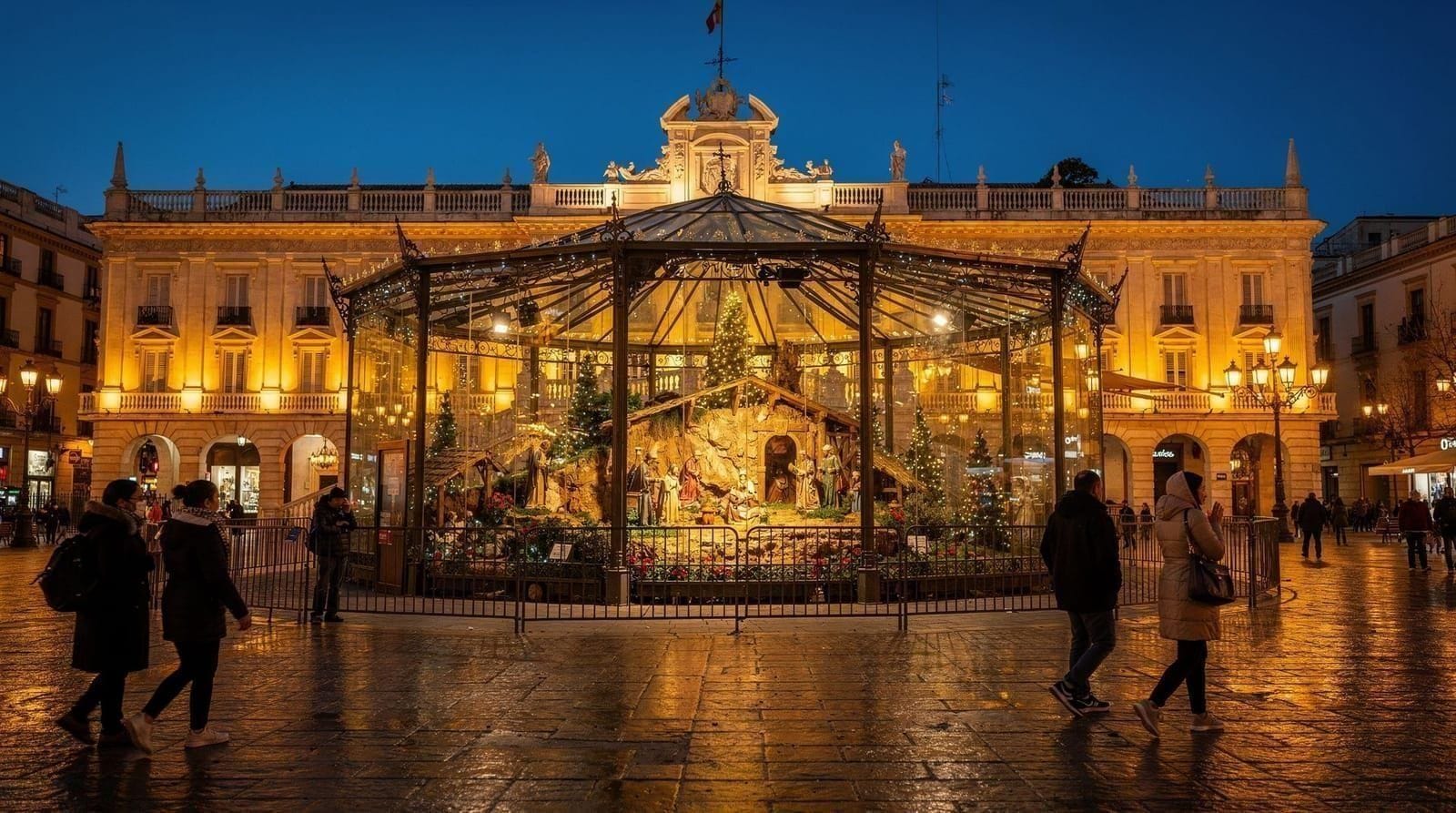
The city during the Christmas period — roughly from early December through 6 January (Epiphany, the actual present-giving day in Spanish tradition) — is lit up, crowded in a different way than tourist season, and genuinely festive in a way that feels organic rather than performed. The streets of the historic centre are strung with lights that rival anything in Northern Europe. The nativity scenes (belenes) in church porches, shop windows, and public buildings are elaborate and taken seriously. And the weather — 14–17°C in December, occasionally rainy but often clear — is considerably more pleasant for wandering than most European Christmas market climates.
| Where | Historic centre, Calle Sierpes area — locations change each year (see visitasevilla.es) |
| When | Dates change each year (see visitasevilla.es) |
| Cost | Free entry; food €1.50–5, gifts €12–18+ |
| Weather | 11–17°C, occasional rain |
| Crowds | Much lighter than spring/autumn, except Christmas week |
For the fuller season picture beyond the markets specifically — what else is open, what changes, how prices move — see the Seville in winter guide and Christmas in Seville guide.
The Christmas markets
Seville’s Christmas markets and their dates change every year; check the official tourist office website (visitasevilla.es) for the current locations and dates. The stalls sell a mix of Christmas decorations, artisan food, seasonal sweets, and craft products.
The food stalls are the most interesting part. Pestiños — honey-dipped fried pastry — are the traditional Sevillano Christmas sweet, made by hand at several stalls and sold warm for €1.50–2 each. Polvorones and mantecados (crumbly shortbread-style biscuits) are everywhere. Hot churros with chocolate are available all day. There are also stalls selling turrón — the nougat confection that appears in Spain exclusively around Christmas — in enough varieties (Alicante hard, Jijona soft, chocolate, marzipan) to spend a long time comparing.
The craft stalls are hit-and-miss. Some sell genuinely handmade ceramics, leatherwork, and textiles; others sell the same mass-produced Christmas decorations you’d find in any market. The quality filter I apply: if it has a price ticket that looks printed rather than handwritten, it’s probably not local.
Best time to visit the markets: late afternoon from 5 pm onward, when the lights come on and the square fills with Sevillanos doing their own Christmas shopping. Avoid Saturday mornings if you’re crowd-averse — it gets genuinely packed.
The Belén del Patio de San Eloy
One of the best free things in Seville at Christmas is the giant nativity scene installed annually in the courtyard of the Patio de San Eloy, a covered arcade near the Calle Sierpes shopping street. This is not a church nativity — it’s a full-scale artistic production with hundreds of figures, mechanical movements, running water, and lighting effects. Sevillanos queue to see it, which tells you something.
Entry is free. Opening hours change each year; check visitasevilla.es.
Shopping street lights: worth the walk
Calle Sierpes and Calle Tetuan — the two main pedestrian shopping streets — are illuminated with LED light installations that Seville has invested in upgrading in recent years. The current installation changes colour gradually over the evening, creating a slow-motion light show above the shops. It sounds garish; it’s actually rather beautiful, particularly when the streets are quiet in the late evening.
The shops along these streets sell everything from the luxury brands you’d find in Madrid to the local artisan shops that stock Seville-specific products — fans, ceramics, linen, olive oil gift sets. December prices on non-tourist goods are unaffected by the tourist premium; you can buy a good olive oil gift set for €12–18 here, considerably less than the gift shops near the Cathedral charge.
Christmas traditions unique to Seville
La Cabalgata de Reyes Magos (5 January): The most important procession of the Seville Christmas calendar. The Three Kings — Melchior, Caspar, and Balthazar — parade through the city on floats, throwing sweets to the enormous crowds. This is the night before Epiphany, when Spanish children traditionally receive their presents. The parade route covers the main streets of the historic centre and runs for several hours. Arrive early for a position with sightlines; the crowds are extraordinary.
El Gordo (22 December): Spain’s enormous Christmas lottery draw, broadcast live on national television. Bars and cafés throughout Seville fill up around 9 am for the televised draw, which lasts for hours as the prize numbers are sung (yes, sung) by children from the lottery school. Even if you haven’t bought a ticket, watching Sevillanos react to the results — collective joy, occasional tears, frequent small prizes celebrated with surprising intensity — is an authentic experience.
Nochebuena vs Nochevieja: Christmas Eve (Nochebuena, 24 December) is the main family dinner in Spain, not Christmas Day. New Year’s Eve (Nochevieja) involves eating twelve grapes at midnight, one per bell stroke, for good luck in the new year. Both are primarily family occasions; the city centre on these evenings is quieter than usual as everyone is at home with their families.
Making the most of a December visit beyond the markets
The Christmas period is also one of the better windows to do the Alcázar and Cathedral without the spring queues — both stay open on their normal schedules through the holidays, with only minor reductions on 25 December and 1 January. A guided city walking tour timed for late afternoon lets you combine the illuminated shopping streets with the historic centre in a single outing, useful on shorter December days when daylight runs out by 6 pm:
Seville 4-hour guided walking tourIf the Alcázar is on your list, December is a forgiving month to see it, and a guided visit gives the palace rooms and gardens more context than wandering alone. Booking a guided palace visit with skip-the-line entry is worth considering if you would rather not improvise on the day, and our Alcázar tickets guide and complete Real Alcázar guide explain the ticket options. The same logic applies to the Seville Cathedral complete guide if you want to climb the Giralda.
If budget is a bigger factor in December than in other seasons — and for many visitors it is, since accommodation is cheaper this time of year — the Seville on a budget guide has a broader breakdown of how to stretch a winter trip further.
Fitting the markets into a longer stay
The markets rarely fill more than an evening or two, so most visitors pair them with the rest of the city. A relaxed rhythm works best: sights by day, then the lights and the stalls once the sun goes down. If you are still deciding how long to stay, the how many days in Seville guide helps, and the Seville 3 days itinerary is an easy frame to slot a market evening into.
Staying near the historic centre makes the whole thing simpler, since the market square, the shopping streets and the Cathedral are all within walking distance of each other. The where to stay in Seville guide and the Santa Cruz neighborhood guide cover the practical side of choosing a base. For getting between neighbourhoods after dark, the getting around Seville guide is a useful read.
If you are travelling with children, the nativity scenes, the sweets and the lights tend to go down well; the Seville with kids guide has ideas for pacing days around younger travellers. And if the festive season is part of a wider winter break in Andalusia, the Córdoba day trip from Seville is a natural addition. For another first-hand account of the city, see our 3 days in Seville trip report.
Where to eat during the Christmas period
Seville’s restaurants and bars operate normally throughout December, with the exception of 24 December evening (many close early or only serve for families with reservations) and 25 December (a significant number close entirely). Check before you go.
For the Christmas period specifically, some traditional dishes appear on menus that aren’t available year-round: caldo (rich broth), bacalao en salsa (salt cod in tomato sauce), and the various Christmas sweets mentioned above. Bar El Comercio in Triana, which has been open since 1904, makes a particularly good caldo that appears on its winter menu from December onward.
The where to eat in Seville guide is useful for identifying bars open during the holiday period, and the Seville in winter guide covers the full picture of what the city is like in December–February.
Practical notes for a December visit
Accommodation: December (excluding the Christmas week itself) is one of the cheaper months in Seville. Mid-range hotels that charge €150+ in April will often be available for €80–100 in early December. The week between 25 December and 2 January sees a secondary price rise as domestic tourists arrive for the holidays.
Weather: Average temperatures in December are 11–17°C. Rain is more likely than in summer but still relatively infrequent — Seville averages 7–8 rainy days per month in winter. A light rain jacket is sensible; a heavy winter coat is not necessary.
Crowds: Much lighter than spring or autumn. The Cathedral and Alcázar queues that can stretch an hour in April will often be under ten minutes in December. The exception is the week between Christmas and New Year, when domestic tourism partially fills the gap.
Opening hours: Some smaller museums and churches have reduced winter hours. The Alcázar and Cathedral maintain their regular schedules. Check individual venues.
Language: Seville’s Christmas traditions are very locally observed; fewer staff at tourist venues will speak English during December than during summer, as the expat and student population that bolsters the English-speaking workforce drops off after October.
Is Seville at Christmas worth it?
Genuinely yes, with modest expectations. It won’t replace Vienna or Prague if you’re specifically seeking the Northern European Christmas market aesthetic. But it will give you Seville’s own character — warm, social, family-oriented, food-obsessed — in a context where you can actually have an experience without fighting tourist crowds for position at every sight.
The combination of good weather, shorter queues, lower prices, and the city in festive mode makes December one of the more underappreciated months to visit. January, after the Three Kings on 6 January, is even quieter and cheaper still.
Frequently asked questions about Christmas in Seville
Are there mulled wine stalls at the Seville Christmas market?
Not in the Northern European sense, but you can find vino caliente (hot spiced wine) at some of the Christmas market stalls. Chocolate with churros is the more typical warm drink option.
When does the Christmas market in Seville open?
Seville’s Christmas markets and their dates change every year; check the official tourist office website (visitasevilla.es) for current dates.
What are pestiños?
Pestiños are the traditional Sevillano Christmas pastry: fried dough flavoured with sesame and anise, coated in honey or sugar. They’re only made in significant quantities during the Christmas period and are worth trying warm from a market stall.
Is the Alcázar open at Christmas?
Yes, with normal hours. The Royal Alcázar does not close for Christmas and New Year. It may have slightly reduced hours on 25 December and 1 January — check the official website.
How busy is Seville on New Year’s Eve?
The Puerta de Jerez and the area around the Cathedral fill up with people at midnight, but not to the sardine-tin extent of, say, Times Square. It’s a manageable crowd and a pleasant atmosphere, especially if you’re near a bar with a television showing the Nochevieja broadcast from Madrid.
Is December a good time to visit the Alcázar and Cathedral?
Yes — both stay open on normal schedules through the holidays (with minor reductions on 25 December and 1 January), and queues that stretch an hour in April are often under ten minutes in December.
Do I need a coat for a December trip to Seville?
A light rain jacket is usually enough; a heavy winter coat isn’t necessary. Average temperatures sit around 11–17°C, colder in the evenings.