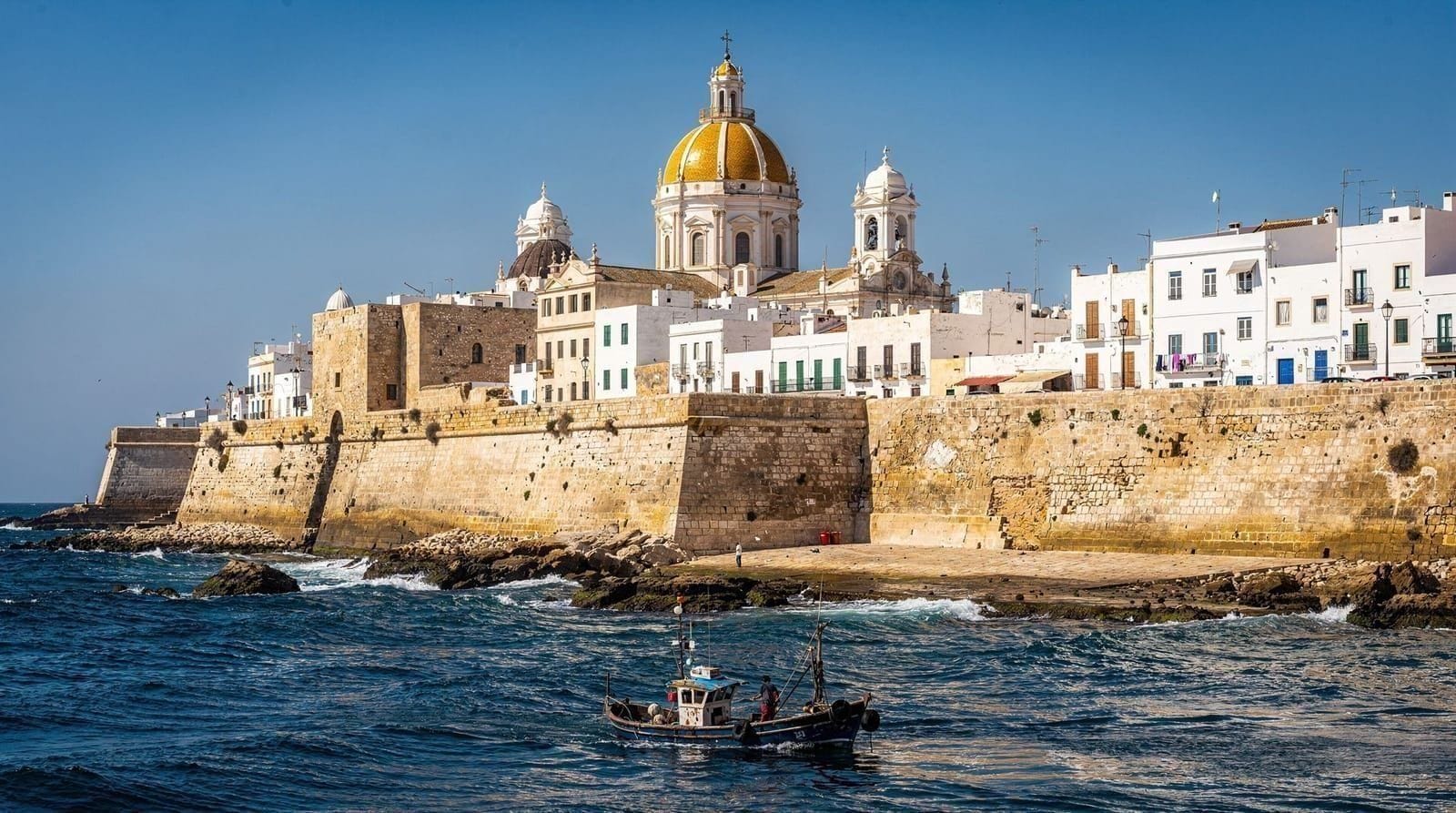
Cádiz — visiting Europe's oldest city
What 3,000 years of history looks like
Cádiz is claimed to be the oldest continuously inhabited city in western Europe — founded by Phoenicians around 1100 BCE, which would make it roughly three millennia old. The history is there if you look for it, but what strikes you first when you arrive is not antiquity but geography: the city is built on a narrow peninsula jutting into the Atlantic Ocean, almost entirely surrounded by water, with the tower of the Cathedral visible from the sea approach and the whole place glittering white in the summer light.
I went in early August, which I’d argue against in retrospect — not because Cádiz in August is unpleasant (the Atlantic breeze keeps the temperatures 5–8°C cooler than Seville in summer), but because the beaches are extremely crowded with Spanish vacationers and the city operates on holiday rhythm rather than its full self. The better visits are May–June or September–October, when you get the good weather without the August compression.
The city is 125 km from Seville by road and 1 hour 40 minutes by direct Renfe train (check current fares on the Renfe website). The train deposits you near the heart of the old city, which is a significant advantage over driving (parking in Cádiz is a nightmare, particularly in summer).
| Where | 125 km southwest of Seville, on the Atlantic coast |
| Getting there | Direct Renfe train, ~1hr 40min, or guided day trip |
| Cost | Train fare on the Renfe website, plus entry fees (Cathedral €12, Torre Tavira €8) |
| Time needed | A full day (8am–8pm realistic) |
| Best months | May–June, September–October |
If you’re deciding between Cádiz and Seville’s other coastal or historic day trips, the best day trips from Seville guide ranks the full set, and the Jerez day trip guide covers the closest comparable option for sherry and horses instead of ocean and antiquity.
Getting there: the options
The direct Renfe train from Seville Santa Justa to Cádiz is the most efficient option if you’re doing this independently. The station in Cádiz is close to the old town, the trains are frequent, and the journey through the Guadalquivir marshes and past the industrial waterfront at Puerto de Santa María is itself interesting.
For a guided day trip that handles the transport and adds historical context:
From Seville: Cádiz full-day guided excursionThe guided tour is worth considering if you want the narrative — Cádiz’s extraordinary history (Phoenicians, Romans, Visigoths, Moors, the Spanish Empire’s primary Atlantic port) benefits from someone who can make it coherent. Going independently means reading more beforehand.
The old town: what to prioritise
Cádiz’s old town (the peninsula tip, Barrio del Pópulo, El Mentidero, and the area around the Cathedral) is compact enough to cover on foot in an afternoon. The following is my personal priority list for a single day:
The Cathedral: The Catedral Nueva, finished in 1838 after almost a century of construction, is a remarkable hybrid of Baroque and Neoclassical styles. The exterior is famous for its yellow-and-white cupola visible from miles out at sea. Entry is €12 (includes the Clock Tower and the Casa de la Contaduría). The Torre Tavira watchtower is ticketed separately at €8 (book ahead on its website) and gives the best views over the city and ocean.
The Mercado Central: The city’s covered market is architecturally beautiful (19th-century iron-and-glass hall) and in practice excellent for the fish and seafood stalls. In August the selection included: live razor clams, langostinos from Sanlúcar, ortiguillas (sea anemones, a Cádiz speciality), and the inevitable fresh tuna from the almadraba trap fishery nearby. The seafood here is not a tourist performance — the local fishing fleet supplies a real market for real Gaditanos.
The Barrio del Pópulo: The oldest neighbourhood in the city — some of the streets here date to the medieval period, with Roman foundations visible in the occasional archaeological opening. The small square in front of the Teatro Romano (the exposed ruins of a 1st-century BCE theatre discovered underneath a medieval theatre) is one of those sites that brings the archaeology up through the surface of the modern city in an unusually direct way.
La Caleta beach: This small bay on the western tip of the peninsula faces southwest toward the Atlantic and has been a bathing beach since Roman times. In August at 4 pm it was impractical (too many people). But in the early morning or off-season, it’s a beautiful city beach with none of the commercial development of the bigger beaches.
The food: what makes Cádiz specifically worth eating
Cádiz has a distinct culinary identity within Andalusia, centred on seafood and specifically on the fritto — the fried fish tradition that claims to have invented the technique that spread to Britain as “fish and chips” (via Jewish Sephardic communities who left Spain after 1492 and maintained the recipe in London). Whether or not the historical claim is accurate, the execution is exceptional.
The key preparation is masa fina — batter made with very cold, slightly sparkling water that produces an almost transparent, shatteringly crisp shell around the fish. At its best, the batter is barely there. The best place I found for this was Freiduría Las Flores at Plaza de las Flores — a standing-only, no-nonsense fry shop that’s been operating since 1937. At €8–10 for a mixed paper cone of boquerones, cazón en adobo (marinated dogfish), and calamari, it’s one of the best eight euros you’ll spend in Andalusia.
The other Cádiz speciality is the tortillita de camarones — a very thin, lacy fritter of baby shrimps bound with a chickpea flour batter. These are €3.50–5 at most bars and are invariably better in Cádiz than anywhere else. Bar Manteca in the Barrio del Pópulo makes a particularly good version alongside its substantial collection of ibérico and local cold cuts.
Eating lunch in Cádiz in August at 2:30 pm (the normal Spanish time) means joining the real city rather than the beach crowd: the fish market bars fill with fishermen and office workers, the wine is cheap and cold, and nobody is paying much attention to you.
The tapas culture: different from Seville
Cádiz’s bar culture is older and rougher than Seville’s more polished tapas scene. The bars tend to be smaller, the service more abrupt, the pricing more honest. At a bar in the Barrio del Pópulo or the old fishermen’s district, a glass of ice-cold Manzanilla from Sanlúcar is €2, the tapas are €2–3, and the default assumption is that you’ll eat at the bar rather than at a table.
One specific recommendation: Taberna El Cordobés near the Mercado Central does a remarkable caracoles (snails in a spiced broth) that appears on the menu only in the late summer months when the snails have finished their grain-field diet. €6 for a substantial bowl. The interior has barely changed since the 1960s.
A note on the history you can’t see
Cádiz was the wealthiest city in Spain for most of the 18th century, when it held the monopoly on trade with the Spanish colonies in the Americas. The silver and gold that flowed through its port financed the Spanish Crown and shaped European power politics for a century. Almost nothing of this extraordinary wealth is visible today — the buildings are there, but the context is missing from most tourist materials.
The Museo de Cádiz (entrance €1.50, EU citizens free) addresses this in part: it has a strong collection of Phoenician and Roman artifacts from archaeological sites throughout the province, and a smaller but good collection of Zurbarán paintings from the colonial period. Two hours minimum.
The 1812 Spanish Constitution — the first modern democratic constitution in Spanish history, drafted in Cádiz during the Napoleonic occupation when it was the only free city in Spain — is commemorated at the Cortes de Cádiz building near the Cathedral. A small museum documents the process; worth 30 minutes if you’re interested in European constitutional history.
Combining Cádiz with Jerez in one day
If a single day trip has to cover more ground, Cádiz and Jerez de la Frontera pair reasonably well since both sit along the same rail and road corridor southwest of Seville. It’s an ambitious day — you’ll trade depth in each city for breadth across two — but it works if your time in the region is genuinely limited to one day:
From Seville: Cádiz and Jerez combined day tripWe’d only recommend the combined version if you’re not planning a separate Jerez visit; on its own, Jerez deserves the fuller treatment covered in the Jerez day trip guide, including the sherry bodegas and the Royal Andalusian School of Equestrian Art.
Is Cádiz better than Jerez as a day trip from Seville?
Different in kind, not directly comparable. Cádiz offers a complete city experience: ocean, history, architecture, beaches, and excellent seafood. Jerez offers two very specific things (sherry and horses) done exceptionally well. Cádiz is more immediately accessible as a day trip for most visitors; Jerez rewards more targeted interest.
The Cádiz day trip guide covers the full logistics in detail, and the comparison guide Jerez vs Cádiz day trip addresses the question of which to prioritise if you can only do one.
Where Cádiz fits in a longer Andalusia trip
Cádiz works best as one chapter of a bigger plan rather than a stand-alone excursion. If you’re still deciding how many days to give Seville itself, the how many days in Seville guide and the Seville in 3 days itinerary show where a coastal day slots in without stealing time from the Alcázar and the Cathedral. For a wider loop that includes the coast, the Andalusia week from Seville itinerary strings several of these trips together.
Once you’ve seen the Atlantic side, the town of El Puerto de Santa María across the bay is an easy addition, and Sanlúcar de Barrameda, where the manzanilla and the langostinos mentioned above come from, makes a natural follow-up visit. Our Cádiz destination page collects the essentials in one place.
If the coast has you wanting more, the Costa de la Luz stretches beyond the city, and Tarifa sits further along it. Travellers who prefer inland scenery to beaches will find the white villages day trip a very different but equally rewarding day.
Back in Seville, the sensible way to balance a tiring coastal day is to keep the next morning for the city’s headline sights. Booking the Alcázar ahead is covered in our skip-the-line decoder, which saves you from improvising once you’re back.
Practical notes
Parking: Genuinely difficult. If driving, use the car park at the rail station approach rather than attempting street parking in the old town.
Beach timing in summer: La Caleta and Playa de La Victoria (the main beach, on the Atlantic-facing eastern side of the peninsula) are full by 10 am in August. Go before 9 or after 5:30 for a sensible experience.
August closures: Some smaller restaurants and bars close for vacation in August — the same paradox that affects many Spanish cities where the residents leave during tourist season.
The ferry to El Puerto de Santa María: A 45-minute ferry connects Cádiz to El Puerto de Santa María across the bay. This is a pleasant excursion that gives you two waterfront cities in a day.
Frequently asked questions about Cádiz
How long does it take to get to Cádiz from Seville by train?
Approximately 1 hour 40 minutes by direct Renfe train. Trains run frequently (every 1–2 hours).
Is Cádiz really Europe’s oldest city?
It’s one of the oldest continuously inhabited cities in western Europe, with Phoenician settlement documented from around 1100 BCE. Exact claims about “oldest” depend on definition (and competing claims from places like Lisbon and Cádiz’s rival Loulé). The historical record in Cádiz is genuine and well-documented.
Is Cádiz good for families with children?
Yes. The beaches are excellent for children, the old town is manageable on foot, and the seafood fry shops (order by the cone) are universally popular with younger visitors.
What is the best month to visit Cádiz?
May–June and September–October offer good weather, manageable crowds, and the full city in operation. August is hot but bearable thanks to ocean breezes; July and August beaches are packed.
Is Cádiz safe?
Yes. Cádiz has a very low level of tourist-directed crime. Normal city awareness applies, particularly around crowded markets in summer.
Can I combine Cádiz with Jerez in one day trip from Seville?
Yes, though it’s an ambitious day that trades depth for breadth in both cities. It works if your time in the region is limited to a single day; otherwise, a dedicated visit to each is more satisfying.