Feria de Abril as a first-timer: what I wish I'd known
The fair that Seville throws for itself
The Feria de Abril is not designed for tourists. This is both its greatest quality and its most significant challenge for visitors. The two-week gap between Semana Santa and the Feria — which opens two weeks after Easter Sunday and runs for six days — is a city-wide decompression followed by a city-wide celebration, and the city is celebrating for itself. I went in without a local contact the first time, made every rookie mistake below, and came back the following year to do it properly.
| Where | Recinto Ferial, west bank of the Guadalquivir, Los Remedios |
| When (2026) | 21–26 April, opens with the alumbrado on Monday midnight |
| Cost to attend | Free to walk the grounds; a bottle of manzanilla around €10–15 |
| Dress | Traje de gitana / traje corto optional but common; smart-casual fine |
| Booking ahead | Accommodation months in advance; guided caseta access weeks in advance |
Most of the 1,040 casetas (private marquee tents) that line the Feria grounds at the Recinto Ferial on the west bank of the Guadalquivir are private: run by families, hermandades, businesses, and political parties for invited guests only. You cannot walk into them. You certainly cannot pull up a chair and order manzanilla.
Understanding this upfront is essential. The Feria is not a festival where you pay an entry fee and access everything inside. It is a party with 1,000 different host families, most of whom are hosting their specific community.
What visitors can actually access
There are public casetas — run by the Seville city council, by some districts, by political parties open to the public, and by a handful of restaurants and businesses that operate them commercially. These are spread through the grounds and can be identified by signs and (often) slightly longer queues.
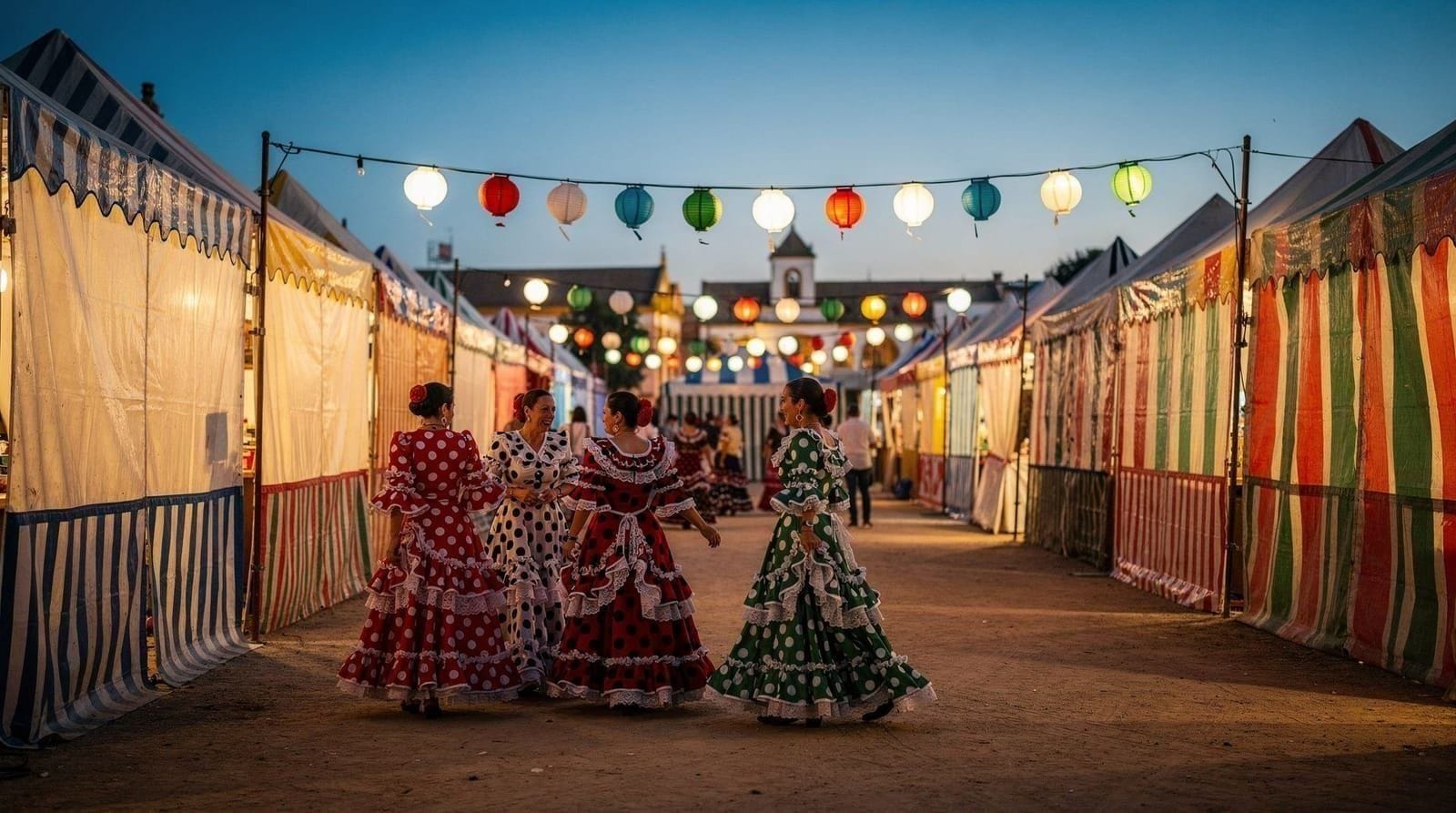
The street itself — the alley between casetas — is always publicly accessible. Walking the Calle del Infierno (where the fairground rides are), watching horse-drawn carriages pass with women in flamenco traje de gitana and men in riding suits, seeing the lanterns (farolillos) lit at dusk — all of this is free and genuinely magnificent.
The solution most experienced visitors use: arrive with an invitation to someone’s caseta.
Getting into a private caseta
If you have Spanish friends or business contacts in Seville, this is the moment to deploy that connection without shame. An invitation to a good private caseta — with proper manzanilla from Sanlúcar, plates of jamón and gambas, dancing that goes until 5 am — is one of the more memorable social experiences available in Spain.
Without a connection, the options are:
Public casetas: The caseta de la Diputación (provincial government) and the caseta de la Juventud are both accessible. Expect queues and somewhat less of the intimate atmosphere.
Commercial operators: Some tour companies sell organised Feria experiences that include access to a catered caseta. The quality varies significantly. If the package advertises a “Feria experience” without specifying which caseta you’re accessing and whether the food/drink is included in the price, probe harder before booking.
The streets and grounds generally: You can spend four hours at the Feria, eat at the food stalls (churros, espetos, bienmesabe), watch the carriage parade, see the alumbrado (the lantern-lighting ceremony, which happens on the Monday evening), and have an entirely authentic experience without setting foot in a private caseta.
Dress code: serious business
The traje de gitana (the traditional flamenco dress) worn by Sevillanas at the Feria is not costume tourism. It is formal Feria attire, worn by women of all ages as a genuine expression of local cultural identity. Men wear the traje corto: short-jacketed riding suit, riding boots, broad-brimmed hat.
Visitors wearing these outfits are increasingly common and generally welcomed if done respectfully and with quality garments (not cheap rentals). Visitors wearing ordinary summer clothes are also fine — nobody will remove you from the grounds for wearing shorts. But you should know that the Feria has a dress culture and that full traje de gitana for a Sevillana is an investment that often costs €200–400+.
The schedule
The Feria opens with the alumbrado — the simultaneous illumination of around 280,000 light bulbs — on Monday at midnight. This first night (noche de alumbrado) is spectacular and extremely crowded. Tuesday through Saturday is the main body of the fair; Saturday night is the last major evening. Sunday has a different, quieter energy as the fair winds down.
Horse carriages parade through the grounds from noon to 8 pm daily. Sevillanas dancing — the specific four-part dance associated with the Feria — happens in casetas and at the flamenco stages throughout the day and into the night.
Booking a caseta experience if you don’t know anyone
If you have zero local connections and don’t want to spend six days looking at tents from the outside, a handful of operators sell a genuine Feria experience: a table in a proper caseta, food and drink included, with transport handled. This isn’t cheating — plenty of Sevillanos who don’t belong to a specific caseta use exactly this route.
Book a Feria de Abril caseta experience with drinks and dancingThe quality still varies by operator, so check what’s actually included (open bar vs a few drinks, live music vs recorded) before paying. For the full pageantry version — VIP viewing of the horse parade plus caseta access — a premium option exists too.
See the VIP Feria de Sevilla experienceWhere to stay during Feria week
Book accommodation in where to stay in Seville territory as early as you can — hotels near Los Remedios and Triana sell out first because they’re walkable to the grounds, and prices in the whole city climb well above normal spring rates. If this is your first trip and you’re stacking Feria onto a longer visit, our first-time travel tips cover the basics that apply any time of year, and how many days in Seville is worth reading before you commit to a Feria-only trip, since the fair itself only really needs two evenings to experience properly.
How Feria compares to Semana Santa
The two weeks before Feria — Semana Santa — could not feel more different: solemn processions, incense, silence, hooded penitents. Feria is the release valve after that intensity: colour, noise, dancing, sherry. If you can only pick one, what to expect at Semana Santa and our Semana Santa guide will help you decide which mood you’re actually after, because trying to do both back to back in the same trip is exhausting rather than efficient.
Making the most of the days around the fair
The Feria rarely fills a whole trip, and the quieter hours of the day are better spent elsewhere. The fair is at its liveliest in the evening, which leaves mornings free for the sights that reward an early start. Our Alcázar and Cathedral comparison helps you decide which to see first, and the real Alcázar complete guide explains what to look for once inside. If you want to skip the queue, a guided Alcázar visit with skip-the-line entry keeps the morning short so you have energy left for the night ahead.
Spring crowds are heavy across the whole city, so when to avoid the crowds in Seville is useful reading, and the best time to visit the Alcázar applies just as much during Feria week. For a lazy afternoon away from the noise, the parks and gardens of Seville and the María Luisa Park guide offer shade and calm.
Eating and getting around before and after the fair
Do not arrive at the grounds hungry and expect to find a seat at once. Eating well beforehand makes the evening easier, and our best tapas in Seville and barra vs terrace pricing guides explain how to eat well without overpaying while the city is busy. To understand the neighbourhoods around the fair, see Triana, a natural base for walking to the grounds, and best neighborhoods in Seville. For moving about when taxis are scarce, getting around Seville covers the options, and the wider Seville destination page ties everything together.
If you want to see how another visitor handled a spring trip, our 3 days in Seville trip report is a useful companion to this one.
Practical notes
The grounds are about 3 km from the city centre. Taxis and buses are available but become scarce after midnight on the busiest nights. Many locals walk 30–45 minutes home. The Sevici bike-share system has stations near the grounds.
Manzanilla de Sanlúcar is the correct drink: a dry, slightly salty fino sherry. Most casetas serve it from 1-litre bottles, poured into small copas. In public casetas, a bottle typically costs €10–15 and is shared across the table.
The Feria grounds for 2026: 21–26 April. Book accommodation months in advance. The city is genuinely full during this period. For the complete guide to attending, see our Feria de Abril guide. If your dates are flexible, our broader Seville in spring guide helps weigh Feria week against the quieter, still-blooming weeks either side of it.
Frequently asked questions about Feria de Abril
Can tourists go to the Feria de Abril without an invitation?
Yes, but you’ll experience the public streets, food stalls, and public casetas rather than the private tents, which require an invitation from a member. A guided caseta experience is the easiest way to get inside without a personal connection.
What should I wear to the Feria if I don’t want to buy a traje de gitana?
Smart-casual clothes are entirely acceptable for walking the grounds. You don’t need traditional dress to attend — it’s common but not compulsory, and nobody will stop you at the entrance for wearing ordinary clothes.