Caminito del Rey — the experience, honestly
The expectation vs what it actually is
The Caminito del Rey has an unusual history for a tourist attraction: it started as a genuinely dangerous maintenance path along the walls of the Málaga gorge and became famous precisely because of its decrepitude. The original pathway, built in the early 20th century for workers maintaining the hydroelectric infrastructure, deteriorated through the 1990s and 2000s to the point where several people died on it, but this only increased its reputation as a destination for adrenaline-seeking climbers and hikers.
It was fully restored and officially reopened in 2015, which is why the Caminito you visit today is different from the one people were illegally accessing a decade before. The wooden walkways are solid, the helmets are compulsory, and the entrance management is professional. This is good — it means you can actually see the gorge safely, rather than balancing on crumbling concrete over a drop.
It does mean that the “world’s most dangerous path” marketing is somewhat dated. The route is challenging in the sense that it requires reasonable fitness and comfort at heights, but it’s not dangerous for anyone who is averagely fit and not severely acrophobic. Let’s be clear about that, because over-selling the drama will set the wrong expectations.
| Where | El Chorro, near Málaga, about 140 km from Seville |
| Getting there | Guided day trip (~7am pickup) or Renfe train via Málaga |
| Cost | Around €60–70 guided; €10 independent entry |
| Time needed | 3–4 hours on the path; a full day from Seville |
| Best months | April–June and September–October |
For the broader day-trip picture, the best day trips from Seville guide shows how Caminito del Rey compares to Ronda and Córdoba in terms of time investment and payoff.
If you want the practical, step-by-step version of this trip rather than our diary of it, the Caminito del Rey from Seville guide and the Caminito del Rey destination page cover the planning side. Think of this post as the honest account of how it felt on the day.
The logistics from Seville
We booked a guided day trip from Seville, which handles the transport and manages the entry slot (the Caminito del Rey has a strict daily limit on visitors):
From Seville: Caminito del Rey guided day tripPickup was at 7 am from central Seville, and we arrived at the El Chorro entrance by 10:30 am — the drive is about 140 km, mostly on fast roads but with some slower mountain sections near the end. This early start is non-negotiable for a day trip from Seville; you need to be on the path by mid-morning to complete it comfortably before the return journey.
Alternatively, you can reach Caminito del Rey independently: the Renfe train from Seville Santa Justa to El Chorro via Málaga takes about 2 hours (with a connection in Málaga). From El Chorro station, a shuttle bus (about €2.50) takes you to the northern entrance area. Independent tickets for the path itself run €10 (self-guided) or €18 (official guided visit). The train approach requires booking in advance and checking return train times carefully — the service is infrequent.
The guided tour from Seville is more expensive (around €60–70 per person) but eliminates the logistics and provides a guide who explains the geology and history as you walk. For a single visit, it’s probably the right choice.
A day trip like this changes how you plan the rest of your stay. We found it easiest to keep the day before and the day after light, rather than stacking a long sightseeing day in the city on either side. If you are still working out how long to spend in town overall, how many days in Seville and the Seville day trips itinerary help you decide where an early-start excursion fits. Getting to the pickup point is simple if you know the city’s transport; our getting around Seville guide explains the options.
The route itself
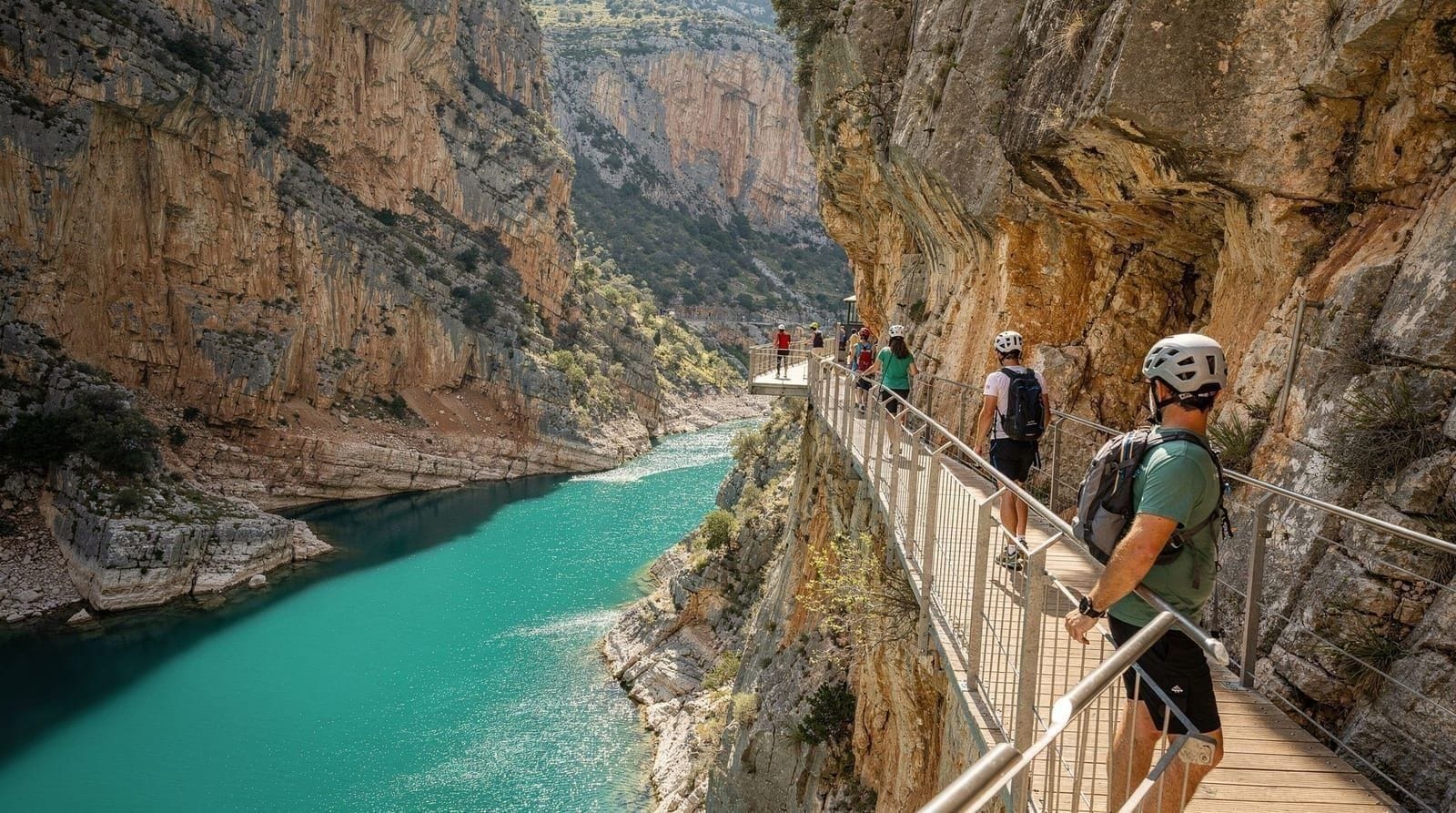
The Caminito del Rey is a linear route, not a loop. It runs approximately 7.7 km through the Desfiladero de los Gaitanes — the Gaitanes Gorge — which was carved by the Guadalhorce river through limestone karst over millions of years. You enter at one end and exit at the other, where a bus collects the group and returns to the starting point.
The route can be divided into three sections:
The terrestrial approach (about 2 km): Before the boardwalk section, you walk through pine and olive scrubland on a normal dirt path. This is the part that surprises people — it takes 45 minutes of ordinary hiking before you reach the famous walkways. The views of the gorge from above begin here.
The boardwalk section (about 3 km): This is what the photographs show — a narrow wooden platform attached to the cliff face, in some sections suspended 100 metres above the river below. The width of the walkway is roughly one metre. In some places the cliff overhangs above you; in others you walk in full sun with the gorge dropping away on both sides. There are two suspension bridges.
The southern exit (about 2.5 km): After the boardwalk, you descend through a gorge section that’s wider and less dramatic but still beautiful, following the river to the exit point where the bus waits.
The full route takes 3–4 hours depending on pace and how much time you spend stopping to look at things. Most people stop a lot.
What September is like on the path
September was the right choice. The height of summer (July–August) puts temperatures in the gorge above 35°C, which is uncomfortable on a narrow wooden walkway with no shade. By mid-September, temperatures had dropped to 27–30°C, the gorge was less crowded than in summer (though still busy), and the light in the late afternoon was beautiful.
The Caminito del Rey limits the number of daily visitors, and the groups are staggered so you don’t experience crowding on the narrow sections. In practice, the path feels busier than the cap suggests because the linear format means all groups end up at the same pinch points (the two suspension bridges, the most dramatic viewpoints).
September also means you avoid the highest summer prices for accommodation at El Chorro village, should you consider an overnight stay to split the experience over two days.
Timing the trip around the rest of your calendar matters too. Spring is lovely in the city but also the busiest period, so read Seville in spring before committing a day to the gorge, and if you are travelling in high summer, the Seville in summer heat guide and our own surviving Seville in July account explain why an exposed walkway in that season needs extra thought. For a wider look at when to come, see the best time to visit Seville.
Seasonal comparison at a glance
| Season | Temperature in the gorge | Crowds | Verdict |
|---|---|---|---|
| Spring (Apr–Jun) | Comfortable, warming | High, book well ahead | Best light, busiest |
| Summer (Jul–Aug) | 35°C+, exposed walkway | Moderate–high | Uncomfortable, avoid midday |
| Autumn (Sep–Oct) | 27–30°C | Moderate | Our pick |
| Winter (Nov–Mar) | Cool, occasional closures | Low | Fewest crowds, check weather |
Heights and what to prepare for
I am not particularly afraid of heights in normal situations, but I’ll be honest: the first section of the boardwalk, where you first step out from solid ground onto the wooden platform with the gorge visible 100 metres below, produced a definite physiological response. Heart rate up, palms slightly damp. This passed after about two minutes of walking, once my brain accepted that the platform was solid and the safety railing was real.
Our guide told us that two people on our tour (a group of 12) quietly decided they couldn’t continue at this point and waited at the start of the boardwalk while the rest of the group completed it. Neither person had described themselves as particularly acrophobic beforehand — it’s one of those things you discover in the moment. The guides handle this gracefully; no one made them feel bad about the decision.
If you have significant vertigo or acrophobia, the Caminito del Rey is probably not the right choice. If you have mild discomfort with heights but can manage it (as I can), you’ll be fine after the first few minutes.
The geology: the part the photos don’t convey
What the photographs of the Caminito del Rey can’t communicate is the geology. The gorge is cut through horizontal layers of limestone, and the exposed cross-section shows about 250 million years of sedimentary record in the cliff faces. The guide pointed out marine fossils — ammonites, bivalves — in the rock walls within arm’s reach of the walkway. You are walking through what was once a shallow warm sea.
The folding and faulting that created the gorge is visible in the contorted strata, compressed by the formation of the Betic Cordillera mountain chain. This is not content that most tourist materials bother with, which is a shame — the Caminito del Rey is as interesting geologically as it is visually dramatic.
Is it worth a full day trip from Seville?
Yes, with the realistic expectation that this is primarily a scenic hike rather than an extreme adventure. The gorge is genuinely extraordinary — one of the most dramatic natural landscapes in mainland Spain — and the boardwalk gives you access to views that are not achievable any other way.
The comparison I’d draw: Ronda’s Tajo gorge is more famous, but you see it from bridges and viewpoints rather than from inside it. Caminito del Rey puts you inside the gorge. That’s a meaningfully different experience.
If you’re building a broader Andalusia week, the planning a week in Andalusia itinerary would fit Caminito del Rey into a logical sequence with other day-trips.
Once you are back in the city in the evening, tired and hungry, the best reward is a relaxed dinner rather than another outing. Our where to eat in Seville guide and the hidden tapas bars locals love post are good places to find something close to where your coach drops you off. If you are weighing this against other excursions, why Córdoba beats Granada for a day trip shows how we compare the big names, and Ronda in our photo diary is the gentler gorge experience.
Booking the guided option, and what it actually includes
For anyone weighing guided vs independent, the guided coach trip removes three specific frictions: the early transport logistics, the entry-slot booking (which has to be arranged in advance regardless), and the geological commentary that turns the walk from “pretty gorge” into something you understand. If a hiking-focused version with a smaller group suits you better than a large coach tour, there’s also an excursion-format option worth comparing on price and group size:
Caminito del Rey excursion from SevilleEither way, book the entry slot itself as early as your dates allow — the daily visitor cap is the actual constraint, not the transport.
Frequently asked questions about Caminito del Rey
How long does the Caminito del Rey route take?
The walkway section takes 3–4 hours including the terrestrial approach. Factor in transport time if you’re coming from Seville (approximately 3 hours round trip by guided coach, longer if doing it independently by train).
Do I need to book in advance?
Yes, in advance — especially in spring and early autumn. The daily visitor limit sells out weeks ahead during peak season. Book as early as possible.
What is the difficulty level?
Moderate. The route requires reasonable walking fitness and comfort at heights, but it is not technically demanding. No climbing experience or special equipment required beyond the helmet provided.
Are children allowed on the Caminito del Rey?
The minimum age is typically 8 years old, and children must be accompanied by an adult at all times. The safety requirements (comfort with heights, physical fitness) apply to children as much as adults.
What are the entry fees for the Caminito del Rey?
Self-guided: approximately €10. Official guided visit: €18. Guided tours from Seville include the entry fee in the overall price (€60–70 per person).
What is the best time of year to visit?
Spring (April–June) and autumn (September–October) are optimal for weather and comfortable temperatures. Summer is hot and the most crowded. The path is closed on Mondays and during bad weather.
How does Caminito del Rey compare to Ronda as a day trip?
They’re different experiences of similar drama: Caminito del Rey puts you inside a gorge on a suspended walkway, while Ronda lets you view its gorge from bridges and clifftop viewpoints. Caminito del Rey requires more logistics and comfort with heights; Ronda is more accessible and combines with a historic town.