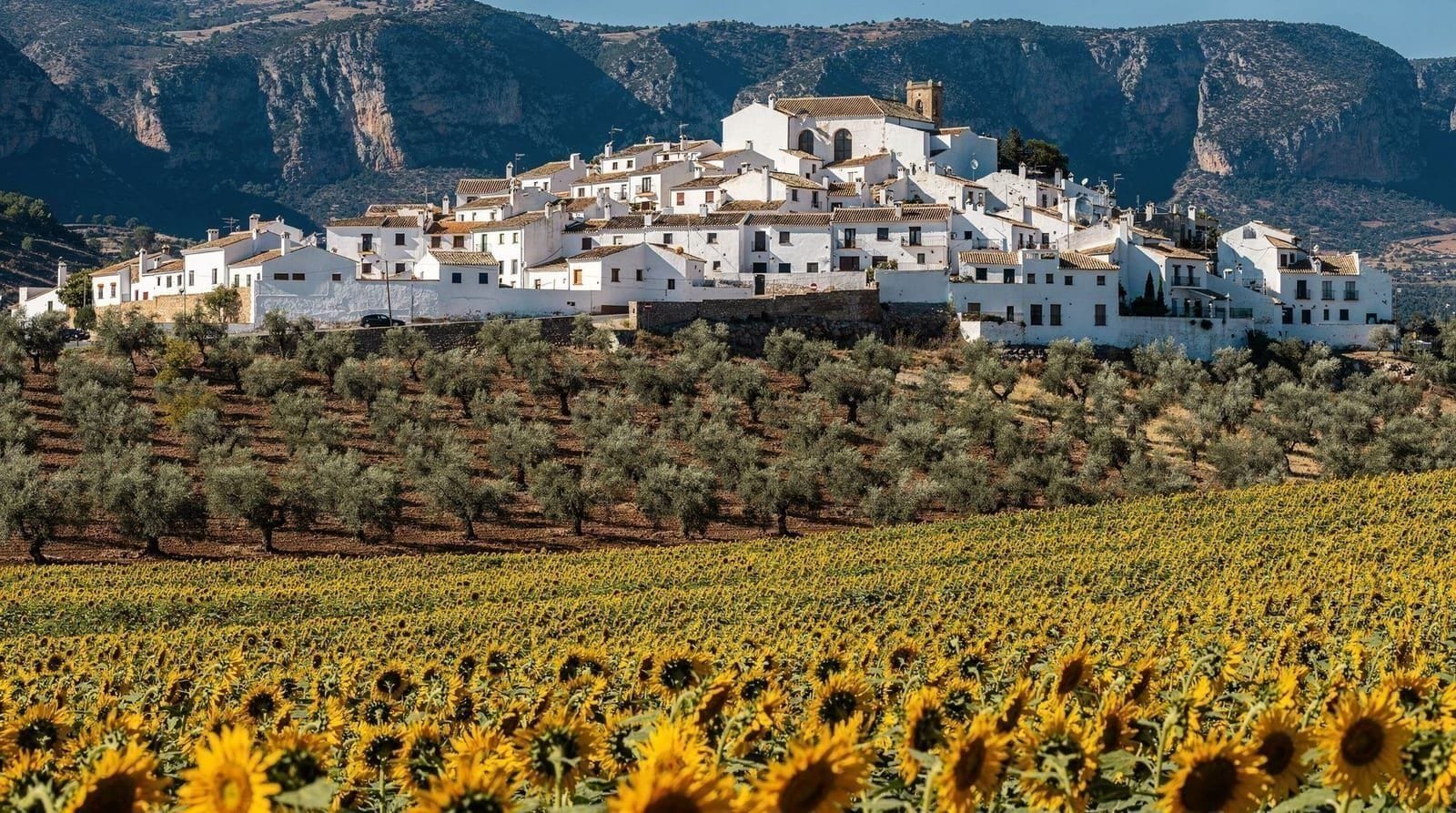
Setenil de las Bodegas
Setenil's cave houses built under overhanging rock faces are among Andalusia's most unusual sights. Day-trip logistics from Seville and Ronda.
From Seville: Ronda and Setenil de las Bodegas private day trip
Quick facts
- Best for
- Cave houses, unusual geology, authentic white village life
- Days needed
- Half day
- Getting there
- Car from Ronda 25 km; guided day-trip from Seville
- Peak crowds
- Spring weekends and August
- Currency
- EUR
Setenil de las Bodegas is unlike any other Andalusian village. While most pueblos blancos perch on hilltops with the standard formula of whitewashed walls and views, Setenil’s old town has spread along the floor of a narrow river gorge, with houses, bars, and shops built directly into and under overhanging volcanic rock faces. Walking the main streets — Calle Cuevas del Sol and Calle Cuevas de la Sombra — you are simultaneously inside a building and outside in an open street, the rock ceiling overhead continuous and irregular.
| Where | Serranía de Ronda, 25 km north of Ronda |
| Cost | Free to walk; museum price and hours via the Ayuntamiento de Setenil de las Bodegas; lunch €12–18/person |
| Time needed | 2–3 hours, half a day with a proper lunch |
| Getting there | Car from Ronda (30 min) or guided day-trip from Seville |
| Best time | Weekday mornings, October–November or March, to avoid crowds |
What makes Setenil distinctive
The village sits in the valley of the Río Guadalporcún, which cut the volcanic tufa rock over millennia. The Moors used the overhanging caves as natural fortifications. The Christians who took the town (after an 18-day siege in 1484) found the existing cave structures and built around and under them. The result is an organic architectural hybrid that no planner would design.
The two main cave streets are short — each about 200 metres — but extremely photogenic. The rock face overhead is visible inside some of the bars, emerging from the whitewashed plaster walls. Bars like La Cueva and Balcón de Setenil serve tapas under the rock. Order a glass of local wine (Serranía de Ronda DO) and a plate of lomo en manteca (pork loin preserved in lard — regional staple) for the full experience.
The hilltop castle (Castillo) and church (Iglesia de la Encarnación) are also worth the climb — the views across the gorge and surrounding countryside are excellent.
If Setenil is your first pueblo blanco, it is worth comparing its cave-street layout against a more conventional hilltop village like Zahara de la Sierra or Grazalema before deciding how much time to allocate to each. The Ronda vs white villages guide covers the trade-offs between spending your day trip on Ronda’s gorge versus a wider circuit that includes Setenil.
Getting to Setenil
By car: Setenil is about 25 km north of Ronda on the A-374 — a 30-minute drive. From Seville by car, it is about 2h10 via the A-376 and A-374.
By guided tour: the most practical option for those without a car. A private Ronda and Setenil day-trip from Seville combines both towns efficiently. The Ronda, Setenil and Zahara tour adds Zahara de la Sierra for a full white villages circuit.
Public transport from Seville to Setenil is not practical without a car — there is no direct bus service and connections require changes at Ronda or Olvera with infrequent connections. If you are coming from Ronda itself, a taxi or hire car for the 30-minute run is the simplest solution; there is no useful bus link between the two towns either.
What to do in Setenil
Beyond the cave streets, the village is small (around 3,000 people). A full visit takes 2–3 hours maximum:
- Walk Calle Cuevas del Sol and Calle Cuevas de la Sombra
- Climb to the castle ruins and the church
- Have lunch in one of the cave bars
There is a small archaeological museum near the castle (erratic opening hours; check price and hours with the Ayuntamiento de Setenil de las Bodegas).
Where to eat
El Almendro (Calle Amargura 4): good for Serranía de Ronda charcuterie (chorizo, morcilla, and the local salchichón ibérico). Part tourist-oriented but the local products are genuine.
Restaurante Palmillo (Avenida de Andalucía): more conventional restaurant with good views and reliable Andalusian menu. Budget €12–18.
The cave bars (Calle Cuevas del Sol) all serve more or less the same range of tapas and montaditos; the food is secondary to the experience of drinking under the rock.
Combining with other white villages
Setenil works best as part of a white villages circuit. From Setenil:
- Ronda: 25 km south (30 min)
- Zahara de la Sierra: 35 km southwest (45 min)
- Grazalema: 40 km southwest (50 min)
- Arcos de la Frontera: 60 km west (1h15)
A car-based circuit of Setenil, Zahara, and Grazalema makes an excellent full day from Seville. See the white villages guide for sequencing options. If you would rather anchor the day on Ronda and add Setenil as a short detour, that is also a well-worn route and arguably easier logistically for a first visit.
Setenil in historical context
The name Setenil derives from the Latin “septem nihil” (seven nothing) — a reference to the seven unsuccessful attempts by Christian forces to take the town from the Moors before Ferdinand finally captured it in 1484. The cave houses that made it so difficult to conquer — fire-resistant, naturally fortified, invisible from above — are the same structures tourists walk through today.
The “bodegas” in the name has nothing to do with wineries. It refers to the cave cellars (bodegas means cellar as well as winery) that the population used for cool storage under the rock. The village was producing mainly grain, olives, and almonds — not wine.
The cave architecture in detail
The geological structure is volcanic tufa — a porous, heat-retaining rock that can be carved relatively easily. The Guadalporcún river cut downward through the tufa over millennia, leaving these dramatic overhanging cave faces on both banks.
Calle Cuevas del Sol (north bank, sunny side): the main tourist street. Houses, bars, and restaurants extending under the rock ceiling. The caves here have been inhabited since Neolithic times.
Calle Cuevas de la Sombra (south bank, shaded side): the quieter, cooler side. Fewer tourists, more genuinely domestic. The rock ceiling here is even lower and more impressive.
Walking between the two streets requires crossing the small bridge over the Guadalporcún. The combined walk is about 400 metres total. It can be done in 20 minutes at tourist pace, 45 minutes if you stop to eat and look.
Local food products from Setenil
The village sits in the Serranía de Ronda agricultural zone. Key local products:
Aceite virgen extra (extra virgin olive oil): from the Picual and Hojiblanca varieties grown in the village territory. Several small producers sell at the local market (held on Tuesdays). Budget €8–10/litre.
Embutidos ibéricos: chorizo, salchichón, and lomo from Iberian pigs raised in the Serranía. Available at small delis on the main street. Better quality-to-price than similar products sold in Seville tourist shops.
Almonds and almond-based sweets: Setenil almonds are sold as raw nuts, in pastries (polvorones de almendra), and as a paste. A bag of whole almonds from a local vendor: €3–5/kg.
Photography notes
The standard shot of Setenil is from the bridge over the Guadalporcún, looking down the canyon with both cave streets visible. Better: walk to the hilltop castle and photograph down into the gorge from above — the scale of the rock overhang against the houses below is clearer from elevation. Best light is in the morning when the sun reaches the cave face on the south side.
Setenil’s agricultural hinterland
The municipal territory of Setenil covers nearly 200 km² of the Serranía de Ronda foothills. The economy is based on olive oil, almonds, sunflowers, and small-scale livestock (mainly goats for cheese and pigs for ibérico products). The average holding is under 10 hectares — this is subsistence and small-family agriculture, not agribusiness.
The olive harvest takes place November–January. If you visit in November or December, you may see families harvesting olives with long rakes and netting laid under the trees — one of the most photogenic agricultural activities in Andalusia.
Practical visiting logistics
Setenil has very limited parking in the village itself. The main parking area is at the edge of the village on the approach road. From the car park, walk down into the gorge — about 5 minutes.
Crowds management: on spring Sundays (April–May), Setenil receives day-trippers from Seville and Málaga and the cave streets become genuinely crowded. Arriving before 10:00 or after 15:00 avoids the peak. On weekdays in October–November, you may have the cave streets essentially to yourself.
The local market (mercadillo) is held on Tuesday mornings. Local producers sell olive oil, cheese, and embutidos at lower prices than the tourist-facing shops.
Where to stay in Setenil
The village has limited but reasonable accommodation:
Casa Rural La Moragaza (Calle Caño 5): small casa rural with 4 rooms, mountain and village views. From €55–70/night.
Casas Cueva (cave house rentals): several privately rented cave houses are available as vacation rentals through standard platforms. Staying in a cave house — a room cut directly into the rock, cool in summer and warm in winter — is the authentic experience. Prices vary from €60–120/night for a complete cave house.
Setenil as an overnight base allows you to walk the cave streets in the morning and evening light (when day-trippers have gone), explore the castle ruins properly, and eat at the local bars at local hours.
Fitting Setenil into a Seville-based trip
Most visitors meet Setenil as one stop on a longer excursion rather than as a destination in its own right. If you are still deciding how to spend your days in Andalusia, the best day trips from Seville guide puts the options side by side, and the Seville day trips itinerary shows how an excursion day slots between city days. Travellers building a longer loop can use the Andalusia week from Seville plan, where a white villages day sits naturally alongside coastal and Moorish-city stops.
If you are weighing the rock town against a very different kind of day, Córdoba and Granada offer monumental Islamic architecture instead of rural atmosphere. The Córdoba vs Granada day trip comparison helps if you want a big-ticket monument day, and Setenil is the better choice when you would rather wander, eat slowly and avoid timed-entry queues.
For a first visit, the Ronda day trip from Seville guide explains how the gorge town and its smaller neighbour work together, and the photo diary of a day trip to Ronda gives a traveller’s-eye view of the same landscape. If the Spanish countryside appeals more than city sightseeing, the Ronda, Setenil and Zahara tour style of circuit is the usual way to see several villages without driving.
A slow-travel way to read the village
Setenil rewards a slower pace than its size suggests. Rather than ticking off the two cave streets and leaving, try treating the village as a place to sit. Take a table at a cave bar, watch the rock ceiling change colour as the light moves, and notice how the temperature drops the moment you step under the overhang. That contrast is the real lesson of the place: the people who lived here solved the problem of heat and cold with geology instead of machinery.
Look closely at how the houses meet the stone. In places the whitewashed front of a house simply stops where the rock begins, and the cave itself serves as a roof, a back wall or both. Doorways, shutters and flower pots are fitted around the natural shape instead of the other way round, which is why no two frontages are quite alike.
Wandering a little off the two headline streets also pays off. The lanes climbing toward the church are quieter, with the ordinary rhythm of a working village: neighbours talking at doorways, small shops and the occasional cat on a step. This is the side of Setenil that day-trip schedules rarely leave time for, and it is a good argument for staying longer than the minimum.
Pairing Setenil with food and wine elsewhere
Setenil is a light-touch stop, so it combines well with stops that have a stronger food or drink identity. After a few days of white villages, the traditional Andalusian dishes guide helps you recognise what you are eating, and the where to eat in Seville guide is useful for the evening you return to the city. If the charcuterie and local wine made an impression, Jerez and the sherry guide are the natural next step, and Arcos de la Frontera makes a pleasant additional village if you are travelling by car and want a second hilltop town to contrast with the cave streets.
Frequently asked questions about Setenil de las Bodegas
Is Setenil de las Bodegas worth the detour from Ronda?
Yes, if you have half a day to spare. The cave-street architecture is genuinely unlike anywhere else in Andalusia, and the 30-minute drive from Ronda is easy. It is not worth a special trip on its own from Seville unless combined with Ronda or a wider white villages circuit.
How much time do I really need in Setenil?
Two to three hours covers the two cave streets, the castle climb, and a leisurely lunch. Add another hour if you want to browse the local market (Tuesdays only) or linger over photography from the castle viewpoint.
Can I visit Setenil without a car?
It is difficult. There is no direct bus from Seville and connections via Ronda or Olvera are infrequent. A guided day-trip tour or a private car/taxi from Ronda are the realistic options for travellers without their own vehicle.
Top experiences
Bookable activities with verified prices and instant confirmation on GetYourGuide.